
1794 Laurie and Whittle Nautical Map of Northwest Java (Jakarta), Indonesia

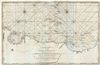

A New Chart of the North Coast of Java, wherein are described The Roads of Bantam and Batavia, from the Manuscript Draught of the Dutch East India Company.
Crossroads of the Spice Trade.
- Digital Map Information
- Suitable for large format printing
- Full resolution TIFF file
- ICC color profile embedded
- Delivered instantly via download link
Crossroads of the Spice Trade.
A fascinating 1794 Laurie and Whittle nautical chart of northwestern Java, mapping one of the great strategic chokepoints of the spice trade. Extending from Bantam and the Sunda Strait eastward to Batavia (Jakarta), the chart details waters through which the immense wealth of the East Indies flowed. Yet this was more than a navigationally challenging archipelago: for nearly two centuries, it formed an arena of intense commercial and imperial rivalry, where Dutch, British, and Portuguese ambitions collided over access to pepper and the lucrative spice markets of Southeast Asia. Published near the end of the Dutch East India Company's extraordinary two-century existence, the chart captures a landscape transformed by that struggle.A Closer Look
The map covers from Bantam Bay (Selat Sunda) and Hill (Serang, Indonesia) eastwards as far as Batavia (Jakarta, Indonesia). Depth soundings are noted all along the coast and along shipping lanes between coastal islands. Numerous small islands off the coast are illustrated and identified, along with shoals and other navigational hazards. Rhumb lines, which were important navigational aids, appear throughout. Batavia (Jakarta) appears in the lower right quadrant along the coast, while Bantam is labeled along the coast in the lower left quadrant in Bantam Bay.The British and Dutch Spice Rivalry
The Dutch and British contested northwestern Java because of its easy access to regional spice ports. Pepper was particularly important to the spice trade. In 1602, the British East India Company established a trade entrepot at Bantam to contest Dutch East India Company (VOC) control based in nearby Batavia. The Dutch, allied with a local Sultan, eventually drove the English out of Bantam and Java itself. By the end of the 18th century, when this map was made, the Bantam entrepot was little more than a name on a map - as seen here - while Batavia further east had risen, with a population of nearly one million, to dominate Java. In 1800, just six years after this map was published, the VOC was formally dissolved, and the Dutch East Indies was established in its place as a full-fledged national colonial venture. The British, meanwhile, established themselves in Bencoolen on Sumatra and later in Singapore and Malacca.Publication History and Census
Laurie and Whittle prepared this chart for their 1799 issue of the East-India Pilot. Though most charts in the East-India Pilot were derived from earlier maps prepared for Jean-Baptiste d'Apres de Mannevillette's 1745 Neptune Oriental, this chart is a new production unique to Laurie and Whittle. This chart is cartographically derived from earlier manuscript maps prepared by the Dutch East India Company (VOC) and later corrected and improved from an English draft prepared by Captain Henry Smedley. This map was registered by Laurie and Whittle from their offices at 53 Fleet Street, London, on May 12, 1794. We note a single cataloged example in OCLC, which is part of the collection at the University of Oxford.Cartographer
Laurie and Whittle (fl. 1794 - 1858) were London, England, based map and atlas publishers active in the late 18th and early 19th century. Generally considered to be the successors to the Robert Sayer firm, Laurie and Whittle was founded by Robert Laurie (c. 1755 - 1836) and James Whittle (1757-1818). Robert Laurie was a skilled mezzotint engraver and is known to have worked with Robert Sayer on numerous projects. James Whittle was a well-known London socialite and print seller whose Fleet Street shop was a popular haunt for intellectual luminaries. The partnership began taking over the general management of Sayer's firm around 1787; however, they did not alter the Sayer imprint until after Sayer's death in 1794. Apparently Laurie did most of the work in managing the firm and hence his name appeared first in the "Laurie and Whittle" imprint. Together Laurie and Whittle published numerous maps and atlases, often bringing in other important cartographers of the day, including Kitchin, Faden, Jefferys and others to update and modify their existing Sayer plates. Robert Laurie retired in 1812, leaving the day to day management of the firm to his son, Richard Holmes Laurie (1777 - 1858). Under R. H. Laurie and James Whittle, the firm renamed itself "Whittle and Laurie". Whittle himself died six years later in 1818, and thereafter the firm continued under the imprint of "R. H. Laurie". After R. H. Laurie's death the publishing house and its printing stock came under control of Alexander George Findlay, who had long been associated with Laurie and Whittle. Since, Laurie and Whittle has passed through numerous permeations, with part of the firm still extant as an English publisher of maritime or nautical charts, 'Imray, Laurie, Norie and Wilson Ltd.' The firm remains the oldest surviving chart publisher in Europe. Further Details...
Condition
Good. Minor wear and verso repair along original centerfold. Original platemark visible. Closed margin tears professionally repaired on verso. Offsetting.
References
OCLC 7455955.