
1855 Magnus Map of New York City and Brooklyn - old color!

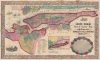



New-York City and County Map with Vicinity entire Brooklyn Williamsburgh Jersey City an c. in the 79th Year of Independence of the United States.
One of the most decorative 19th century maps of New York City - here with original full color.
- Digital Map Information
- Suitable for large format printing
- Full resolution TIFF file
- ICC color profile embedded
- Delivered instantly via download link
One of the most decorative 19th century maps of New York City - here with original full color.
The rare full-color edition of Charles Magnus's extraordinary 1855 broadside map of New York City, issued to commemorate the signing of the Declaration of Independence. This is one of the finest and most visually striking maps of New York City to appear in the 19th century. Moreover, the present example is only the 2nd full original color example of this map we have seen.A Closer Look
The map depicts the entirety of Manhattan as well as most of Brooklyn, Bedford-Stuyvesant, Williamsburg, Greenpoint, Queens, Ravenswood, Astoria, Jersey City, and Hoboken. An inset map at the bottom center details Long Island. The whole is rendered in detail with special attention given to individual streets, blocks, parks, and important buildings. The map reveals the early growth of Hunters Point (now Long Island City) in Queens. Important ferry crossings, canals, and railroads are also included. In Hoboken, Jersey City, and Long Island City, several planned landfills are indicated. Also in Hoboken, we see the Elysian Fields, a park along the Hudson River that hosted the world's first baseball game.Manhattan
In Manhattan, the map identifies various districts, including Manhattanville, Yorkville, and Harlem. Central Park has yet to materialize, and although the grid structure above 155th Street is ghosted in, it had not yet been formally approved. Where Columbia University stands today, this map shows the location of the New York Lunatic Asylum. At the bottom center, an alphanumerically keyed legend notes 'Universities, Colleges and Scientific and Literary, Benevolent-Institutions,' 'Public Buildings', and 'Places of Amusement.' In the lower left, there is an inset engraving of New York City Hall. Steamships navigate the Hudson River in both the upper right and left.The Medallion
In the lower right, an elaborate medallion features the full text of the Declaration of Independence as well as sigils representing each of the original 13 colonies. A bright blue pastedown, unique to this example, declares the purpose of this map, to commemorate the 79th Year of the Independence of these United States. The whole is surrounded by an attractive acanthus leaf motif border.Publication History and Census
This map was issued in lithograph in 1855 by the New York publisher Charles Magnus. Most examples are broadsheets, in black and white, intended for framing. At the same time, a few examples were issued as folding pocket maps, as here. These few were elaborated with a full hand-color treatment. While we have seen and handled other examples of the uncolored broadside, this is only the second full-color issue we have seen (the other one having passed through our hands about 5 years previously). Unfortunately, it is impossible to determine whether examples held in some institutional collections are uncolored broadsides or colored pocket maps, as most are poorly cataloged and not digitized. It is nonetheless of extreme rarity on the market in any state, but particularly this full-color issue.Cartographer
Charles Magnus (March 16, 1826 - May 3, 1900) was a German-American map and print publisher, stationer, and bookseller active in New York City from about 1850 until his death. Born Julian Carl Magnus in Elberfeld, Germany, he reportedly worked as a salesman for a silk firm before emigrating to the United States in 1848. In the early 1850s he learned the printing business while working with his older brother at the German-language weekly Deutsche Schnellpost. He married Christina Koerner, a native of Munich, in New York City on December 31, 1854. Magnus established a publishing business whose geographical productions included separate maps, pictorial lettersheets, city views, and the Commercial Atlas of the World, apparently issued in cooperation with the British firm George Philip and Son. His maps frequently combined geographical information with city panoramas, architectural vignettes, and decorative imagery also employed on his stationery. Rather than consistently commissioning original designs, he adapted and recombined existing illustrations, updating urban views as buildings and bridges appeared and later drawing extensively upon photographs. During the American Civil War he supported the Union through battlefield maps, military views, patriotic envelopes, and illustrated songsheets. Institutional accounts credit him with approximately 700 patriotic envelope designs and more than 300 illustrated songsheets from the war years, within a career output exceeding 1,000 different publications and designs. After the war his offerings expanded to include games, rewards of merit, advertising material, and custom printing, while his business increasingly emphasized retail sales. He maintained commercial connections with Germany and German-speaking Americans through bilingual captions, advertising, and imported publications. Magnus continued to employ lithography and hand coloring after competing printers had adopted photomechanical methods. His wife died in 1896, and he died at his daughter's home in New York City on May 3, 1900, leaving four surviving children. Further Details...
Condition
Very good. Comes with original binder. Map has been backed on archival tissue. There were a few older repairs on the verso, which causes some slight discoloration on the recto (apparent as brown spots). We have reversed and redone these repairs with archival materials. Original old color.
References
OCLC 23876813. Haskell, Daniel Carl, Manhattan Maps; a Co-operative List, 1004.