
1880 Goddard / Snow Bird's-Eye View of San Francisco Bay

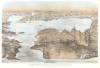
Birdseye View of San Francisco and Surrounding Country.
Greatest view of San Francisco.
- Digital Map Information
- Suitable for large format printing
- Full resolution TIFF file
- ICC color profile embedded
- Delivered instantly via download link
Greatest view of San Francisco.
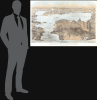
This is George Henry Goddard's stunning chromolithograph bird's-eye view of San Francisco Bay, city, and environs, here in its 1880 edition. A product of Goddard's artistic virtuosity, this is not only the best early view of the San Francisco Bay area but also one of the finest American views ever made, offering a unique and outstanding artistic take on the genre.A Closer Look
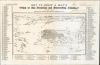
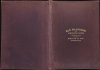
Oriented to the east and seen as if from a high point over the Pacific, the panoptic view embraces the full San Francisco Bay region, covering from San Pablo Bay to San Jose, and from Oakland to the Pacific, including all of the San Francisco Peninsula, San Francisco City, Sausalito, and Oakland. In the foreground, ships of all kinds navigate the Golden Gate while the peaks of the Sierra Nevada range rise in the background. Goddard takes considerable liberties with scale, expanding some geographical features and foreshortening others to maximize both coverage and effect. He thus achieves extraordinary detail, with many individual buildings recognizable throughout San Francisco. The view is accompanied by its original binder and key sheet.American Bird's-Eye City Views
The Bird's-Eye view industry emerged in the United States in the middle part of the 19th century and coincided with the commercial development of lithographic printing. Before the rise of lithography, the ability to own and display artwork in the home was largely limited to the extremely wealthy, but the advent of lithographic printing made it possible for everyone to own visually striking artwork. A robust trade developed in portraits of political leaders, allegorical and religious images, and city views.City views were being produced in the United States as early as the 1830s, but the genre exploded after the American Civil War (1861 - 1865). Bridging the gap between maps and pictures, most 19th-century American bird's-eye views presented cities to the public from high points. Some were imagined, but others were drawn from hot-air balloons or nearby hills. The presentation, combining high elevation, commercial interest, and new printing technology, created a uniquely American art form, as described by historian Donald Karshan,
Some print connoisseurs believe that it was only with the advent of the full-blown city-view lithograph that American printmaking reached its first plateau of originality, making a historical contribution to the graphic arts. They cite the differences between the European city-view prints and the expansive American version that reflects a new land and a new attitude toward the land.The vogue for bird's-eye city views lasted from about 1845 to 1920, during which period some 2,400 cities were thus portrayed, some multiple times. Although views were produced in many urban centers, the nexus of view production in the United States was Milwaukee, Wisconsin. The major American viewmakers were Stoner, Wellge, Bailey, Fowler, Hill, Ruger, Koch, Burleigh, Norris, and Morse, among others.
Chromolithography
Chromolithography, sometimes called oleography, is a color lithographic technique developed in the mid-19th century. The process uses multiple lithographic stones, one for each color, to yield a rich composite effect. Generally, a chromolithograph begins with a black basecoat upon which subsequent colors are layered. Some chromolithographs used 30 or more separate lithographic stones to achieve the desired effect. Chromolithograph color can be blended for even more dramatic results. The process became extremely popular in the late 19th and early 20th centuries when it emerged as the dominant method of color printing. The vivid color chromolithography made it exceptionally effective for advertising and propaganda.Publication History and Census
This view was drawn by George Henry Goddard, printed by Britton and Ray, and published in 1880 by Snow and May. There are seven editions; the first four appeared in 1868, followed by subsequent issues in 1875, 1876, and 1880. The breakdown is as follows:- 1868: Published by Snow and Roos, 21 Kearney St. S.F.
- 1868: Published by Snow and Roos, San Francisco
- 1868: Published by Snow and May, San Francisco
- 1868: Snow and Roos (copyright)
- 1875: Published by Snow andamp; May, 21 Kearney St. S.F.
- 1876: Snow and Roos (San Francisco)
- 1880: Snow and May, S.F. Re-published in 1880 by Snow and Co. 20 Post Street, S.F.
Cartographer
George Henry Goddard (May 17, 1817 - December 27, 1906) was a British-American artist and civil engineer active in California in the mid to late 19th century. Goddard was born in Bristol, England. He took a degree in civil engineering from Oxford. Lured by the promise of the California Gold Rush, he moved to the United States in 1850, arriving on the Diana, settling in Sacramento. Failing to strike it rich in the Gold Fields, he turned to his civil engineering background, securing lucrative contracts with various private and municipal concerns, including the City of San Francisco and the booming railroad industry. During this period, he produced at least 10 important views focusing on Columbia, Sonora, and Tuolumne - most were published in 1852-53 in lettersheet format but were not financially successful. He produced the surveys for Britton and Rey's 1857 Map of the State of California. He settled in San Francisco in 1862, or possibly earlier, where he issued two important large-format bird's-eye views, considered the best images of San Francisco in the 19th century: Birds Eye View of the City of San Francisco (1868) and Bird's Eye View of San Francisco and Surrounding Country (1868). Around the same time, railway speculation made him extremely wealthy, and he constructed an impressive mansion at Golden Gate and Van Ness, which he filled with 'maps, minerals, paintings and other objects of historical interest'. The collection was so large and impressive that Stanford University, to whom it was bequeathed, planned a new museum to house it. Unfortunately, before this could happen, the 1906 San Francisco Earthquake and Fire destroyed both the mansion and the collection. Goddard died in Berkeley shortly after. Further Details...
Britton and Rey (1852 - 1916) was a lithographic firm based in San Francisco founded by Joseph Britton (1825 - 1901) and Jacques Joseph Rey (1820 - 1892). The leading firm in the area during the second half of the 19th century, Britton and Rey eventually earned the reputation of being the western Currier and Ives. They published both large-format and postcard views of California, as well as with stock certificates, stationery, and maps. Within the partnership, Rey was the artist and Britton the principal lithographer. Britton was also principally concerned with the business aspects of the firm. The firm also printed lithographs by other artists, including Thomas Almond Ayres (1816 - 1858), George Holbrook Baker (1824 - 1906), Charles Christian Nahl (1818 - 1878), and Frederick August Wenderoth (1819 - 1884). After Rey's death in 1892 and Britton's subsequent retirement, the firm passed to Rey's son, Valentine J. A. Rey, who ran the firm until at least the 1906 San Francisco earthquake and fire. A. Carlisle and Company, another San Francisco printer, acquired the remains of the Britton and Rey firm in 1916. For more information about Joseph Britton and Jacques Joseph Rey, please reference their individual biographies included in our cartographer database. Further Details...
Condition
Good. Toning on old fold lines. A few old fold splits repaired and stabilized on the verso. Original key exhibits foxing. Detached but shipped with the original binder.
References
Rumsey 5682.000. Baird, J. A., Historic Lithographs of San Francisco, #52c. Deak, Gloria Gilda, Picturing America: 1497-1899, #821. Reps, John, Views and Viewmakers of Urban America (University of Missouri, Columbia, 1984), #305. Peters, Harry T., California on Stone, p. 124.