
1943 British Propaganda Leaflet Celebrating the Soviet Victory at Stalingrad

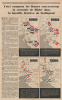
Supplement Cartographique du Courrier de L'Air. Voici comment les Russes renversèrent la stratégie de Hitler dans la bataille décisive de Stalingrad.
British air-drop propaganda celebrating the Soviet victory at Stalingrad.
$375.00
Choose a Collection:
- Digital Map Information
- Suitable for large format printing
- Full resolution TIFF file
- ICC color profile embedded
- Delivered instantly via download link
This Item
Enquire
British air-drop propaganda celebrating the Soviet victory at Stalingrad.
World War II propaganda is a remarkable survivor. This is a 1943 leaflet celebrating the Soviet victory at Stalingrad, published by the British Political Warfare Executive for air distribution by the Royal Air Force over occupied France. It is part of the popular series entitled Le Courrier de l'Air, and is the only known cartographic supplement to that propaganda publication. This map, and others like it, were air-dropped to French civilians under Nazi occupation, who were hungry for news not controlled by Nazi Germany or the collaborationist Vichy. This sheet, and others like it, fulfilled that desire.A Closer Look
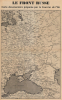
Entitled 'Voici comment les Russes renversèrent la stratégie de Hitler dans la bataille decisive de Stalingrad' ('Here's how the Russians reversed Hitler's strategy at the decisive Battle of Stalingrad'), four maps illustrate how the Red Army won the Battle of Stalingrad. The first map, dated November 30, 1942, depicts the Soviet encirclement of the German Sixth Army at Stalingrad, while other Soviet forces prepare to attack the remaining Axis positions. The following three maps, dated January 10, 1943; February 8, 1943 (6 days after the German surrender at Stalingrad); and February 23, 1943, trace the Soviet advance west from Stalingrad to the recapture of Kharkiv (Kharkov) and Rostov. The text on the left and below each map summarizes the events since the end of the summer of 1942, and underlines the connections between the victory at Stalingrad and the Allied victories in North Africa.A map on the verso summarizes the situation on the Eastern Front with coverage from central Russia to west of Minsk.
The Battle of Stalingrad
The Battle of Stalingrad took place from July 17, 1942, through February 2, 1943, when the last elements of the German Army surrendered to the Soviets. It was part of the German offensive known as Case Blue, which had the overall objectives of capturing the Caucasus oilfields and severing Volga River supply lines. Diverting from the main thrust toward the oilfields, the German Army Group B laid siege to Stalingrad (Volgograd).The Volga River splits Stalingrad into east and west banks. The German assault began in August with an aerial bombardment followed by ground forces. Over the course of the next several months, German ground forces captured most of the western bank in brutal house-to-house urban combat. There were instances when German troops occupied the basement and ground floor of a building while Soviet troops occupied the upper floors, and they shot at each other through holes in the ceiling/floor or in stairwells. The Red Army held part of the west bank, allowing reinforcements and supplies to be ferried across the river.
While the German Army was occupied within Stalingrad, the Soviets began amassing forces to the north and south, having realized that the German flanks consisted of ineffective Italian and Romanian forces. On November 19, 1942, the Red Army launched a massive pincer attack on both flanks, with 700,000 soldiers and 1,400 tanks. By November 23, the Red Army fully surrounded the German Sixth Army. Adolf Hitler commanded the Sixth to fight to the last man, forbidding them from any attempts to break out of the encirclement. The Sixth Army continued fighting for several months before surrendering on February 2, 1943.
The Battle of Stalingrad is remembered as the deadliest battle in human history. It is estimated that the 200-day battle cost over 2 million civilian and military casualties. Nearly every building in the city was reduced to rubble. Soviet military casualties are estimated at a minimum of 750,000. Nonetheless, the Red Army was able to go on the offensive and spent the next 2 years pushing the Germans back to Berlin. The Germans never recovered from the losses of men and materiel at Stalingrad. Also, Stalingrad marks the first major German defeat on the Eastern Front. The Germans never recovered from the psychological blow, and, when combined with the morale boost it provided to the Allies, historians say that, in hindsight, Stalingrad was the pivotal battle in the East.
Le Courrier de l’Air
Le Courrier de l’Air (“Air Mail” in English) was a British propaganda leaflet first produced during World War I (1914-1918) and distributed by air over occupied France and Belgium. Following the fall of France to Nazi Germany in June 1940, Britain revived the publication for air-drop distribution across occupied France. It soon became the country’s principal wartime newssheet and one of hundreds of leaflets produced under the supervision of the Political Warfare Executive (PWE).Le Courrier proved highly popular with French readers. Refugees reported that copies were eagerly sought, widely shared, and needed in greater numbers. German occupation authorities and the Vichy government confiscated every copy they could find, though many continued to circulate. They also produced imitations, including the Courrier des Français de France, which copied Le Courrier’s format. Their willingness to create such forgeries further demonstrates the publication’s reach and influence in occupied France. Britain discontinued Le Courrier de l’Air after the liberation of France in the fall of 1944.
Publication History and Census
This example of Le Courrier de l'Air was published on February 25, 1943, with the reference number 'F.27'. Our research indicates that this is the only edition of Le Courrier de l'Air that had a cartographic supplement. We note 2 examples cataloged in OCLC: Deutsche Nationalbibliothek Frankfurt am Main and the Deutsche Nationalbibliothek Leipzig.Condition
Good. Wear along original fold lines. Light soiling. Closed tear extending one quarter inch into printed area from top margin professionally repaired on verso.
References
OCLC 1185318124.