
1884 George Norris Bird's-Eye View of St. Johnsbury, Vermont


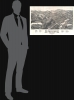
St. Johnsbury County Seat of Caledonia County VT.
One of the gateways to the Northeast Kingdom.
- Digital Map Information
- Suitable for large format printing
- Full resolution TIFF file
- ICC color profile embedded
- Delivered instantly via download link
One of the gateways to the Northeast Kingdom.
This is an 1884 George Norris bird's-eye view of St. Johnsbury, seat of Caledonia County, Vermont.A Closer Look
The view looks northwest over St. Johnsbury with the intersection of Main Street and Eastern Avenue at the center. Buildings, streets, and trees throughout the city are illustrated. Fifty-nine locations are numerically identified and correspond with an index below the bottom border. Among these are 10 churches, the Y.M.C.A. building and lecture hall, several schools, the St. Johnsbury Academy, the post office, and nearly three dozen businesses. These include several furniture manufacturers, a lumber mill, a foundry, two photographers, and a florist. The Passumpsic River flows through town from north to south and appears in the foreground. A train from the St. Johnsbury and Lake Champlain Railroad is illustrated just as it is about to cross the river. An inset in the lower left details the Fairbanks Scale Works, the town's largest business, whose owner, Franklin Fairbanks, founded the town's superb natural history museum and planetarium. The Green Mountains rise in the distance.American Bird's-Eye City Views
The Bird's-Eye view industry emerged in the United States in the middle part of the 19th century and coincided with the commercial development of lithographic printing. Before the rise of lithography, the ability to own and display artwork in the home was largely limited to the extremely wealthy, but the advent of lithographic printing made it possible for everyone to own visually striking artwork. A robust trade developed in portraits of political leaders, allegorical and religious images, and city views.City views were being produced in the United States as early as the 1830s, but the genre exploded after the American Civil War (1861-1865). Bridging the gap between maps and pictures, most 19th-century American bird's-eye views presented cities to the public from high points. Some were imagined, but others were drawn from hot-air balloons or nearby hills. The presentation, combining high elevation, commercial interest, and new printing technology, created a uniquely American art form, as described by historian Donald Karshan:
Some print connoisseurs believe that it was only with the advent of the full-blown city-view lithograph that American printmaking reached its first plateau of originality, making a historical contribution to the graphic arts. They cite the differences between the European city-view prints and the expansive American version that reflects a new land and a new attitude toward the land.The vogue for bird's-eye city views lasted from about 1845 to 1920, during which period some 2,400 cities were thus portrayed, some multiple times. Although views were produced in many urban centers, Milwaukee, Wisconsin, was the nexus of view production in the United States. The major American viewmakers were Stoner, Wellge, Bailey, Fowler, Hill Ruger, Koch, Burleigh, Norris, and Morse, among others.
Publication History and Census
This view was lithographed by Beck and Pauli of Milwaukee, Wisconsin, and published in 1884 by George E. Norris of Brockton, Massachusetts. We note 4 cataloged examples: the Library of Congress, Pennsylvania State University, the Boston Public Library, and the California Genealogical Society and Library.Cartographers
George E. Norris (September 29, 1855 – August 18, 1926) was an American hotelier, publisher, and bird's-eye view artist based in Brockton, Massachusetts during the latter part of the 19th century. Norris was born in Massachusetts, likely his lifelong hometown, Brockton. Norris began publishing views in partnership with Albert F. Poole (1853 - 1934), an established viewmaker who, at the time, was renting a house in Brockton from Norris' mother. His first views, most of which were signed by Poole, were published in 1883. In 1884, Norris partnered with Henry Wellge (1850 - 1917), publishing out of Brockton as Norris and Wellge, and later out of Milwaukee as Norris, Wellge and Co. Norris began drawing views independently around 1887. Most of these were initially printed in lithograph by Lucien Burleigh of Troy, New York. Around 1890, Norris switched printers and began using a more modern photomechanical technique, likely Albertype, a style of collotype printing. Although unattributed on any of Norris's post 1890 views, the pioneers of Albertyping in the United States were Adolph (1845 - 1938) and Herman L. Wittemann, who founded the Albertype Company in Brooklyn, New York in 1890 - corresponding perfectly to Norris' change in printers. In total, Norris produced about 135 individual city views. In 1897 he left the view business to open a hotel, the Hotel Norris, in Brockton. Meeting some success as a hotelier, in 1912 he also acquired the Hotel Grayson, also in Brockton. He ran this until his death of cerebral hemorrhage in 1926. Further Details...
Beck and Pauli (fl. c. 1878 – 1889) was a Milwaukee, Wisconsin based lithography firm founded in 1878 by Clemens J. Pauli and Adam Beck. The firm published hundreds of lithograph city views for many of the most prominent viewmakers of the period, including Lucien Rinaldo Burleigh, J. J. Stoner, Henry Wellge, Pauli himself, and others. The company was most active in the mid-1880 until about 1889, when the partners went separate ways and closed the company. Further Details...
Condition
Good. Some light toning. Two creases. Closed edge tear along crease professionally repaired on verso. Closed tear extending .5 inch near center of printed image professionally repaired on verso.
References
OCLC 5479316.