
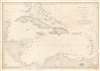
1842 Dépôt de la Marine Nautical Map of the West Indies

This item has been sold.
Carte des Antilles Dressée par M. Keller, Ingénieur Hydrographe de 2e Classe, d'après les travaus les plus récents.
French interest in the Caribbean and a Nicaragua Canal.
- Digital Map Information
- Suitable for large format printing
- DPI: 600
- File Size: 35.02 MB
- File Type: ZIP / TIFF
- ICC color profile embedded
- Delivered instantly via download link
French interest in the Caribbean and a Nicaragua Canal.
This is the 1862 edition of the Dépôt de la Marine / Francois-Antoine-Edouard Keller nautical chart of the West Indies. It is the most general of Keller's West Indies charts reflecting the full scope of his definitive surveys - the coverage embracing the full Caribbean Basin from the Yucatan to Barbados and from Florida to Panama and the mouths of the Orinoco. This chart reflects French interest in the region relating to a possible Nicaragua Canal.The Nicaragua Canal
The purpose of Keller's hydrographic work in the West Indies from roughly 1840 to 1847 was to determine the safest, fastest, and most practical nautical route through the West Indies to Pt. St. Jean de Nicaragua. At the time, the general consensus posited the Nicaragua Route as the most practical Trans-continental canal route. The French in particular had a great interest in such a project and, in 1859, a French company was granted a lease to construct just such a route. Plans to build the Nicaragua canal ultimately floundered with the volcano Momotombo erupted, leading many to doubt the viability of the project. Interests quickly turned to the Panama Route.Publication History and Census
This chart was issued by the Dépôt de la Marine based upon the c. 1840 hydrographic work of Francois-Antoine-Edouard Keller. It was engraved by Chassant and Jacques-Marie Hacq. The present map was first printed in 1842, with the present edition bearing updates to 1862. Scarce in all editions.Cartographers
Dépôt des Cartes et Plans de la Marine (fl. 1720 - present), often called the Dépôt Général de la Marine, was a French hydrographic mapping organization founded in 1720 under Charles-Hercule of Albert de Luynes (1674 - 1734). Much like the U.S. Coast Survey, the British Admiralty, and the Spanish Deposito Hydrografico, the Dépôt was initiated as a storehouse and distribution center of existing nautical and marine charts. Eventually the Dépôt initiated its own mapping activities in an attempt to improve and expand upon existing material. Some of the more prominent cartographers and hydrographers associated with the of Dépôt Générale des Cartes were, Philippe Buache, Jacques-Nicholas Bellin, Giovanni Rizzi-Zannoni, Rigobert Bonne, and Jean Nicolas Buache. Further Details...
Francois-Antoine-Edouard Keller (December 30, 1803 - April 24, 1874) was a French naval officer and hydrographer active in the mid 19th century. Keller was born in Wissembourg, Alsace. He studied at the École Polytechnique from 1821, afterwards in 1823 joining the Marine national Française. From 1824 to 1826, then again from 1829 to 1838, he surveyed the western coasts of France under Charles-Francois Beautemps-Beaupre (1766 - 1854). He was then sent to the West Indies, where he produced several important charts published between 1842 and 1847. In 1848 he was promoted to an ingénieur hydrographe de 1re classe. He worked extensively on current and meteorological studies. Keller retired from the Navy in 1860 and settled in Paris until his death in 1874. Further Details...
Chassant (fl. c. 1830 - 1860) was a French line and chart engraver active in Paris in the middle part of the 19th century. Chassant was active with the French Dépôt de Marine from the 1830s into the 1860s. He was a master engraver and, some have argued, his dramatic hachuring work to illustrate topography suggests he may have been wasted on nautical charts. Most of his engraving was completed in partnerships with Jacques-Marie Hacq (September 22, 1785 – 18??). Chassant did not sign any of his engravings with a first name or other identifier, so it is difficult to track him down. He may be Alphonse Antoine Louis Chassant (August 1, 1808 - September 7, 1907), who in later life was an art historian and librarian of the city of Évreux. He wrote several books, including works on engraving. We cannot alas verify the connection and it may be pure guesswork. Further Details...
Jacques-Marie Hacq (September 22, 1785 – 18??) was a French letter and line engraver, and historian, active in Paris during the middle part of the 19th century. Hacq was born in Paris and trained under J. P. Besançon, who he succeeded at the Dépôt de la Guerre in 1830. He engraved for the Dépôt de la Guerre as early as 1830 and for the Dépôt des Cartes et Plans de la Marine from, at least, 1840 to 1852. In addition to his work for the French Government, he also completed maps and engravings for Lesage, Lapie, Dufour, Duperrez, Gouvion St. Cyr, and Dumont d'Urville. His historical works include a history of the Napoleonic Wars and a history of Paris under the reign of Louis XIII. During most of his career in Paris he lived at 58 Rue de la Harpe. Further Details...
Condition
Good. Light soiling.
References
OCLC 905533539.