
1848 Oakes Views of White Mountains, New Hampshire

Scenery of the White Mountains.
Essential Work for White Mountains Collectors.
Essential Work for White Mountains Collectors.
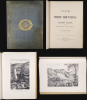
This is William Oakes and Isaac Sprague's 1848 collection of views of the White Mountains of New Hampshire, titled Scenery of the White Mountains. Aside from its striking imagery, the work was among the earliest published books to deal specifically with the White Mountains, making it highly desirable for White Mountains collectors.A Closer Look
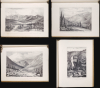
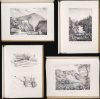
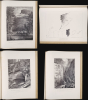
The book consists of 16 lithographed plates, some with more than one illustration, totaling 19 illustrations and diagrams in all. The plates are, in order:- 'The White Mountains, from the Giant's Grave, near the Mount Washington House'
- 'Mount Crawford, near the White Mountains, with the Mt. Crawford House'
- 'The Notch of the White Mountains, with the Willey House'
- 'The Lower Cascade in the Notch of the White Mountains' [likely Silver Cascade]
- 'The Gate of the Notch of the White Mountains, with the Notch House'
- 'The Falls of the Amonoosuck [Ammonoosuc], near the Mt. Washington House'
- 'The Cliffs of the Falls of the Amonoosuck' [one plate with two illustrations]
- 'The Franconia Notch with the Lafayette House'
- 'The Profile Mountain at Franconia, New Hampshire'
- 'The Profile Rock' [Old Man of the Mountain]
- 'The Basin, in Lincoln, New Hampshire'
- 'The Flume, in Lincoln, New Hampshire'
- 'Nancy's Bridge, near the White Mountains'
- 'Mount Crawford, from the Notch' and 'The Notch of the White Mountains from Mt. Crawford'
- 'The White Mountains, from Bethlehem, N.H.,' 'Mount Washington, from the Summit of Mount Pleasant,' and 'Diagram of the Whole Range of the White Mountains'
- 'Mount Washington, over Tuckerman's Ravine'
Crawford Notch
Crawford Notch is given special prominence here, not only due to its geographical importance but also, one suspects, because of Oakes' friendship with the Crawford family (see biography below). The Notch is one of several well-known notches, or deep mountain passes, in the White Mountains of New Hampshire that are famous for their remarkable natural beauty. Originally known as 'White Mountain Notch,' it follows the course of the Saco River on the western side of Mt. Washington and the Presidential Range (another well-known notch, Pinkham Notch, is on the eastern side of Mt. Washington). Crawford Notch has long been a major thoroughfare through the White Mountains region, first by turnpike (1803), then by railroad (1875), and finally by paved automobile road (U.S. Route 302). It is named for a pioneering family that settled in the area, a descendant of which (George T. Crawford) produced a large and important map of the White Mountains in 1890. Other members of the family built and operated the Crawford House, one of the earliest grand hotels in the area (built 1850); it closed in 1975 and burned down shortly afterward, but the Appalachian Mountain Club acquired the land and built on the same site the Highland Center, a haven for hikers and tourists.Publication History and Census
Scenery of the White Mountains was arranged by William Oakes, with most illustrations drawn by Isaac Sprague and printed by Benjamin W. Thayer. Two of the plates are lithographs (one by Thayer and one by J.H. Bufford) of larger paintings by landscape painter Godfrey Frankenstein, namesake for Frankenstein Cliff and later the Frankenstein Trestle railroad bridge in Crawford Notch. As Oakes explains in the preface, he had originally intended to include scenic views in an octavo volume on the flora of the White Mountains but found the size inadequate, so instead prepared this separate, larger (folio) work. His planned octavo Book of the White Mountains was alas never published, as he died only a week after writing the preface to Scenery of the White Mountains.There were at least two printings of this book, both in 1848, either published by Crosby, Nichols, and Co. alone or by the same in conjunction with Little Brown. There are only minor differences between the printings, such as the titles of a few of the plates and the attribution of various plates to either Bufford or Thayer. Some catalog listings credit all the prints to Bufford, but in others, there are one or two plates with no printer noted. In addition, according to Allen Bent's Bibliography of the White Mountains, 'The views of Profile Mt. and the Old Man of the Mountain, with description, appeared separately in 1847.'
In any case, regardless of printing, the book is quite rare; the OCLC records it being held at 18 institutions (with the University of Michigan and Crystal Bridges Museum of American Art holding examples of both the sole Crosby, Nichols, and Co. printing and the Little Brown printing). Several museums and institutions, such as the Currier Museum of Art and the Museum of the White Mountains at Plymouth State University, also hold examples not listed in the OCLC. Some plates are also individually cataloged at various institutions, having been disbound and, in some cases, having hand-color added.
Cartographers
William Oakes (July 1, 1799 - July 31, 1848) was one of the most famed American botanists of the 19th century and an expert on the flora of New England. Oakes attended Harvard University and became interested in natural history under his professor William Dandridge Peck (1763 - 1822). However, after graduation, he initially pursued a career in law without giving up his interest in nature. Upon the completion of a hiking path to the summit of Mount Washington in New Hampshire by Ethan Crawford, Oakes became one of the first white men to ascend the mountain. Oakes befriended Crawford and made future ventures to the White Mountains, giving up his law career to pursue his naturalist interests full-time, focusing on botany in particular. He wrote a very detailed description of the flora of the White Mountains that exceeded all previous cataloged knowledge. He also made important contributions to the study of the trees and plants of Massachusetts. Oakes died suddenly when, 'in a temporary fit of insanity,' he threw himself into Boston Harbor while taking a ferry between Boston and East Boston. Further Details...
Isaac Sprague (September 5, 1811 - March 13, 1895) was a mostly self-taught American draughtsman and painter specializing in ornithological, landscape, and botanical paintings. Sprague was born in Hingham, Massachusetts, and apprenticed as a carriage painter with his uncle. During that time, he taught himself to draw birds, already being known locally as a talented artist. In 1840, Sprague met John James Audubon (1785 - 1851). Three years later, he accompanied Audubon on an ornithological expedition up the Missouri River, from which several of his drawings later appeared (uncredited) in Audubon's works. Soon afterwards, Sprague met Asa Grey (1810 - 1888), the foremost American botanist of his day, and went on to illustrate many of Grey's works in the following decades, including Grey's botanical report (with John Torrey) for the Pacific Railroad Surveys (Reports of Explorations and Surveys to ascertain the most practicable and economical route for a railroad from the Mississippi River to the Pacific Ocean). Much of Sprague's work focused on the flora, fauna, and landscapes of his native New England. Sprague's work, considered second-to-none, was among the earliest domestically produced high-quality scientific illustrations and helped Grey and Torrey become internationally renowned naturalists on par with their European colleagues. Further Details...
Benjamin W. Thayer (1814 - December 17, 1875) was a Boston based lithographer, newspaper investor, and real-estate broker active in the middle part of the 19th century. Thayer published as 'B. W. Thayer and Company.' He appears to have had two periods of activity, between 1840 and 1847 and between 1851 and 1853. In 1840 he took over the shop of William S. Pendleton and Moore, which he rand with his brother-in-law, John H. Bufford, and John E. Moody. He abandoned the partnership in 1846, establishing himself at 208 Washington Street as a 'fancy goods seller' and lithographer. He does not appear in the Boston Directory between 1848 and 1850, suggesting he was no longer active. He reestablished his partnership with Bufford in 1851 and appears again in the Directory until 1853, when he sold the shop to S. W. Chandler. He leveraged the assets of the sale to become a wealthy newspaper investor and real estate agent. Further Details...
John Henry Bufford (July 27, 1810 - October 8, 1870) was a Boston based lithographer and printer. Bufford was born in Portsmouth, New Hampshire. He apprenticed as an artist and lithographer at Pendleton Lithography (1825 - 1836) of Boston. In 1835 he relocated to New York where he took independent commissions from George Endicott and Nathaniel Currier, among others. Returning to his hometown of Boston in 1839, he took a position of chief artist with the firm of Benjamin W. Thayer, heir to Pendleton Lithography. He probably married Thayer's sister, Anna Melora Tufts Thayer (1808-1878). Bufford has been highly criticized as an engraver, with one historian, David Tatham, stating he had 'a mediocre sort of craftsmanship at best' and 'no very special skills as an original artist.' We, however, find no justification for this harsh criticism. Instead Bufford gravitated toward business and management. By 1844 Thayer's shop was renamed J. H. Bufford and Company. The firm specialized in decorative sheet music, panoramic views, illustrations for books, retractions of paintings, and commercial printing. Bufford is credited with being one of the first employers and mentors of the important artist and engraver Winslow Homer. Bufford died in 1870, passing on the business to his sons Frank G. Bufford and John Henry Bufford Jr. These young men, operating under the imprint of 'J.H. Bufford's Sons, Manufacturing Publishers of Novelties in Fine Arts', expanded the firm with offices in New York and Chicago. A possibly related lithographic printing firm named Bufford Chandler was incorporated in Boston in 1893. It later relocated to Concord, New Hampshire but closed in 1925 when its state business charter was repealed. Further Details...
Condition
Very good. Folio plate book. 16 lithograph plates. Some plates have ink discoloration at top and bottom, near spine, affectingly only margins. A few minor repairs. Pencil dedication on inside cover. Original gilt stamped linen binding tight.
References
OCLC 670461, 11575029. Currier Museum of Art 2006.16. Museum of the White Mountains MWM2010.0001.2605. Bent, Bibliography of the White Mountains, p. 1. Howes, U.S.-Iana, O-1.