
1914 Hasegawa / Hakubunkan Map of Europe, World War I


This item has been sold.
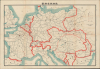
歐洲戰局詳圖 / [Detailed Map of the European War Situation].
Japan Makes Hay while Europe Burns.
- Digital Map Information
- Suitable for large format printing
- DPI: 600
- File Size: 33.77 MB
- File Type: ZIP / TIFF
- ICC color profile embedded
- Delivered instantly via download link
Japan Makes Hay while Europe Burns.
This is a scarce 1914 Japanese-language map of Europe in the opening months of World War I, edited by Hasegawa Seiya for the periodical True Account of the War in Europe. It reflects the significant but often overlooked role that World War I had in catapulting Japan into a global power and setting the stage for World War II. Although little known in the West, Japan was an enthusiastic member of the Entente Alliance during World War I (1914 - 1918), which it leveraged to expand its influence in China and East Asia.A Closer Look
Coverage embraces the core theater of World War I, focusing on Germany, France, and Austro-Hungary, but also including theaters of war in the bordering countries, including Russia, the Low Countries, and the Balkans. International borders, rail lines, fortifications (塞要), cities (including 'temporary capitals' 假首府, namely Serbia's Niš and France's Bordeaux), mountains, waterways, and other features are labeled throughout. Although the war's front lines are not indicated, they can be surmised from the notation of fortifications with red dots.Making the Most of an Opportunity
By the time this map was published, the war on the Western Front had settled into a stalemate, with neither side able to outflank or overpower the other. On the other side of Eurasia, Japan was making hay of the war. Having joined the Allies/Entente early on in the conflict, Japan moved in August 1914 to besiege the German-leased territory of Jiaozhou (based in Qingdao) on the Shandong Peninsula in China, forcing its surrender in early November. Having already annexed Korea and in the process of expanding commercial interests in Manchuria and throughout eastern China, the seizure of Qingdao removed a potential threat and opened the door for Japan's future preeminence in China.Moreover, the Imperial Japanese Navy (acting on its own initiative) easily captured German territories in Micronesia, several of which became major battlegrounds in World War II (1939 - 1945). In early 1915, Japan attempted to impose the Twenty-One Demands on the severely weakened Chinese Beiyang government, which would have effectively made China a Japanese protectorate (as Korea had been before annexation). Japan even sent a naval squadron to the Mediterranean to assist the British against German U-boats. The war was also an economic and financial boon to Japan, as its industries provided clothing and other war materiel for Allied troops, and its banks could lend money to Allied nations (on the other hand, the booming economy led to severe inflation, which in turn led to riots).
Publication History and Census
This map was edited and published by Hasegawa Seiya (長谷川誠也) and printed in December 1914 by Ichikawa Satorusaku (市川七作) of Hakubunkan (博文館) as a supplement for the periodical True Account of the War in Europe (歐洲戰爭實記). The map is also noted as being printed by Seibidō (精美堂), probably indicating that Seibidō printed this map while Hakubunkan printed and published the entire periodical. The map is not cataloged in any collection, while partial or full runs of True Account of the War in Europe (OCLC 1342524345) are held by the National Diet Library, the Nichibunken (International Research Center for Japanese Studies), the Academia Sinica in Taiwan (中央研究院), and the State Library of Victoria.Cartographers
Hasegawa Seiya (長谷川誠也; November 26, 1876 - August 30, 1940), better known as Hasegawa Tenkei (長谷川天渓), was a Japanese intellectual and literary critic. He was born in Niigata Prefecture and grew up in Kashiwazaki. After junior high school, he moved to Tokyo to attend Tokyo Senmon Gakko (later Waseda University), where he studied under the literary critic / intellectuals Tsubouchi Shōyō (坪内逍遥, 1859 - 1935) and Onishi Hajime (大西祝, 1864 - 1900). After graduating, he began working for the publisher Hakubunkan (博文館), editing several publications including Taiyō ('The Sun,' 太陽), a journal primarily of literary criticism that is often considered Japan's first general-purpose magazine. For much of the 1910s, he was the director of Hakubunkan, and in the mid-1920s served as editor-in-chief of Taiyō. Hasegawa's writings drew on many influences, including world history, psychoanalysis, Naturalism, and aesthetics. He played an important role in developing and popularizing the field of literary criticism in Japan. Further Details...
Hakubunkan (博文館; 1887 - present) is a prominent Japanese publishing company with origins in the Meiji era. The company was founded in Tokyo in 1887 by Ōhashi Sahei (大橋 佐平). Its name is an homage to the Japanese Prime Minister at the time and the architect of Japan's modernization Itō Hirobumi (1841 - 1909). The company's first successful publication was Nihon Taika Ronshū (日本大家論集), a literary journal appealing to Japan's growing, demi-Westernized urban middle class. Hakubunkan aimed for gaining the largest audience possible and kept publishing costs down by eschewing woodblock prints, making their works less attractive but more accessible to the general public. By the 1890s, the company had launched several subsidiaries and published some of the earliest Japanese magazines aimed at a general audience, including Taiyō> ('The Sun,' 太陽) and Literary Club (文芸倶楽部), publishing many of the leading Japanese literary figures of the era. The company's output often had a strong nationalistic tone, so much so that it was shut down during the American occupation after the Second World War. It was allowed to reconstitute at the end of the 1940s under different leadership, though it was broken up into six smaller companies, then reorganized as three companies, which then reintegrated as Hakubunkan Shinsha (博文館新社). Nowadays, the company largely produced journals and diaries, with magazines having become unprofitable. Further Details...
Seibidō (株式會社精美堂; fl. c. 1886 - present) is a Tokyo-based printer and publisher. Initially specializing in newspaper illustrations, advertisements, and headline fonts, Seibidō later branched into other areas of publishing and printing. The company was late to switch away from woodblock techniques, not doing so until the postwar period, but then rapidly adopted the latest technology of the 1950s. By the 1970s, the company had stopped publishing their own material but focused instead on platemaking and advertisements, and by the 1990s had embraced digital printing techniques. Further Details...
Condition
Very good. Light wear along original fold lines. Very slight loss at a few fold intersections.