
Hage, Aece

Aece Hage (fl. c. 1890 - 1900) was an Arab businessman and shop owner active in Boston in the late 19th century. Little is known of Hage, but one incident, appearing in the Boston Globe (Dec 19, 1896), describes him as the owner of a 'smallware' or 'pot and pan' store at 332 Federal Street. It goes on to describe him as an 'Assyrian.' Although today Assyria generally refers to parts of present-day northern Iraq, southeastern Turkey, northwestern Iran, and western Syria; in this case, it is a reference to the Ottoman province of Greater Syria, including all of Israel, Palestine, Jordan, Lebanon, and Syria. In the late 19th century a wave of Arab Christian, Arab Muslim, and Druze immigrants, most from Palestine and Syria, came to the United States seeking a better life. Many, like Hage, established small businesses, considering themselves al-Nizaleh, or sojourners. The Boston Globe article in question, the only reference to Hage we have found, describes a robbery in which Hage was burgled of 40 USD by a fellow 'Assyrian', Nasim M. Asseese. The short article further notes that both Hage and Asseese were 'locked up.'
Masterpiece of chromolithography.
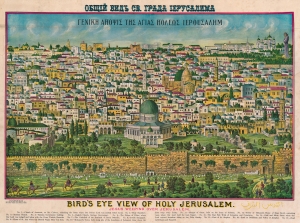
Bird's Eye View of Holy Jerusalem. Jesus Weeping Over Jerusalem. / Γενικη Αηοψις Της Αγιας Ηολεως Ιερουσαλημ. / القدس الشف
$2,000.00
Acquire
- Digital Map Information
- Suitable for large format printing
- File Size: 65.83 MB
- File Type: ZIP / TIFF
- ICC color profile embedded
- Delivered instantly via download link
A rare example of Rand McNally's 1900 chromolithograph view of Jerusalem. Although here unattributed, this view is a revised version of an earlier view issued in 1896 by the Palestinian / Syrian immigrant Aece Hage. Sometime after Hage's original printing, the view was acquired and revised by the Rand McNally Company, who updated and 'Christianized' it, adding a figure of Jesus in the upper right. They published from about 1900 both on their own account and to order - in this case, for the Chapel of Our Lady of the Cedars of Mt. Lebanon in West Roxbury, Massachusetts. The map is titled in Greek and English. Aece Hage's own title, in Arabic, also appears at the bottom right. Text below the view identifies 17 locations, which correspond to numerical assignments. The cartographer identifies Christian, Muslim, and Jewish religious sites. (more details)