
Hage, Aece (sold)

Aece Hage (fl. c. 1890 - 1900) was an Arab businessman and shop owner active in Boston in the late 19th century. Little is known of Hage, but one incident, appearing in the Boston Globe (Dec 19, 1896), describes him as the owner of a 'smallware' or 'pot and pan' store at 332 Federal Street. It goes on to describe him as an 'Assyrian.' Although today Assyria generally refers to parts of present-day northern Iraq, southeastern Turkey, northwestern Iran, and western Syria; in this case, it is a reference to the Ottoman province of Greater Syria, including all of Israel, Palestine, Jordan, Lebanon, and Syria. In the late 19th century a wave of Arab Christian, Arab Muslim, and Druze immigrants, most from Palestine and Syria, came to the United States seeking a better life. Many, like Hage, established small businesses, considering themselves al-Nizaleh, or sojourners. The Boston Globe article in question, the only reference to Hage we have found, describes a robbery in which Hage was burgled of 40 USD by a fellow 'Assyrian', Nasim M. Asseese. The short article further notes that both Hage and Asseese were 'locked up.'
Strange Arabic- Boston imprint from first wave of Islamic immigration to the United States.
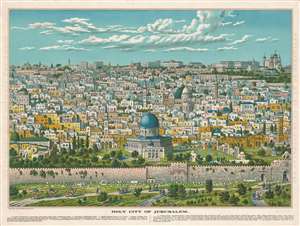
Bird's Eye View of Holy Jerusalem. / Vue Générale de la Villie de Jerusalem. / القدس الشف
sold
- Digital Map Information
- Suitable for large format printing
- File Size: 59.52 MB
- File Type: ZIP / TIFF
- ICC color profile embedded
- Delivered instantly via download link
The only known example of a magnificent and previously unknown c. 1896 Boston-Arab chromolithograph view of Jerusalem by the Palestinian / Syrian immigrant Aece Hage. This view is a veritable masterpiece of chromolithography, employing at least six separate plates, a feat even more remarkable when compounded with the knowledge that this view was produced in a flophouse under extenuating circumstances and on a low budget. The unusual view looks on Jerusalem from the Mount of Olives, east of the Old City, and centers on the Temple Mount and the Dome of the Rock (Qubbat al-Sakhrah), with other holy sites of multiple religions appearing behind it. In the foreground the Eastern Wall of Jerusalem, the walled off Golden Gate, the open Lion's Gate, and the 1400-year-old Bab-ur-Rahmah Cemetery are illustrated. The predominate colors, blue and green, are significant in Islamic tradition, representing protection, hope, and life. The view, although stylized, is mostly accurate, suggesting that Hage (or the artist) had been to or lived in Jerusalem and drew the image from life.
The view is titled in light brown lettering to either side of the view, and in the bottom right just below the view. Title text appears in English (left), French (right) and Arabic (bottom right). Text below the map identifies 15 locations, which correspond to numerical assignments appearing on the map. The cartographer identifies Christian, Muslim, and Jewish religious sites, without apparent preference. (more details)
The view is titled in light brown lettering to either side of the view, and in the bottom right just below the view. Title text appears in English (left), French (right) and Arabic (bottom right). Text below the map identifies 15 locations, which correspond to numerical assignments appearing on the map. The cartographer identifies Christian, Muslim, and Jewish religious sites, without apparent preference. (more details)