
Castleman, Philip Frederick (sold)
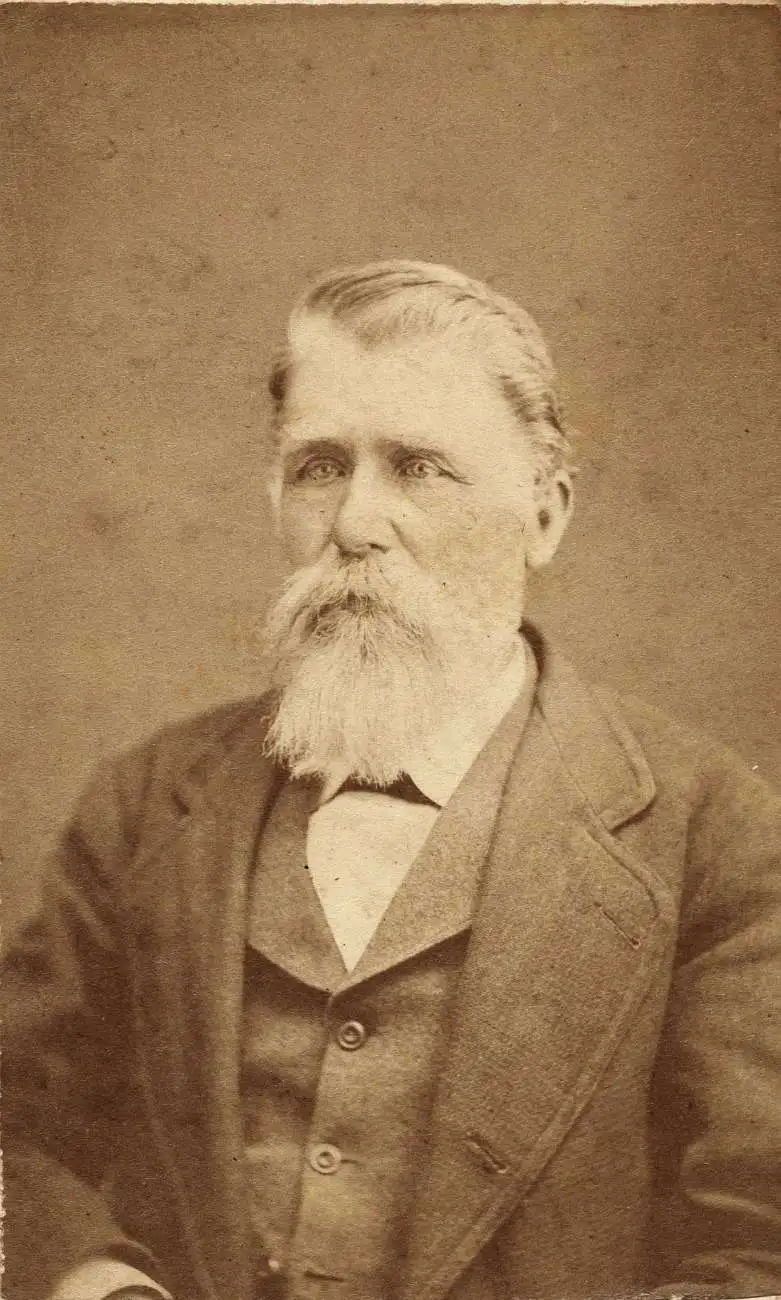
Philip Frederick Castleman (May 17, 1827 - March 24, 1913) was an American daguerreotype photographer active in the late 19th and early 20th centuries. Castleman was born in Hodgenville, Kentucky, where he received a very basic frontier education. At some point, showing promise, he transitioned to teaching and secured a position in Bacon Creek, Kentucky. When gold was discovered at Sutter's Mill, he traveled west with other 49ers - departing on May 3,1849 in a cross-country caravan under the leadership of C. W. Churchill. Of the eighteen men accompanying him, only eleven made it to California. After a few failed attempts at mining at Bidwell's Bar, on the Feather River, Castleman took a position in Sacramento as a baker's assistant. After about half a year, he turned again to mining, working the Redding Diggings, but taking ill, sold his claims. He relocated to Eugene, Oregon in 1851, using his small gold-rush earnings to build a sawmill on Bear Creek, the first such in southern Oregon. Two years later, in 1853, he sold the first mill and in partnership with Milton Lindley built a new mill at Phoenix, on the Rogue River. With some financial security, Castleman decided to return east by ship, crossing the isthmus at Nicaragua. While in New York, he discovered daguerreotyping, with which he became enamored. Toting a full daguerreotyping and developing setup, Castleman returned to the west coast, this time via Panama. He was one of the first two photographers on the west coast, pioneering the art in Northern California and Southern Oregon. Around this time, he fought and was wounded in the Indian Wars along the Rogue River. He was sent to Eugene to recover from this war wounds. In 1855, after the Indian War, he sold his mill interests and began running pack-trains from the Willamette Valley to mining camps in southern Oregon. By 1857, he established livery stables in Oregon, and later in Walla Walla. Between 1862 and 1867, Castleman alternated between running supply caravans to mines in Oregon and Idaho Territory and doing professional photography 'of all kinds'. Often, Castleman carried his photographic equipment with him while on supply missions, recording some of the most important and ephemeral mining booms in American history. During this time, he developed a lucrative partnership with the African American San Francisco lithographer Grafton T. Brown (1841 - 1918), wherein Brown would create lithographic city views from Castleman's photographs. The views are among the earliest and most important views of important mining sites and boomtowns in the Pacific Northwest. Some of these views include Silver City, Walla Walla, Boise, and Portland, among others. He relocated to Portland in 1878, where remained until 1908, when he moved to Berkeley, California. He died in San Francisco in 1913.
Silver boomtown by the first African American Lithographer.
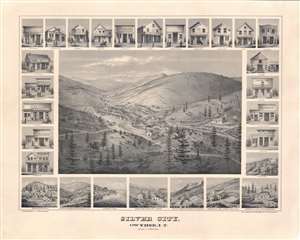
Silver City, Owyhee, I.T.
sold
- Digital Map Information
- Suitable for large format printing
- File Size: 52.62 MB
- File Type: ZIP / TIFF
- ICC color profile embedded
- Delivered instantly via download link
A remarkable 1866 bird's-eye view of Silver City, Idaho Territory, issued by Grafton Tyler Brown, America's first African American lithographer, and presenting the mining boomtown at its height of prosperity. Silver City experienced one of America's richest mineral strikes, producing gold and silver for more than 40 years. This view is one of only two known examples, significant not only for its historic illustration of a pop-up boomtown in full bloom, but also for being one of the few surviving views engraved and printed by Grafton T. Brown. Unlike many views, it has the unique distinction of being drawn from daguerreotype photographs taken by Philip Frederick Castleman, who visited with a supply caravan in 1866. (more details)