
Coffin, William Henry 'Haskell' (sold)

William Henry 'Haskell' Coffin (October 21, 1878 - May 12, 1941) was an American artist and painter. Born in Charleston, South Carolina, his family moved to Washington, D.C. while he was still an infant. He studied art at the Corcoran School of Art in Washington, D.C., before heading overseas to Paris to study under Paul Laurens, who was renowned as one of the greatest teachers of art at the time. After returning from Europe, Coffin lived in New York City, where he began a successful career as a commercial artist in advertising. His work graced the covers of The Redbook and Cosmopolitan and appeared on the cover of The Saturday Evening Post thirty-four times. Coffin gained a reputation as a portraitist, particularly for portraits of beautiful women. His work 'glorified the American girl', with a particular emphasis placed on the show girl. His subjects were often depicted making small, elegant gestures, accompanied by graceful expressions. Coffin was married and divorced twice, with three children from his first marriage. He was admitted to a hospital in St. Petersburg, Florida, in April 1941 to treat a mental illness, said to be 'melancholia', and he was still in the hospital for treatment when he leaped to his death from his third-floor room.
World War I propaganda broadside featuring Joan of Arc.
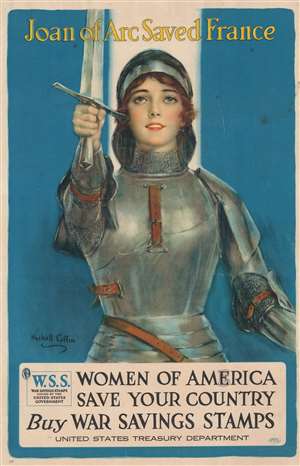
Joan of Arc Saved France. Women of America Save Your Country Buy War Savings Stamps.
sold
- Digital Map Information
- Suitable for large format printing
- File Size: 31.81 MB
- File Type: ZIP / TIFF
- ICC color profile embedded
- Delivered instantly via download link
This is a 1918 Haskell Coffin World War I propaganda broadside depicting Joan of Arc. A portrait of Joan looking toward the future dominates the sheet. Clad in full armor, Joan holds a sword aloft effortlessly, calling on the women to help save America as she had saved France - by buying War Savings Stamps. War Savings Stamps cost ten cents or twenty-five cents each and were mostly bought by women and young children. Raising near $1 billion, the War Savings Stamps program proved successful, although not so much as the Treasury Department hoped. (more details)