
1941 Flying and Popular Aviation Pictorial Map of the Americas, World War II

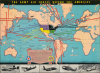
The Army Air Forces Defend the Americas.
Gearing Up for Total War.
$175.00
Choose a Collection:
- Digital Map Information
- Suitable for large format printing
- Full resolution TIFF file
- ICC color profile embedded
- Delivered instantly via download link
This Item
Enquire
Gearing Up for Total War.
This is a colorful September 1941 pictorial map of the Americas, Atlantic, and Pacific that appeared in Flying and Popular Aviation magazine. It depicts the defensive arrangements of the U.S. Army Air Forces (USAAF), reflecting that the country was already largely on a war footing even before Pearl Harbor.A Closer Look
The map covers much of the world, centered on the Americas and using a Mercator Projection. The United States is divided into four color-shaded portions indicating the areas of responsibility of the four air forces of the newly-created U.S. Army Air Forces. Arrows display the ranges of aircraft operating from each region of the Continental U.S., while red arrows similarly denote the range of planes operating from overseas bases. Although neutral at this point, the U.S. was already deeply concerned about German U-Boat attacks in the Atlantic Ocean and the potential of Japanese naval activities in the Pacific should a war break out, as indeed happened only a few months later. Images of five of the newest American airplane designs appear at bottom; though not labeled, they appear to be the Consolidated B-24 Liberator, the Martin B-26 Marauder, the Douglas A-10 Havoc, the Curtiss P-36 Hawk, and the Lockheed P-38 Lightning.America's Slide towards Total War
In the years and months leading up to the attack on Pearl Harbor in December 1941, the United States undertook a gradual but significant process of military and industrial mobilization in anticipation of possible involvement in World War II (1939 - 1945). Although officially neutral, President Franklin D. Roosevelt's administration recognized the growing threat posed by Axis expansion and began to prepare accordingly. The 1940 Selective Training and Service Act instituted the first peacetime draft in American history, while Congress authorized major increases in defense spending.Industrial production shifted toward armaments, ships, and aircraft, laying the groundwork for what Roosevelt later called the Arsenal of Democracy. American shipyards, factories, and research facilities ramped up output dramatically, aided by the Reconstruction Finance Corporation and the creation of defense production agencies that coordinated contracts with private industry. A key element of the prewar effort was the Lend-Lease program, enacted in March 1941, which allowed the United States to supply Britain, China, and later the Soviet Union with vital war materials without direct payment. Through Lend-Lease, the U.S. effectively became the principal supplier for nations fighting the Axis powers, sending billions on food, vehicles, and equipment overseas. At the same time, the U.S. Navy expanded its patrol zones in the Atlantic and began limited convoy protection for Allied shipping, leading to a 'shooting war' with German submarines months before formal entry into the conflict. Public opinion, still wary of war after World War I (1914 - 1918), began to shift as the threat of Axis domination grew clearer. By late 1941, the United States was effectively on a war footing - mobilized industrially, diplomatically engaged in the global struggle, and poised for full-scale conflict - when the Japanese attack on Pearl Harbor brought the nation formally into World War II.
The American air forces were no exception to this trend, and in fact are an especially dramatic example since the German blitzkrieg in 1939 had demonstrated the importance of air power to modern warfare. Beginning from a rather diminished interwar basis, with a small budget, few personnel, and outdated planes, the U.S. Army Air Corps was reorganized as the USAAF in June 1941. Starting with a budget of just $19 million in 1939, the Air Corps was allocated $300 million in April 1939 at President Roosevelt's request, and its budget reached more than $3 billion by 1941. President Roosevelt set a goal to produce 50,000 military aircraft per year by the end of 1940 (many of them going towards Lend-Lease, though this lofty goal was not met), and the construction of new bases and pilot training. When including the years 1939-1941, the U.S. had produced some 300,000 military aircraft by the end of the war, a truly astounding figure.
Publication History and Census
This map appeared in the September 1941 issue of Flying and Popular Aviation magazine (still in publication simply as Flying). It is only independently cataloged by the David Rumsey Historical Map Collection, while Flying and Popular Aviation is well-represented in institutional collections.Condition
Very good. Light wear along original centerfold.
References
Rumsey 9698.000.