
1935 Gin Ka Pictorial 'Game of Goose' Map, Polar Exploration

This item has been sold.
La Corsa al Polo.
L'Italia e l'Artico.
- Digital Map Information
- Suitable for large format printing
- Full resolution TIFF file
- ICC color profile embedded
- Delivered instantly via download link
L'Italia e l'Artico.
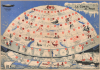
This is a rare 1934 Italian pictorial game board map prepared by the artist Gin Ka as an advertisement for the textile producer Maglificio. Based on the traditional 'Game of the Goose' (il giocho dell'oca ), it takes players on a journey to the North Pole past Inuit villages, polar bears, and a range of natural hazards like crevasses and blizzards.A Closer Look
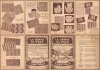
Players embark from a ship stuck in the ice at bottom-right, advancing by rolls of a dice through 90 squares until reaching the destination of the North Pole. A series of hazards - including icebergs, a polar bear, a walrus, and broken skis or radios - can cause the players to lose turns or go back several spaces. Alternatively, players can be granted extra turns or jump ahead several spaces by landing on helpful squares with, for example, 'Eskimo villages,' an aurora borealis, a 'good pack of dogs,' or a successful bird hunt. Although not immediately obvious, the game board serves as an advertisement for the 'Polo' brand of wool (lana polo), using a pun as the basis for the polar theme of the game. The verso has extensive promotional text and illustrations for the wool in question, along with the game's rules.The Game of the Goose
The Game of the Goose (il giocho dell'oca ) is widely considered the grandfather of the modern 'race' board game, with origins tracing back to 16th-century Italy. It gained international fame after Francesco de Medici gifted a copy to King Philip II of Spain, eventually becoming a staple of European parlor entertainment. Played on a spiral-shaped board usually consisting of 63 numbered spaces (90 in this case), the game is a journey of pure luck. Because players move their tokens based entirely on the roll of two dice with no strategic choices involved, it historically served as a popular gambling tool and a lighthearted pastime that bridged the gap between social classes.The board is famously populated with symbolic 'hazard' squares that determine a player's fate. Landing on a Goose allows you to double your move, while the Bridge offers a quick leap forward. However, the path is fraught with setbacks: certain spaces force a player to miss turns, or require another player to pass by to 'rescue' the victim, and the dreaded Death square sends a token all the way back to the start. To win, a player must land exactly on the 63rd space (or the 90th in this case); overshooting the mark forces the player to move backward from the finish, often landing them right back into the clutches of a well-placed trap.
Historical Context
By the time this map was produced, although both the North and South Pole had been reached by explorers in some fashion, they still represented the final frontiers of Earthly exploration, capturing the imagination of a public eager for heroics amidst the economic gloom of the Great Depression (1929 - 1939). This decade marked a pivotal transition from the grueling 'heroic age' of dog sleds to an era defined by long-range aviation and wireless radio, exemplified by Roald Amundsen's reaching the North Pole by airship in 1926 and American Rear Admiral Richard E. Byrd's establishment of the 'Little America' scientific base in Antarctica. The poles were viewed as the ultimate testing ground for national grit and technological prowess, akin to the Space Race of the 1950s and 1960s.This 'polar-mania' was particularly potent in youth culture, where children's magazines transformed explorers into the era's equivalent of superheroes. These publications were saturated with serialized adventure stories, detailed diagrams of ice-breaking ships, and 'how-to' guides on building igloos or surviving sub-zero temperatures. Polar exploration was framed as the ultimate apprenticeship for adulthood, blending scientific curiosity with rugged survivalism.
Italy and Italians played an important but oft-forgotten role in polar exploration, beginning with the Stella Polare Expedition of 1899-1900, led by the nobleman Luigi Amedeo di Savoia (1873 - 1933), better known as Duca degli Abruzzi (a cousin of Vittorio Emanuele III). Although it did not reach the North Pole as hoped, the Stella Polare Expedition did slightly surpass the 'furthest north' mark set by Fridtjof Nansen's 1893 - 1896 Fram Expedition, as well as collect rocks and other samples for scientific study. An Italian aeronautical engineer, Umberto Nobile (1885 - 1978), was at the helm of the airship Norge in 1926, when it carried Roald Amundsen's team over the North Pole. Unfortunately, Nobile's follow-up Italia Expedition in 1928 ended in a crash and the deaths of 17 men, either due to the crash or in the following rescue efforts. Among the missing and presumed dead was none other than Roald Amundsen, who had embarked on a flying boat with a small crew to look for the Italia after it had crashed.
Publication History and Census
This map was prepared by artist Gin Ka (a nom de plume) and printed by Arti Grafiche Navarra S.A. in Milan in 1934 (note that the date is also written as 'Anno XIII,' according to the fascist calendar). It was prepared as an advertisement for the textile producer Maglificio. We are only aware of one other example of the map, held in the collection of Game of Goose expert Adrian Seville, which is identical on the recto except that it advertises a different textile producer, Lanificio V. E. Marzotto, at top-left (it appears that both Maglificio and Lanificio V. E. Marzotto utilized the Polo brand of wool in their products).Cartographer
Arti Grafiche Navarra S.A. (fl. c. 1925 - 1940), often abbreviated as 'Art. Graf. Navarra,' was an Italian lithographic printed based in Milan, known for their bold and impressive chromolithographic posters. The firm was best known for their attention-grabbing Art Deco-inspired advertising broadsides, but also produced some books on technical subjects, one being a fairly ludicrous propaganda piece to extol Mussolini's 'expertise' on aviation titled L'aviazione negli scritti e nella parola del Duce (1937) - at the time, Mussolini was the nominal Minister of Aeronautics along with holding about a dozen other titles and governmental positions. Further Details...
Condition
Very good.
References
Seville, A., 'Advertising and Promotion' in The Cultural Legacy of the Royal Game of the Goose 400 Years of Printed Board Games (Amsterdam: Amsterdam University Press) 2019, pp. 317 - 330. Giochi dell'Oca e di percorso (online database), Numero di catalogo: 323.