
1925 Batik Map of Dutch East Indies (Indonesia) on cotton

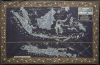
Kaart van Ned. Oost-Indie.
Traditional Batik interprets colonial cartography.
$1,250.00
Choose a Collection:
- Digital Map Information
- Suitable for large format printing
- Full resolution TIFF file
- ICC color profile embedded
- Delivered instantly via download link
This Item
Enquire
Traditional Batik interprets colonial cartography.
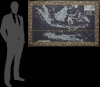
A rare, possibly unique, c. 1925 map of the Dutch East Indies (Indonesia), remarkable for its fusion of Western cartography with the traditional Indonesian art of batik. Measuring an impressive 60 x 39.5 inches, the map was rendered on cotton using the wax-resist dyeing techniques for which Indonesian textile arts are celebrated, transforming a conventionally Western cartographic image into an unmistakably Indonesian material object. This extraordinary meeting of two visual traditions - European mapmaking and indigenous textile production - emerged at a pivotal moment in the history of the archipelago, when Dutch colonial rule was near an apogee even as Indonesian nationalism gathered momentum.A Closer Look
The map is divided into two parts: the upper two-thirds cover the entire Indonesian archipelago, along with today's Singapore, Papua New Guinea, Timor-Leste, Brunei, and portions of Malaysia, Thailand, and the Philippines. The bottom third is a map of Java and its immediate neighboring islands. Islands and territories (Residenties or Residencies) are labeled throughout on both maps. An elaborately patterned border surrounds the map portion of the fabric.The Dutch East Indies in the Interwar Period
The Interwar period (1918 - 1939) in the Dutch East Indies was defined by the extractive colonial economy reaching its apogee and the emergence of a powerful anti-colonial movement with an increasing sense of shared national identity. After World War I (1914 - 1918), early political movements gave way to anti-colonial political parties, culminating in 1927 with Sukarno's founding of the Indonesian Nationalist Party (PNI). A defining milestone occurred during the 1928 Youth Pledge (Sumpah Pemuda), when youth representatives from across the archipelago formally united under the promise of one motherland, one nation, and one unifying language: Bahasa Indonesia. As Benedict Anderson shows in his influential 1983 book Imagined Communities, expanding literacy and print culture fostered a singular Indonesian identity in direct opposition to Dutch imperial authority.In response to rising political agitation and aborted communist uprisings in 1926-27, the Dutch colonial administration abandoned its former reformist 'Ethical Policy' in favor of strict authoritarian crackdowns. Imperial authorities heavily censored the press, outlawed public gatherings, and established the brutal Boven Digoel penal camp in New Guinea to exile key nationalist leaders, including Sukarno, Mohammad Hatta, and Sutan Sjahrir. At the same time, the Great Depression devastated the colony's export-dependent sugar, rubber, and petroleum industries, causing widespread economic hardship. This combination of harsh political suppression and economic instability alienated the populace, causing many to embrace Japanese invasion in 1941-42 more enthusiastically than other colonized people in Southeast Asia. Though Japanese rule soon proved even worse than the Dutch, the groundwork laid before World War II (1939 - 1945) enabled a successful repulse of Dutch attempts (with British help) to reestablish colonial rule in the late 1940s.
Batik
Batik is an ancient textile art form utilizing wax-resist dyeing (often somewhat inaccurately referred to as painting) most famously perfected on the island of Java. Historically reserved for royal courts, traditional batik patterns carried deep symbolic meanings, signifying social status, lineage, or spiritual protection through motifs like royal geometric blades (parang) or botanical representations. Javanese master artisans refined the craft into a high art, earning UNESCO's recognition as an Intangible Cultural Heritage of Humanity in 2009. Today, while modern industrial adaptations exist worldwide, traditional hand-crafted batik remains a deeply revered cultural tradition throughout Southeast Asia.The core of the batik technique relies on a precise wax-resist dyeing process to create intricate patterns on natural cotton or silk fabric. Artisans apply molten beeswax or paraffin onto the cloth using either a canting (a small, handheld copper pen with a spout for freehand drawing) or a cap (a hand-forged copper stamp used for repeating patterns). Once the applied wax cools and hardens, the fabric is submerged in a dye bath, where the waxed areas resist the color. Creating multi-colored designs requires a repetitive, laborious cycle, in which artisans selectively boil away the old wax, reapply fresh wax to new areas, and immerse the cloth in progressively darker dyes, often resulting in batik's signature fine 'crackle' lines where pigment seeps into microscopic cracks in the wax.
Publication History and Census
This batik map is based on a large-format printed automobile map of the Dutch East Indies, which is itself quite rare, held only by the Nationaal Militair Museum, Leiden University, and the Vrije Universiteit Amsterdam (OCLC 71595288). This batik version was sold by a shop named (rather generically) Toko Djokja located in Weltevreden, the European-style colonial commercial district of Jakarta (then Batavia). Therefore, it is safe to assume that this map was sold as a souvenir to a foreign, likely Dutch, customer.Condition
Very good. Creasing and some small tears along fold lines. Fading of dye in places, especially northern Borneo.