
1952 Hagstrom Map of Florida


This item has been sold.
America's Finest Highways Lead to Florida's Silver Springs.
Silver Springs - the largest tourist attractions in Florida in the 1950s.
- Digital Map Information
- Suitable for large format printing
- Full resolution TIFF file
- ICC color profile embedded
- Delivered instantly via download link
Silver Springs - the largest tourist attractions in Florida in the 1950s.
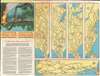
This is a 1952 Hagstrom map of Florida. Created as a promotional piece for Silver Springs, a tourist attraction outside Ocala, Florida, a large red 'arrow' emphasizes Silver Springs' location in central Florida. U.S. highways are illustrated in red and four highways pass through Ocala, highlighting how easy it would be for travelers to stop at Silver Springs on their way to their final destination or on their way home. Gorgeous color photographs increase Silver Springs' appeal and promote its crystal-clear water, glass-bottom boats, reptile house, and its rhesus macaques. Throughout the 1930s and 1940s, billboards and other advertisements appeared along highways around the country proclaiming the wonders found at Silver Springs, pointing the way, and telling motorists just how far it was from where they were to this paradise. By the 1950s, Silver Springs was the largest tourist attraction in Florida. Today, the 'attraction' is now part of Silver Springs State Park, but the glass-bottom boats (and the slightly dangerous monkeys) still beckon thousands of visitors every year. A wonderful pictorial border, consisting of illustrations of fish, a woman swimming, and a glass-bottom boat, surrounds the entire map. Five maps on the verso detail the highway connections between locations throughout the United States and Silver Springs.Publication History and Census
This map was created by the Hagstrom Company and published by Ray, Davidson, and Ray (the owners of Silver Springs) in 1952. We have been unable to locate any other surviving examples of the present map.Cartographer
Andrew Gunnar Hagstrom (1890 - September 24, 1977) was a map publisher based in Maspeth, Queens. Hagstrom was born in Karleby, Skaraborg, Sweden. He emigrated to New York in 1909, where he took work milking cows at a farm near Coney Island, Brooklyn. He then worked in the meatpacking industry while taking a degree in commercial art at the New York Mechanics Institute. Afterward, he founded a drafting business in Manhattan and created a map to showcase his drafting skill and help customers find his shop. Around 1916, he purchased the copyrights to Dolph & Street Company's base maps of New York City. His maps proved popular, and he expanded operations by founding the Hagstrom Map Company (1916 - 1968) and issuing additional maps of parts of New York City and the surrounding regions. By 1949, Hagstrom had issued more than 150 maps, guides, and atlases, most of which focused on New York. Many of his maps from this period feature a unique dating cipher based on his name (HAGSTROMCX corresponds to the numbers 1-9, with 0 representing the months and years; for example, a map with the code OSO would be 7/47, or July 1947). Hagstrom pioneered a cartographic style that exaggerated street widths to improve clarity and make room for large-print, readable labels. The New York Subway system even hired Hagstrom to produce its map, which was in use from the 1940s to 1958. In 1958, the King of Sweden knighted Hagstrom (Royal Order of Vasa, First Class) for his success in the United States. His company flourished until 1968, when Macmillan acquired it. The brand has since passed through multiple corporate portfolios and is now owned by Kappa Publishing Group. Hagstrom died in 1977 at age 81 in the Virgin Islands. Further Details...
Condition
Very good. Exhibits light wear along original fold lines. Exhibits some toning. Road maps on verso.