
1929 Jillson Geological Map of Kentucky



This item has been sold.
Geologic Map of Kentucky.
Gigantic geological map of Kentucky.
- Digital Map Information
- Suitable for large format printing
- File Size: 83.35 MB
- File Type: ZIP / TIFF
- ICC color profile embedded
- Delivered instantly via download link
Gigantic geological map of Kentucky.
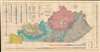
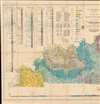
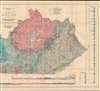
This is a gigantic 1929 Willard Rouse Jillson geological map of Kentucky. The map locates seventeen geological zones with distinct colors and patterns, each defined in the legend in the upper right. Fault lines are also noted and traced in green. As are resources: coal mines, rock asphalt mines, and oil and gas fields. Oil and gas fields are numerically identified and correspond with an index in the upper left. Five different geologic cores are also included in the upper left and right. Two profile sections illustrating layered geological formations are included along the bottom border.Railroads and Power Lines
Within the state itself, counties are illustrated and labeled. Power transmission lines are illustrated in blue, with eleven patterns differentiating various power companies. Railroads throughout are illustrated and labeled.Publication History and Census
This map was created by Willard Rouse Jillson, published by the Kentucky Geological Survey, and engraved and printed by the U.S. Geological Survey. It is well represented in institutional collections but scarce on the private market.Cartographers
Willard Rouse Jillson (May 28, 1890 - October 4, 1975) was an American geologist, historian, author, and academic best known for his extensive contributions to the study of Kentucky's geology and history. Born in Syracuse, New York, Jillson worked briefly in the Midwest before moving to Kentucky in 1917, drawn by the rapidly expanding oil and gas industry. He joined the faculty of the University of Kentucky in Lexington in 1918 and later taught at Transylvania University beginning in 1947. In 1919, Jillson was appointed State Geologist of Kentucky, eventually serving as director of the Sixth Kentucky Geological Survey; in 1924, he became Commissioner of Kentucky Parks. His long public career also included service as Curator of the State Museum, and in the private sector he helped develop Kentucky oil and gas fields. A prolific scholar, Jillson authored numerous works on Kentucky geology, natural resources, history, and political figures, becoming one of the foremost chroniclers of the Commonwealth's geological and historical heritage. Further Details...
The United States Geological Survey (March 3, 1879 - present), commonly abbreviated USGS, is an American federal scientific bureau and civilian mapping agency within the Department of the Interior, established in Washington, D.C., and subsequently headquartered in Reston, Virginia. Congress created the Survey to classify public lands and investigate the geological structure, mineral resources, and products of the national domain, replacing separate western investigations with a permanent scientific organization. Its first director, Clarence King (1842 - 1901), organized geological investigations and recruited experienced scientists and topographers from earlier federal surveys. Under his successor, John Wesley Powell (1834 - 1902), director from 1881 to 1894, topographic mapping expanded from support for individual geological investigations into a nationwide undertaking. Congressional authorization in 1882 to continue preparation of a geological map of the United States extended the Survey's work into the eastern states, while systematic topographic mapping received authorization in 1884. Henry Gannett (1846 - 1914), the Survey's chief geographer, helped establish enduring methods and standards for this work. Its topographic quadrangles represented terrain through contour lines alongside drainage, settlements, roads, and other features, furnishing a common geographic foundation for scientific investigation and practical land use. During the 20th century, the Survey's mapping evolved from field surveying and compilation toward aerial photography, photogrammetry, and digital geographic information systems. A formal program begun in 1947 to map the conterminous United States at 1:24,000 scale culminated in nationwide coverage in 1992, comprising more than 55,000 maps. The Survey also produced geological and thematic maps and assembled national geographic information. In 2009 it introduced US Topo, a digitally generated successor to its traditional topographic quadrangles. Its continuing cartographic work includes The National Map, digital topographic products, and public access to historical quadrangles, alongside broader investigations of water, ecosystems, mineral and energy resources, and natural hazards. Further Details...
Condition
Very good. Ex-Library. Dissected and laid on linen. Accompanies original binder.
References
OCLC 57244300.