
1946 Smith Cyanotype WWII Route Map of the 987th Field Artillery Battalion in Europe

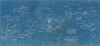

Graphical History of the 987th F.A. Battalion 155 MM Self Propelled Guns. Lt. Col. Wm. C. Smith, BN CO.
Cyanotype World War II route map!
$2,500.00
Choose a Collection:
- Digital Map Information
- Suitable for large format printing
- DPI: 600
- File Size: 42.67 MB
- File Type: ZIP / TIFF
- ICC color profile embedded
- Delivered instantly via download link
This Item
Enquire
Cyanotype World War II route map!
This is a rare 1946 cyanotype World War II route map of the 987th Field Artillery Battalion in Europe, drawn by the battalion's commanding officer, Lieutenant Colonel William C. Smith. The map highlights moments throughout the 987th's campaign across Europe and provides snippets of the battalion's experiences in the war. This map is the only cyanotype route map we have encountered. Due to restrictions imposed by the cyanotyping process, this map was likely produced in a very small print run.A Closer Look
Coverage embraces from Berlin, Germany, to Auxerre, France, and Berchtesgaden, Germany, and from Rennes, France to Prague, Czechoslovakia. A bold line follows the 987th movements from embarking on LSTs at Felixstowe, England, on June 1, 1944, through spending time at a rest area near Bezdekov, Czechoslovakia, before being redeployed to the United States on July 3, 1945. Text boxes provide information (and some commentary) on the 987th movements, engagements, and the divisions to which the battalion was attached. The largest text box attempts to recount the action surrounding the Battle of the Bulge and the advance to the Remagen Bridgehead. Smith states, 'too much action in this area to detail.' Smith also illustrates the Falaise Pocket and Gap, the Ruhr Pocket, and 'Buzz Bomb Alley.'The 987th Field Artillery Battalion
The 987th Field Artillery Battalion was a federalized unit of the Ohio National Guard. The Battalion left Camp Bowie, Texas, for Camp Shanks, New York, on February 17, 1944, and arrived on February 22. It left New York Harbor on March 13, 1944, and arrived at Greenock, Scotland, on March 22, 1944. It crossed the Atlantic unescorted aboard a luxury liner that outran several U-boats during the crossing. The Battalion embarked at Felixstowe, England, on June 1, and sailed for Normandy on June 5. Its first elements landed on Gold Beach on the evening of D-Day. Its artillery pieces were unloaded on the morning of June 7, and the battalion was on the battle line by that night. The battalion fought across France, Luxembourg, Belgium, and Germany, and ended the war in Czechoslovakia on Occupation Duty.Cyanotype: Why so Blue?
Cyanotype is a photo-reprographic technique developed in 1842 by the British astronomer John Herschel (1792 - 1871). Sometimes called a 'sunprint', the technique employs a solution of ferric ammonium citrate and potassium ferricyanide, which is painted on white paper or cloth, and reacts when exposed to sunlight to dye the object a brilliant blue. Areas blocked from ultraviolet exposure remain undyed and white. Herschel developed the technique to reproduce his astronomical notes, but others quickly realized that any object capable of blocking light could be used to create a cyanotype image quickly and easily. By the late 19th century, the process became popular with designers, the military, architects, and engineers (blueprints), who used the cost-effective technique to quickly and exactly reproduce images in the field. Cyanotyping is limited in that only a single copy can be made at one time, so it was only practical for short-term fieldwork. Cyanotypes remain extremely reactive to light and, over time, fade or degrade, making them extremely ephemeral. The process fell out of fashion in most places by the 1920s but remains in use in some parts of the world, such as India and Nepal, to this day.Publication History and Census
This map was drawn by William C. Smith and dated October 15, 1946. We note one other cataloged example, which is part of the collection at Texas A and M University.Condition
Very good. Light wear along original fold lines.
References
Texas A and M University G5721.S7 1946 .S65.
CartoCuriosity Podcast