
1923 Hughes and Bailey Bird's-Eye Aeroview of Hudson, New York

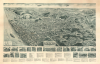
Aero-View of Hudson New York 1923.
Heart of the Hudson Valley.
- Digital Map Information
- Suitable for large format printing
- File Size: 48.43 MB
- File Type: ZIP / TIFF
- ICC color profile embedded
- Delivered instantly via download link
Heart of the Hudson Valley.
This is a rare c. 1923 bird's-eye view of Hudson, New York, by the firm of Hughes and Bailey. Hudson is one of the most beloved and vibrant towns in the Mid-Hudson Valley.A Closer Look
The view looks northeast on Hudson. The Hudson River and the New York City Railroad are on the left. Hudson's main thoroughfare, Warren Street, runs perpendicular to the river. Countless buildings, many of which still stand and are recognizable, fill the town. All streets are labeled. Just outside town, there are several large factories, singling the town's industrial prowess. Two bi-planes hover above the city - a sign of the times. At the bottom right is the 'State Training School', today the Hudson Correctional Facility. Along the bottom of the view, 20 key civic buildings and businesses are illustrated. Below this, at the base, is a business directory.A Note on Authenticity
The present view is a collotype, a kind of photo-mechanical reprographic technique pioneered in the 1850s. It exhibits signs of having been photographically compiled from sections, some of which exhibit damage and trimming, and some of which are layered, then collotyped to a single large sheet, as here. On an earlier 19th-century stone lithograph, this would be a damning indication of reproduction; however, Hughes and Bailey did employ such techniques as part of their modernized 'aero-view' process, and this view came to us in its original, c. 1930s frame, so we believe it to be the original 1923 printing. We have not been able to identify a comparable example of this view in any known collection for comparison. However, we have been able to access comparable Hughes and Bailey 'aero-views' from collections like the Boston Public Library and the Library of Congress, and this piece is consistent with that work, including the collotype process, the printing of minor damage, and the blue-tinted ink.Hughes and Bailey Views
In 1904, Bailey was in his early 60s. At an age when most men would be looking toward retirement, Bailey entered into a new business, partnering with the younger Thomas S. Hughes. Under the imprint of 'Hughes and Bailey', the duo traveled throughout New York and New England, revisiting the sites of Bailey's earlier views. In each, they painstakingly made new views, what they called 'aero-views' from the same perspective point of the earlier view, but 20 - 40 years later. Most were artistic renderings, like the earlier views, but some incorporated photography. These were then printed using various processes - including photo-lithograph, colotype, and half-tone, some considerably cheaper than the older stone lithographs. The marketing angle, evident in numerous newspaper advertisements from 1904 to 1926, was to set the old and new side by side, thus illustrating change and growth. They worked together on these views, as is described in an article appearing in the March 29, 1912, issue of the Norwich Bulletin,It has taken the artists eight months of hard and faithful work to go through the streets and sketch each building separately. They did most of their work during the summer months. It is quite amusing to hear them relate some of their experiences, having been mistaken for burglars, prospective real estate promoters and curiosity seekers.Hughes and Bailey remained partners for over 20 years, pushing Bailey well into his 80s - nothing to the vigorous man who lived to 104.
American Bird's-Eye City Views
The Bird's-Eye view industry emerged in the United States in the middle part of the 19th century and coincided with the commercial development of lithographic printing. Before the rise of lithography, the ability to own and display artwork in the home was largely limited to the extremely wealthy, but the advent of lithographic printing made it possible for everyone to own visually striking artwork. A robust trade developed in portraits of political leaders, allegorical and religious images, and city views.City views were being produced in the United States as early as the 1830s, but the genre exploded after the American Civil War (1861 - 1865). Bridging the gap between maps and pictures, most 19th-century American bird's-eye views presented cities to the public from high points. Some were imagined, but others were drawn from hot-air balloons or nearby hills. The presentation, combining high elevation, commercial interest, and new printing technology, created a uniquely American art form, as described by historian Donald Karshan,
Some print connoisseurs believe that it was only with the advent of the full-blown city-view lithograph that American printmaking reached its first plateau of originality, making a historical contribution to the graphic arts. They cite the differences between the European city-view prints and the expansive American version that reflects a new land and a new attitude toward the land.The vogue for bird's-eye city views lasted from about 1845 to 1920, during which period some 2,400 cities were thus portrayed, some multiple times. Although views were produced in many urban centers, the nexus of view production in the United States was Milwaukee, Wisconsin. The major American viewmakers were Stoner, Wellge, Bailey, Fowler, Hill, Ruger, Koch, Burleigh, Norris, and Morse, among others.
Publication History and Census
This view was published by Hughes and Bailey (Thomas S. Hughes and Oakley Hoopes Bailey) in 1923. The present example may be from as late as 1930, but is unlikely to have been printed any later. We note some modern reproductions being sold in Hudson, likely from a locally preserved original, but see no examples of this piece in any institutional collection. All views by Hughes and Bailey are extremely rare, this one is exceptionally so, not even being recorded in John Reps's canonical Views and Viewmakers of Urban America.Cartographers
Thomas S. Hughes (fl. 1904 - 1926) was an American viewmaker active in the early years of the 20th century. Hughes is an elusive figure before and after his viewmaking career - due in part to the commonality of his name. In 1904 Hughes partnered with the venerable Oakley Hoopes Bailey (1843 - 1947), who was then in his 60s. The duo traveled throughout New York, New Jersey, and New England, revisiting the sites where 20-40 years earlier, Bailey made his own views. There they made new views, illustrating the development and change that occurred over the intervening period. The 'Hughes and Bailey' Aero-Views as they were known are universally copper half-tone images - suggesting that Hughes implemented modern photo-mechanical printing technology and even photography to enhance the viewmaking process and printing. Hughes appears to have moved around a lot. When the partnership was founded, he was living in Brooklyn. His wife died in that year, shortly after the firm was founded. By 1912, he is noted has having relocated to Cambridge, Boston. The last Hughes and Bailey view appears in 1926. After this time, there is no verifiable record of Hughes. Further Details...
Oakley Hoopes Bailey (June 14, 1843 - August 13, 1947) was a prolific American viewmaker, artist, and lithographer active in the late 19th and early 20th centuries. Bailey was born in Beloit, Mahoning County, Ohio. He matriculated in 1861 at Mount Union College in Alliance, Ohio, where he studied architecture. At the outbreak of the American Civil War (1861 - 1865), he briefly abandoned his studies for 2 years, during which time he saw combat as a Union soldier. After the war, in 1866, he returned to Mount Union to complete his degree. Bailey was the younger brother of another view artist, Howard Heston Bailey (1836 - 1878), and followed his brother into the print business, producing his first city views of Milwaukee, Wisconsin, in 1871. Active from 1871 to 1926, Bailey produced more than 375 recorded city views across more than 13 states and 2 Canadian provinces, making him one of the most active viewmakers in American history. In 1875, he settled in Cambridge, Massachusetts, and most of his subsequent work focused on Massachusetts and Connecticut. Bailey worked with many other American viewmakers of the period, including his brother, Howard Heston Bailey, Thaddeus M. Flower, and J. C. Hazen, among others. Even his wife, Sarah F. Bailey (1846 - 19??), got into the business, drawing at least one view of Watkins Glen, New York. Around 1904, in his 60s, Bailey entered a publishing partnership with Thomas S. Hughes, publishing their 'Aero-Views' as 'Hughes and Bailey'. Together, Hughes and Bailey revisited many of Bailey's early view sites, remaking them sometimes 20-40 years later, with the idea of setting them beside the earlier views to show how much the towns had changed. The partnership lasted until about 1926. Bailey died in his hometown of Alliance at the ripe old age of 103. Further Details...
Condition
Very good. Slight toning. A few minor stabilizations on verso.