
1943 Danyach Free French Persuasive Map Poster, French Indochina


This item has been sold.
Il Manque l'Indochine à l'Empire.
Saving Indochine from Algiers
Choose a Collection:
- Digital Map Information
- Suitable for large format printing
- File Size: 42.43 MB
- File Type: ZIP / TIFF
- ICC color profile embedded
- Delivered instantly via download link
This Item
Enquire
Saving Indochine from Algiers
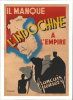
This is a striking 1943 propaganda poster designed by R. Danyach for the Commissariat à l'Information and the Service Géographique Militaire en Afrique of the Free French government-in-exile during World War II. Produced in Algeria, headquarters of the Free French government before the liberation of Paris the following year, the map focuses on resisting Japanese control over Indochina, reflecting concerns that the war would ultimately lead to the end of France's overseas empire.A Closer Look
The sheet is roughly divided in half, with the top including a map of mainland Southeast Asia highlighting French Indochina (Tonkin, Annam, Cochinchine, Laos, Cambodia). At bottom-right is the shadow of a Frenchman wearing the distinctive kepi of French military and police officers (including Charles de Gaulle). He is riding a camel that is being guided by a spear-wielding African, with the clear implication that the White Frenchmen and Black Africans would work together to liberate the colonies from Vichy control. Large text reads: 'Indochina is missing from the empire / Frenchmen, keep this in mind!'Saving the Empire while Liberating France
Although it might seem contradictory from today's perspective, Charles de Gaulle and his associates firmly believed in the importance of preserving France's empire while also fighting to liberate France itself from foreign control. In fact, De Gaulle's earliest victories in recovering France from fascism were in the colonies, particularly in west and central Africa. Through a combination of political maneuvering and military campaigns (effectively a civil war between Vichy and Free French forces, though most of the troops were colonial subjects), de Gaulle had managed to secure all of equatorial Africa for France Libre by the end of November 1940. In doing so, de Gaulle relied heavily on Félix Éboué (1884 - 1944), the French Guyanese-born Governor of Chad, the first Black man to hold such a high post in France's colonies (Chad was the first of France's colonies to swear allegiance to Free France instead of Vichy). A Conseil de défense de l'Empire was organized as an administrative structure for the colonies in late 1940, replaced the following year by the Comité national français, which became France's proper government in exile (as opposed to the earlier patchwork of allegiances and military commands loyal to de Gaulle). Moving on from these successes, Free French forces and British allies fought into southern and eastern Libya and then worked to reoccupy colonies in north Africa following the Allied invasion of Algeria and Morocco (Operation Torch) in November 1942. One of the major Allied coups during the confused early fighting in these weeks was the defection of Admiral François Darlan, based in Algiers, to the Allied / Free French side (Darlan was assassinated shortly afterwards). After its capture, Algiers was made the capital of Free France and became a staging ground for further Allied advances in the Mediterranean.Saving Indochine from Algiers
This work reflects French anxieties about retaining the empire, even while fighting to liberate France itself. Although the history of French Indochina during the Second World War is little known, the area actually played a central role in the development of the conflict in the Pacific. When Japan and China entered into a full-scale war in late 1937, Japan quickly seized most of the major Chinese ports in addition to winning a series of battles on land. In order to continue fighting, Chinese leader Chiang Kai-shek needed to acquire supplies via alternative routes, with French Indochina becoming one of the primary sources, in particular the porous French-leased territory of Guangzhouwan and the Kunming-Haiphong Railway. Although Japan repeatedly pestered the French about cutting off such supplies, France, was both unable and unwilling to do so, having their own concerns about growing Japanese militarism in East Asia.After France was occupied by the Germans in the spring of 1940, Japan took advantage of the unsettled situation and forced French authorities in Tonkin to accept a Japanese occupation in September 1940, though French officials (now aligned with Vichy) still handled day-to-day administration. Foreign powers, particularly the U.S. and Great Britain, already irritated at Japan's war in China, expressed dismay over these developments and increasingly warned Japan of the serious consequences of continued aggression. Consequently, foreign aid from the U.S., U.K., and the Soviet Union to Chiang's government, now based in Chongqing, increased, though the Japanese blockade made supplying Chiang increasingly difficult. Over the following months, Japan negotiated with Vichy to similarly occupy southern Indochina. As tensions with the U.S. mounted in the summer of 1941, tens of thousands of Japanese troops were moved into southern Indochina. (By this time the Soviets were preoccupied with fighting off Germany's invasion.)
By this time, Japan's military commanders had already decided on a course of 'Southern Expansion' to counter what they saw as U.S. confinement of their legitimate ambitions. In particular, the Japanese were keen to seize the Dutch East Indies and British Malaya as sources of oil, rubber, tin, and other essential war materiel. In reaction to Japan's full occupation of Indochina, on August 1, the U.S. (along with the U.K. and the Dutch government-in-exile) responded by freezing Japanese assets and imposing an embargo on oil exports to Japan, effectively starving the empire of fuel. Efforts at negotiations failed and Japan proceeded with its plans to invade Southeast Asia, now adding an invasion of the Philippines and an attack on Pearl Harbor to stave off an American military response.
Despite remaining nominally in control of Indochina, France's role to these larger machinations was marginal. The empire was itself the site of contention throughout the war, as some officials refused to work with Vichy while others did so enthusiastically. Many officials, however, were primarily concerned about retaining French imperial control, regardless of the government in the metropole. Indochine already had an active independence movement before the Second World War, which was only emboldened by the embarrassing defeat of France in 1940. The seemingly inexorable rise of Japan as a new global power lent credence to hopes of a 'Greater East Asia Co-Prosperity Sphere,' where Japan would 'liberate' colonies from their Western masters and shepherd them into modernity. During the war, as economic conditions worsened, the Vietnamese independence movement (Việt Minh) shifted to military campaigns, initially against the French but also against Japanese forces.
A devastating famine in northern Vietnam in 1944-1945 swelled the ranks of the Việt Minh and added impetus to the drive to expel all foreign troops and imperialists. In a bid to appeal to Vietnamese nationalists and oppose de Gaulle's government, now in Paris, Japan moved in March 1945 to end French imperial control and establish independent kingdoms in Indochina under their own aegis. French forces were caught off guard and quickly overrun, with 15,000 taken prisoner and many of the prisoners being executed or dying of starvation in the following months. Meanwhile, the leaders of the Việt Minh, including Ho Chi Minh, established contact with and gained support from the Soviet Union and the U.S., launched a revolution in mid-August, and moved to declare independence immediately at the end of the war (on September 2, before Japan had even officially surrendered). Immediately after Japan's surrender, Chinese troops occupied northern Vietnam and British troops the south (on France's behalf). France regained control of all of Indochina, promising to renounce all claims to leased territories and concessions in China (lost during the war) to secure Chiang's agreement. After a brief period of peace, armed resistance to France continued, with some Japanese troops (still waiting to be repatriated) assisting the French with counter-insurgency and others helping the Việt Minh. Ultimately, France was unable to quell the insurgency and was forced to sign the 1954 Geneva Accords, which ended French control of Indochina and partitioned it into independent states (Laos, Cambodia, North Vietnam, and South Vietnam). Although Japan's occupation was not the sole or even the main cause of Indochine's independence, it likely hastened France's loss of control.
Publication History and Census
This poster was drawn by one R. Danyach, printed by 'Affiches' la Typo. Litho. and J. Carbonel, and published by the Commissariat à l'Information and the Service Géographique Militaire en Afrique (S.G.M.A.) in October 1943 in Algiers. Danyach also produced two other works around the same time on the same theme ('Français... Tu dois Délivrer l'Indochine de l'Hydre Japonaise!' and 'Français, l'Indochine est captive'). The Commissariat à l'Information and the Service Géographique Militaire en Afrique were Free French offices established in liberated territories to help the war effort. The current work is only cataloged among the holdings of the Imperial War Museums in London and the Musée de la Résistance et de la Déportation in Besançon, France, and is scarce to the market.Condition
Very good. Mounted on heavy linen.
References
Imperial War Museums Art.IWM PST 4058. Musée de la Résistance et de la Déportation 979.65.234.