
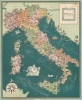
1946 Agostini Pictorial Map of Italy

This item has been sold.
Italia.
Italia Viva.
- Digital Map Information
- Suitable for large format printing
- File Size: 43.27 MB
- File Type: ZIP / TIFF
- ICC color profile embedded
- Delivered instantly via download link
Italia Viva.
A vibrant pictorial map of Italy produced in the wake of World War II. This 1946 maps was drawn by Vsevolode Nicouline and published by Giovanni De Agostini. Its intricate drawings bring to life the local culture, economy, and history of Italy.A Closer Look
Taking in the entire Italian Peninsula plus adjoining islands (Sicily, Sardinia, etc.) and portions of neighboring countries, this richly illustrated pictorial map highlights local characteristics and history. The administrative regions (Regioni) of Italy are shaded for easy distinction. Within the regions, local products, landmarks, and leisure activities are represented, along with references to the dates of important historical events, including battles during the Risorgimento and the First World War. Historical figures also make an appearance, including Thomas Aquinas and the polymath Roger Joseph Boscovich, the latter being one of several symbols and allusions to the Jesuits that appear throughout. These motifs extend to the seas, where ships of various sizes and historical eras appear, along with ornate text in the style of early modern engraved maps.Publication History and Census
Though no publication information is presented, the map appears in the style of those drawn by Vsevolode Nicouline and published by Giovanni de Agostini in the late 1930s and early 1940s, with some features (such as the compass rose and illustration of Poseidon) matching exactly with smaller-scale maps from the work Italia Viva published in 1941. The present map appears to have been published in 1946 by Agostini, in conjunction with the firm Italgeo, with a second edition published in 1960 as part of an advertisement for the food company Motta. We are aware of it appearing on the market only once in recent years, and it is only noted among the institutional holdings of the Library of Congress, Columbia University, and the University of Michigan.Cartographers
Giovanni De Agostini (August 23, 1863 - November 21, 1941) was an Italian cartographer and publisher. In 1901, he founded the Istituto Geografico Italiano del dott. G. De Agostini and C. in Rome. In addition to school atlases, the group published the Calendario Atlante de Agostini, a compact yearbook, calendar, and atlas, which was highly successful. In 1908, the company moved to Novara in Piemonte, in large part to be closer to Germany, from where they sourced their equipment. In 1919, the company was acquired by Marco Boroli and Cesare Rossi and began to expand more rapidly, including the installation of Italy's first rotogravure printing press and the publication of the esteemed Grande Atlante Geografico, though it retained its name and identity. After De Agostini's death, the Istituto geografico and publishing house he had founded continued to use his name. His younger brother, Alberto Maria de Agostini (1883 - 1960) was a Salesian priest and polymath who lived most of his life in Tierra del Fuego and Patagonia, contributing greatly to the geographic and ethnographic knowledge of the region. Giovanni's son, Federico De Agostini (1905 - 1960), began working at the firm in 1927 and was known for his own discoveries in South America as well as several important maps, textbooks, encyclopedias, and murals, including some in Arabic. Another of Agostini's sons, Giovanni De Agostini, Jr., became especially adept at speaking and reading Arabic and was an expert on the history of Islam. In the years after the Second World War, the company retained the name Agostini but was fully taken over by the Boroli family. It diversified into publishing school textbooks, books on art, children's books, encyclopedias, and more. In subsequent decades, it became one of the best known Italian publishing houses and expanded throughout Europe to become a multifaceted international holding company with publishing, cartographic, arts, media, gaming, and asset management subsidiaries. Further Details...
Vsevolode Nicouline (Vsevolod Petrovič Nikulin, Всеволод Петрович Нікулін; November 27, 1890 - July 18, 1968) was a Russian-born Italian artist, illustrator, and set designer. Born in Mykolaiv, Russian Empire (now Ukraine) to an Orthodox priest, he attended the Odessa Art College (now the Grekov Odessa Art School), where he studied with Italian sculptors Luigi Iorini and Giuseppe Mormone, before enrolling at the Imperial Academy of Arts in 1917. The Russian Revolution derailed Nicouline's studies, and he became an officer in the White Russian forces. As the Bolsheviks gained the upper hand, he fled to Constantinople and then to Genoa. Soon afterwards, he began to publish woodcuts that were heavily inspired by Japanese woodblock printing and took on Japanese themes (such as samurai and Japanese folk tales). He then moved on to watercolors and then towards illustrations, focusing on mythologies of various cultures. Later in his career, his illustrations appeared in popular formats, such as fiction, magazines, and children's literature. Further Details...
Condition
Very good. Minor soiling and scuffing to bottom margin. Spotting near title.
References
OCLC 1110675935.