
1890 Fayou Jiming View and Pilgrim's Map of Mianshan, Shanxi Province

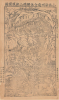

山西汾州府介休縣綿山抱腹巗圖 / [View of Baofu Cliff, Mianshan, Fenzhou Prefecture, Jiexiu County, Shanxi].
Buddhist Pilgrim's Progress.
$3,200.00
Choose a Collection:
- Digital Map Information
- Suitable for large format printing
- Full resolution TIFF file
- ICC color profile embedded
- Delivered instantly via download link
This Item
Enquire
Buddhist Pilgrim's Progress.
A rare and likely unique survival, this is a 1890 Buddhist pilgrim map, drawn and printed by monks, depicting the Yunfeng Temple (雲峰寺) and associated Buddhist and Daoist sites on Mianshan (绵山), Shanxi, China. These ephemeral works provide uncommon insight into the religious life of the late Qing era, much of which has been lost due to China's destructive 20th-century wars and revolutions.A Closer Look
This view, roughly oriented towards the north, covers from the highest religious site on Mianshan, the Moshi Pagoda (摩師塔) at top-left down to the walled county seat of Jiexiu (介休縣) at the base of the mountain, seen in the foreground at left. Just above the city wall of Jiexiu is text describing the distance from the city gate to various temples and other locations on the mountain, essential information for pilgrims aiming to ascend Mianshan. Paths wind through the mountains, leading beneath grand gates, past villages, over bridges, and, as elevation increases, increasingly encountering monasteries, nunneries, and Buddhist and Daoist temples, ultimately ending at the imposing Yunfeng Temple (雲峰寺). This remarkable structure sits within the hollow of a cavernous, crescent-shaped overhang formed by the Baofu Cliff (抱腹巗), so named because the mountain face resembles a giant torso 'holding its belly.' The Yunfeng Temple complex itself features multiple buildings, caves, springs, and other historic sites, but is centered on the encased remains of the Tang Dynasty era monk Tian Zhichao, discussed below and depicted at center-top here.Mianshan, Yunfeng Temple, and Baofu Cliff
Mianshan was an important Daoist site since the Spring and Autumn Period, and developed into a Buddhist site in the mid-7th century early Tang Dynasty. The sizable natural rock overhangs of Baofu Cliff and other nearby cliffs serve as giant built-in umbrellas, shielding the site's multi-tiered wooden structures from the elements and helping explain their longevity. Yunfeng Temple's prominence was established by imperial decree during the Zhenguan (Taizong) reign, anchored by the legendary monk Tian Zhichao (田志超, 571-641 CE), who arrived at Mianshan in 622 CE to propagate the Dharma. Following his death, Emperor Taizong posthumously declared him the 'Empty King Buddha' (空王佛), celebrating him as the first Chinese practitioner to achieve Buddhahood. The temple's historic core houses Tian's mummified remains, encased inside a clay-painted sculpture of the monk (包骨真身), a striking, millennium-old holy relic.The Buddhist footprint extends well beyond Yunfeng Temple itself, with a dizzying network of cliffside sky ladders and wooden plank walkways connecting Baofu Cliff to adjacent springs, caves, and holy sites, including Zhengguo Temple (正果寺), just beyond the scope of this view, which holds arguably the most profound collection of mummified incorruptible Zen masters in China. Together, these vertiginous sanctuaries have transformed the daunting cliffs of Mianshan into an enduring showcase of Chinese Buddhist heritage. Like nearly all historical religious sites in China, the temples, statues, and other structures at Mianshan suffered significant damage during the Cultural Revolution and have had to be reconstructed in recent decades.
Publication History and Census
This woodblock print was based on a drawing by Jiming (極明), a fayou (法友) or 'Friend of the Dharma,' a title indicating either a Buddhist monk or devout lay Buddhist (Jiming's prefix Gutao 古陶 could be a pseudonym or refer to a studio or geographical location, almost certainly local). It was printed by Chief Monk Yuanzhen (經理主僧元珍) and sold by Jinwenzhai (錦文齋), a bookseller and publisher (whose location is uncertain as the first character is difficult to discern, but it could be 并, which is a historical name for Taiyuan). The view was printed in 1890 (Guangxu 16). We are unaware of any other surviving examples of this view; as a pilgrim's guide printed on-site or nearby, this print was highly ephemeral, and its survival is quite extraordinary.Condition
Very good. Even overall toning. Laid down on kozo tissue.