
1984 Steiner / Wick View of the New York City Marathon Route


This item has been sold.
New York City Marathon.
Multimedia Marathon.
Multimedia Marathon.
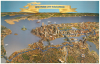
This is a 1984 birds-eye view of the route of the New York City Marathon produced by artist Joan C. Steiner and photographer Walter Wick for the New York Times. Aside from its relevance to the history of the marathon, the 'map' is unusual for being a print of a photograph of a multimedia sculpture rather than an offset lithograph or other common method for producing maps in this era.A Closer Look
The view looks to the west-northwest from the direction of Brooklyn and Queens, taking in portions of both boroughs, as well as a sliver of Staten Island and the Bronx, most of Manhattan, and New Jersey in the distance. The route of the marathon is traced in blue, with both runners and spectators depicted (using clay figures). The attention to detail is remarkable, with local landmarks and individual buildings, such as the Statue of Liberty and the World Trade Center, as well as somewhat lesser-known sites, including the Soldiers and Sailors Memorial Arch in Brooklyn, Sunnyside Yards in Queens, and the Central Park Reservoir, easily distinguishable. Every year, the New York Times commissions a poster for the New York City Marathon, with the present edition being among the more unusual and memorable modes of representing the marathon route.The New York City Marathon
The New York City Marathon, now one of the world's premier long-distance races, began modestly in 1970 when Fred Lebow and the New York Road Runners organized a 26.2-mile course entirely within Central Park (at a time when it had a decidedly worse reputation than now), attracting just 127 entrants and even fewer spectators. Its scope changed dramatically in 1976, during the U.S. Bicentennial, when the race expanded to all five boroughs, showcasing the city's diversity and streetscape while drawing thousands of runners and spectators. Since then, it has followed roughly the same course, beginning in Staten Island at the Verrazano-Narrows Bridge, moving along Fourth Avenue and Bedford Avenue through Brooklyn, across the Pulaski Bridge into Queens, then across the Queensborough Bridge into Manhattan, up First Avenue and into the Bronx across the Willis Avenue Bridge, crossing back into Manhattan via the Madison Avenue Bridge, and then down Fifth Avenue to Central Park, finally ending near Columbus Circle in the southwest corner of the park.In recent decades, the New York City Marathon has grown into the largest marathon in the world, with tens of thousands of participants annually, including elite international athletes, amateurs, and charity runners. It has become a symbol of resilience and community for New York City, notably resuming after crises such as the September 11 attacks, Hurricane Sandy, and the COVID-19 pandemic.
Publication History and Census
This map was issued by the New York Times in 1984, with Walter Wick photographing an elaborate multimedia sculpture by artist Joan Steiner. This work is unrecorded in institutional collections and only occasionally appears on the market.Cartographers
Joan C. Steiner (October 10, 1943 - September 8, 2010) was an American designer, illustrator, and artist based in the New York City area. She was born in New Brunswick, New Jersey and attended Barnard College and then received a graduate degree in philosophy from the University of Chicago. Afterwards, she moved to New York City and began to produce pieces of wearable art and quickly received several awards and presentations of her work in museums and galleries. She then focused on producing the types of work that she was most widely known for, three-dimensional illustrations for books and magazine covers, eventually publishing a series of Look-Alikes books, which were widely acclaimed for their complexity, the result of elaborate and time-consuming work. Steiner was for many years a fixture in the arts and literary scene of Claverack, New York in the Hudson River Valley. Further Details...
Walter Wick (February 23, 1953 - present) is a photographer of meticulously-designed multimedia scenes best known for his popular series of children's books I Spy (with Jean Marzollo) and Can You See What I See?. Wick was born in Hartford, Connecticut and grew up in nearby East Granby. He developed an interest in photography in childhood and studied photojournalism at the Paier College of Art. After graduating, he opened a studio in New York City and began working as a commercial photographer, but later moved on to photo-illustration, producing works for children's books and magazine covers. The first I Spy book was published in 1992 to wide acclaim, wuickly making Wick a leader in the field of photo-illustration. He has since published nearly forty books of his mind-bending images, mostly in the I Spy and Can You See What I See? series, as well as a work of non-fiction titled A Drop of Water: A Book of Science and Wonder (1997). Further Details...
Condition
Excellent.