
1986 Russo Pictorial View of Soho, Manhattan, New York City

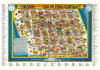
The SoHo (South of Houston) Tour and Poster Guide Map.
The Soho Effect.
The Soho Effect.
This is an unrecorded 1986 David Russo pictorial promotional view of the SoHo neighborhood of Manhattan. It depicts the neighborhood at the peak of its renewal phase, when it established itself as an arts district but had not yet felt the full impact of gentrification.A Closer Look
The map covers the area between Houston Street and Canal Street, bounded on the west by Sixth Avenue (Avenue of the Americas) and on the east by Broadway. Dozens of individual businesses - including restaurants, art galleries, art supply companies, clothing stores, and boutique shops - are labeled, along with several landmarks and public institutions such as parks, libraries, museums, and post offices. Among the clothiers is a Comme des Garçons boutique on Wooster Street, between Prince Street and Spring Street, the first U.S. location of the now celebrated company led by designer Rei Kawakubo. Other businesses present capture the quirkiness of the neighborhood and the cosmopolitanism of New York City, with a notable inclusion being Miriam Mizakura's Shalom Japan Kosher Japanese Supper Club, on Wooster Street near Canal Street, famous for its purported oddball menu items like gefiltefish sushi and campy standup show led by the titular owner (another restaurant by the same name apparently unconnected to the now-closed SoHo restaurant currently operates in Brooklyn).Historical anecdotes are written throughout, such as the locations of Revolutionary War-era forts. A grid surrounds the view, corresponding to a business index that surrounds it. A brief history of SoHo is included in a text box at the bottom left.
Historical Context
The revival of Manhattan's SoHo is one of the most successful urban rebranding campaigns in history, matching but exceeding the wider revival of New York from the 1970s doldrums. For most of its history, the area was known for manufacturing industries, particularly textiles, a legacy which can still be seen in its architecture, including the unique cast-iron facades on many larger buildings. By the 1950s, the area was an industrial wasteland known as the Eighth Ward (its official city designation) or Hell's Hundred Acres, filled with sweatshops but few residents. But in the 1960s, it became known as a haven for artists and bohemians seeking affordable housing. Around the same time, urban planner Chester Rapkin successfully introduced the term SoHo (South of Houston) to help the neighborhood move past its negative image.A large portion of the neighborhood was granted preservation status in 1973 by the New York City Landmarks Preservation Commission when it was dubbed the SoHo-Cast Iron Historic District. Formerly, industrial and commercial buildings were repurposed for residential use, defining the Manhattan 'artist loft' which became desirable for its spaciousness and ample lighting. In the following years, art galleries sprang up, and wealthier residents began moving in. Today, SoHo is home to some of the most expensive real estate in the United States. It saw such a dramatic turnaround that the 'SoHo effect' has become a synonym for the process of industrial decline, followed by bohemian settlement, followed by gentrification.
Publication History and Census
This view was prepared by artist David Anson Russo and New Jersey-based Secret Beach Enterprises, and printed by Surrey Litho, Inc., in 1986 for the ten-year anniversary of the now-defunct local classical music radio station WNCN. This is among Russo's earliest published works and reflects early manifestations of his distinctive style. Unrecorded in institutional collections.Cartographer
David Anson Russo (February 5, 1961 - present) is an American multi-media artist, author, and television producer known blending high-concept interactive art with mainstream commercial success. He first rose to international prominence in the early 1990s for his intricate, dramatic maze designs. This period saw him secure a landmark 11-book contract with Simon and Schuster, including the best-selling The Ultimate Maze Book, as well as deals to design advertisements for major international brands. He was also commissioned by MAD Magazine to create a portrait of Alfred E. Neuman for their 1993 Collector's Edition cover. Russo later transitioned successfully into television, serving as an executive producer and creator for several major television companies, including MTV and Bravo. Today, Russo continues to create commissioned works and performs 'live paintings' at charitable events, using his art to raise significant funds for global causes, while his maze installations continue to tour museums across North America. Further Details...
Condition
Excellent.