
1885 Beard Satirical Political Cartoon, Union Pacific Corruption, Rock Springs Massacre

This item has been sold.
The Scourge of the West.
Epitome of the Gilded Age - Corruption, Monopoly, Xenophobia, Violence.
- Digital Map Information
- Suitable for large format printing
- Full resolution TIFF file
- ICC color profile embedded
- Delivered instantly via download link
Epitome of the Gilded Age - Corruption, Monopoly, Xenophobia, Violence.
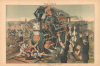
This is an October 1885 Frank Beard satirical political cartoon that appeared in The Judge. It excoriates the Union Pacific Railroad for its perceived corruption, political influence, and exploitation of common folk on the Nebraska and Wyoming frontier through which the railroad ran. The cartoon was produced in the wake of the horrific anti-Chinese Rock Springs Massacre, one of the worst instances of mass violence of the era.A Closer Look
The view depicts a Union Pacific Railroad train (officially the Union Pacific Railway at this time) with a sign on its front reading 'The public be damned!' Atop the locomotive, holding revolvers, is a figure likely meant to be Sidney Dillon, who was not actually the President of the Union Pacific at the time but had been for a decade between 1874 and 1884 and was a key figure in its construction, being implicated in the infamous Crédit Mobilier scandal along the way. Dillon's guns read 'Appropriations,' 'Land Grants,' and 'U.S. Congress' and are held up by a belt reading 'Fraud.' The train pulls a carload of U.S. Army troops, reflecting the public perception that the U.S. government and military would back up the railroad's interests over those of common citizens. Having already run over Justice and Industry, which are caught in the train's cowcatcher, Dillon is now robbing a miner, mechanic, and merchant, while refugees flee towards a ruined factory and mine in the background.An article in the same issue of Judge titled 'Monopoly in the Saddle' spells out criticisms of the railroad. Incidentally, this cartoon was published less than a month after the death of Thomas Durant, one of the most corrupt businessmen in U.S. history, who was the driving force of the Union Pacific in its early years and the primary cause of its notoriety for fraud and financial dishonesty.
Historical Context
Chartered under the Pacific Railway Act of 1862 to build the eastern leg of the First Transcontinental Railroad, the Union Pacific Railroad quickly evolved from a symbol of national ambition into an emblem of Gilded Age corporate corruption. Public trust eroded dramatically during the Crédit Mobilier scandal of 1872, when company insiders created a dummy construction firm to siphon tens of millions of dollars in federal subsidies into their own pockets while bribing key congressmen with discounted shares to stave off government oversight. Coupled with this staggering fraud, Union Pacific drew widespread public fury through predatory monopoly practices, using its near-exclusive control over Western transportation corridors to charge extortionate freight rates, squeeze local farmers and merchants, and manipulate regional economies. Consequently, the railroad was increasingly perceived not as a public good, but as a deceitful corporate juggernaut that exploited public funds, bought political immunity, and prioritized insider profit over the public good.The sad irony of this cartoon is that it came after Dillon had been removed from the company's Presidency (at Congressional urging) and replaced with the respected railroad historian Charles Francis Adams, Jr., who was tasked with cleaning up the railroad's terrible reputation. He had begun to do so but quickly became embroiled in a labor dispute with the Knights of Labor and other labor organizations. The Union Pacific Coal Company, the railroad's mining subsidiary, aggressively recruited Chinese immigrant workers, whom they paid lower wages and used as strikebreakers against White miners.
Combined with the already potent public hatred towards the railroad and general xenophobia towards Chinese, especially among White laborers, the tense situation culminated on September 2, 1885, in the violent tragedy known as the Rock Springs Massacre. When Chinese miners refused to join a localized strike against the Union Pacific Coal Company, an armed mob of White miners invaded Rock Springs' Chinatown, burning over 70 homes to the ground and brutally murdering at least 28 Chinese workers while injuring dozens more. The railroad called in federal troops, not out of concern for the Chinese workers, but to safeguard its coal production and escort surviving Chinese laborers back into the mines under armed guard to continue work. Much of the media reaction of the time either celebrated the violence or at least, as here, viewed its perpetrators as the true victims, having been exploited by the Union Pacific and similar monopolies.
Publication History and Census
This cartoon was drawn by artist Frank Beard, was likely printed by the Franklin Square Lithography Company, and was published as the centerfold of the October 31, 1885, issue of The Judge. It does not appear to be independently cataloged with any institution.Cartographers
Frank Beard (February 6, 1842 - September 28, 1905) was an American artist, illustrator and draughtsman. Born in Cincinnati, Ohio, he began drawing at an early age and was submitting material for publication as young as 12. In the Civil War, Leslie's and Harper's commissioned the 18 -year-old Beard to accompany the Army of the Potomac as a correspondent. After the war he originated the 'chalk talk' - a popular lecture accompanied with rapid illustration - primarily in aid of his methodist wife's temperance lectures. He was for three years the chair for aesthetics and painting at Syracuse University; at the end of this tenure, he became one of the editors for The Judge magazine. Following the 1884 election of Grover Cleveland, he shifted from political humor to education, Sunday school work, and Chautaquas. Beginning in about 1885 he illustrated The Ram's Horn, a Chicago religious weekly; by 1890 he was entirely engaged with work for that magazine. Further Details...
Franklin Square Lithographic (fl. c. 1883 - 1886) was a short-lived New York City lithography firm active in the late 19th century. We have been able to trace just 2 separately-issued pieces with the Franklin Square imprint, though they also printed covers for the satirical weekly Judge. Despite their brief period of operation and limited output, the overall quality of their work, mostly chromolithography, is high. Further Details...
Source
The Judge, Vol. 9 No. 211, Oct. 31, 1885.
Judge (1881 - 1947) was a weekly satirical magazine published in the United States. The first issue was first printed on October 29, 1881 as The Judge and was only sixteen pages long. Judge was launched by James Albert Wales, Frank Tousey, and George H. Jessop, who had previously worked for its rival magazine Puck. In the mid-1880s, William J. Arkell purchased the magazine, which was having difficulty competing with Puck; at this time the magazine's title was shorn of its definite article. Arkell, taking advantage of his considerable wealth, persuaded cartoonists Eugene Zimmermann, Frank Beard, and Bernhard Gillam to leave Puck and join the staff at Judge. As Arkell was a supporter of the Republican Party, Judge soon became a platform for criticizing the Democratic administration of Grover Cleveland, which was blamed for the Panic of 1893, among other issues. With support from the Republican Party, Judge saw a rise in popularity during the 1880s and 90s, surpassing Puck in both content and circulation. Judge also widely supported the candidacy of William McKinley, largely through the work of cartoonists Victor Gillam and Grant E. Hamilton. Judge reached its peak circulation of around 100,000 by 1912. One of its former editors, Harold Ross, used his experience at the magazine to launch his own publication, The New Yorker in 1925, which quickly began to compete with Judge. Due to the success of The New Yorker and the Great Depression, Judge became a monthly is 1932 and ceased circulation in 1947.
Condition
Good. Centerfold split, repaired and stabilized.