
1647 Johannes Hevelius Selenographia, Bound with Eclipse Observations

This item has been sold.
Selenographia: sive lunae descriptio; atque Accurata, Tam Macularum eius, addita est, lentes expoliendi nova ratio (with) Observatio eclipseos solaris Gedani, anno aerae Christianae 1652, die 8. Aprilis (and) Eclipsis Solis observata Gedani Anno á nato Christo 1649, die 4, Novembris, st. Greg. Johanne Hevelio.
A Monument of Renaissance Astronomy
A Monument of Renaissance Astronomy
A masterpiece of 17th-century scientific engraving and publishing: This is the first edition of Johannes Hevelius' magnificent 1647 Selenographia. This is the first lunar atlas and one of the finest scientific books of the 17th century, in a beautiful example bound with two rare, printed letters regarding Hevelius' observations of the eclipses of November 4, 1649, and April 8, 1652.A Closer Look
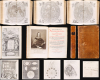
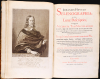
The work is a visual as well as an intellectual feast, with 113 engraved plates and 26 engravings within the text - most of which were engraved by Hevelius himself. (The beautifully executed engraved title, with its portraits of Alhazen and Galileo, was engraved by Jeremias Falck after Adolf Boÿ). The work was thunderously authoritative on its publication and was widely acclaimed. Moreover, Hevelius' lunar mapping would remain so:The value of the book may be judged, however, not so much by the praise of Hevelius' contemporaries, as by the fact that, even in that time of rapid development in astronomy, his lunar maps remained the best for more than 100 years. (Brigham Young University, Johannes Hevelius... pp. 15-18).
Scope
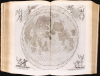
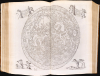
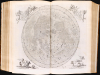
Hevelius' work was necessarily broad, providing his readers with not only his own observations but his methodology. The first chapters address his method for producing high-quality lenses and the instruments necessary to repeat his observations; some of the finest engravings in the book depict his lens-grinding machines, telescopes, and camerae obscurae. Hevelius' most magnificent plates are the three two-page lunar maps embellished with a mob of putti in the finest baroque tradition. These present both representations of the moon as it meets the eye, and representations with the lunar mountains and seas. The work includes a gazetteer of new names for lunar features. A full 40 plates chronicle the phases of the moon at various points between 1643 and 1644.His groundbreaking studies included lunar motion and a discussion of the Solar System overall. He compares competing theories regarding the Solar System's formation, and in doing so incorporates his visual observations of Jupiter, Saturn, and Mars. His discussions of Solar and Lunar eclipses are supported with illustrative plates.
The appendices of Selenographia include the other great bodies of the Solar System. Heliographicas aliquot annorum observationes addresses the Sun, studying the motion of sunspots across its surface; 13 double-sided leaves track visible changes of the face of the Sun over a period of years. Orbis Jovialis records Hevelius' observations of Jupiter and its four (then-identified) moons.
An Updated Volume
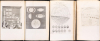
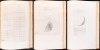
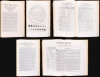
Selenographia was published in 1647: Hevelius' Ad Lectorem was dated May 9 of that year, and of the plates listed in the book's contents, the most recent observations appeared in plate QQQ observing the transit of Jupiter on April 12. Our example includes a further plate RRR, recording a further transit of Jupiter dated June 6, 1647. This plate is not present in most copies of the book, but was occasionally included as an update to the work.This copy is further enriched with two rare, separately illustrated letters: one to mathematics professors Petro Gassendo and Ismaeli Bullialdo, on the solar eclipse of April 8, 1652, and one to Laurentius Eichstädt, Professor of Mathematics at Danzig, on the solar eclipse of November 4, 1649. Both of these letters include engraved plates and tables. Both of the letters and the above-mentioned plate RRR were printed to the same watermarked paper, cut to the same size, and were probably printed together and bound into the book at the same time.
Publication History and Census
Johannes Hevelius published this work himself in 1647. He imported Dutch artisans to Danzig in order to complete the engraving and typesetting. It was printed by Andreas Hünefeld. The additional matter discussed above was probably printed together in 1652, and may have been added to the book at that time, or may have been included in a later rebinding. Selenographia was a popular and successful work, and is well-represented in institutional collections: Sammelband examples such as this are more unusual, and while we see such copies with one or another of these letters appended, the appearance of both is rare. Overall, this is a remarkable example, with no plates in facsimile, and its volvelle is complete and genuine.Cartographer
Johannes Hevelius (January 28, 1611 - January 28, 1687) was a Polish politician, brewer, and astronomer. Hevelius was born into a prominent Danzig brewing family of Bohemian origins. Supported by Jopenbier fortunes Hevelius received an excellent education at the hands astronomer and polymath Peter Cruger. Following his primary education Hevelius moved to Leiden where he studied law and befriended such luminaries as Pierre Gassendi, Marin Marsenne, and Athanasius Kircher. On his return to Danzig he married his neighbor Katharine Rebeschke. Hevelius had a lifelong interest in politics, which, along with his family name, eventually earned him a number of important positions including councilor and mayor of Danzig. Nonetheless, his most significant achievements were in astronomy. Hevelius is considered 'the founder of lunar topography'. His important book, Selenographia, sive Lunae descriptio laid the foundations for lunar cartography that are still in general use today. Hevelius established the conventions of naming lunar landforms after terrestrial features such as seas and political regions. He also formalized the idea of presenting the moon from a singular temporal perspective - in his case, the morning, though modern lunar maps tend to use evening light. In addition to his lunar work, Hevelius named a number of constellations that are still recognized today - including the sextant. Though known to have owned the world's largest tubular telescope, a monster of some 45 meters, Hevelius did most of his astronomical observations with a sextant and, as such, is considered one of the last astronomers to work without a telescope. His second wife, Elisabeth Koopmann, assisted in much of Hevelius' research and published two of Hevelius' astronomical texts after Hevelius' 1687 death. She is considered the world's first female astronomer. Further Details...
Condition
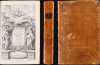
Excellent. Folio (14 x 9.25 inches, 23 x 36 cm). 19th century calf, re-backed. Contents complete, minor soiling but overall remarkably clean. Half-title, engraved frontispiece by Jeremias Falck after Adolf Boÿ, engraved portrait of Hevelius, title printed in red and black, 563 pp, 110 engraved plates on 90 leaves 20 printed recto and verso, 3 double-page folding, plate 21 complete with volvelle and string, with additional plate RRR inserted after QQQ. 26 illustrations in text. Bound with Observatio eclipseos solaris Gedani, anno aerae Christianae 1652, die 8. Aprilis... (Danzig) 1652. 8 unnumbered pages with engraved plate and table, and Eclipsis Solis Observata Gedani... (Danzig) 1649. 1 page text, two-page table and engraved plate.
References
OCLC,36218413 ,25083228, 1042383053. Brigham Young University Press, Johannes Hevelius and his Catalog of Stars #1. Brown, J. W., Astronomical Atlases, Maps and Charts; An Historical and General Guide. #124.