
1945 China Edition Newsmap Map of Shanghai, China, End of World War II


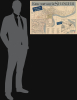
Know Your Way in Shanghai / China Edition Newsmap for U.S. Forces in China 19 Nov. 1945, Vol. 1, No. 1.
America's Postwar Quasi-Occupation of China.
$1,200.00
Choose a Collection:
- Digital Map Information
- Suitable for large format printing
- File Size: 34.79 MB
- File Type: ZIP / TIFF
- ICC color profile embedded
- Delivered instantly via download link
This Item
Enquire
America's Postwar Quasi-Occupation of China.
This is a scarce 1945 Newsmap of Shanghai, China, issued to U.S. forces sent to the city in the wake of Japan's surrender in World War II (1939 - 1945). The U.S. servicemen (Marines, primarily) were sent to disarm Japanese troops and repatriate Japanese civilians, but instead were caught up in China's descent into civil war.A Closer Look
The sheet includes three maps. The primary map covers the central portion of the Greater Shanghai Municipality, which includes the former International Settlement and French Concession, eliminated during the war by Japan to boost the lagging credibility of Wang Jingwei's collaborationist government. Roads and railways are traced, with major roads shaded yellow. An area traced in red, the absolute center of the city between the Recreation Grounds/Race Track (now People's Park) and the Bund, is presented in more detail in the inset at the bottom-left.On both the main map and inset, circled numbers in red ink correspond to an index at the bottom, pointing out hotels, clubs, shops and services for American troops, and military facilities such as the Marines Barracks (number 29). Another inset at the bottom-right presents the area around Shanghai nearly to Suzhou, including Kunshan, Jiading (Chia Ting), Songjiang (Sung Chiang), and Jiaxing (Chia Hsing).
Send in the Marines
This map was the product of a significant but little-known period in the immediate aftermath of World War II, when U.S. forces were dispatched to Chinese port cities to oversee the surrender and repatriation of Japanese troops, known as Operation Beleaguer. The operation's main contingent was the Marines' III Amphibious Corps based in northern China, particularly at Tianjin (Tientsin) and Qingdao (Tsingtao); at this time, Qingdao also served as the headquarters of the U.S. Navy's Seventh Fleet. Just as important as accepting the surrender of Japanese troops, the U.S. forces meant to facilitate the transfer (return) of power to the Chinese national government, previously based in Nanjing but temporarily relocated to Chongqing during the war. Although American military and diplomatic figures were often exasperated with China's quasi-dictator and 'generalissimo' Chiang Kai-shek, there was also concern in the U.S. about any potential moves by the growing Chinese Communist movement, which had become considerably more powerful during the war from its remote base in Yan'an. Although initially intended only to handle the Japanese surrender and repatriation, which was completed by mid-1946, the Marines did not depart China until mid-1947, and some remained until 1949. In the meantime, they increasingly became the target of Chinese Communist propaganda and even some ambushes and small-scale skirmishes.Still, for the Marines sent to China (including the recently deceased actor Gene Hackman), it was a welcome assignment as prior to Japan's surrender they were preparing for an amphibious assault on the Japanese Home Islands (Operation Downfall), which would have likely seen them suffer staggering casualties. Instead, they spent much of their time getting drunk and cavorting with prostitutes and 'Jeep girls,' similar to U.S. forces occupying Japan, though without the same backdrop of bombed-out cities. The fact that the U.S. and China had been wartime allies also gave the presence of U.S. troops in Chinese coastal cities a different valence than in Japan. Still, there were issues of racial tensions, prostitution, black markets, and violence which had characterized the treaty ports in China before World War II, and which would become common in Asian countries (the Philippines, South Korea, South Vietnam, the Republic of China/Taiwan, Thailand) hosting U.S. troops in the Cold War period.
Shanghai's role in all this was somewhat complicated as it was a part of Operation Beleaguer but was also a major transit point for U.S. military forces and home to a U.S. garrison tasked with protecting U.S. consular staff and civilians. We can imagine that the present map was more likely than not given to a U.S. Marine of the III Amphibious Corps passing through Shanghai before leaving for an assignment further north in Hebei or Shandong.
Publication History and Census
Although not indicated, this map was likely prepared by the U.S. Army Information Branch, which issued Newsmaps for internal training and information purposes between 1942 and 1946. Although wartime Newsmaps are not uncommon on the market, this is the first time we have encountered a 'China Edition' Newsmap. The present map was the first number of the first volume of the 'China Edition' and may have been the only such map ever produced. It is only cataloged among the institutional holdings of the Hong Kong University of Science and Technology and is very scarce to the market.Condition
Very good. Slight wear on old fold lines.
References
OCLC 1200305952.