
1795 Wadstrom Map of Sierra Leone (Slave Trade, Abolitionalist Colonialism)


This item has been sold.
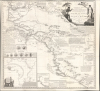
Nautical Map Intended for the use of Colonial Undertakings on the W. Coast of Africa from Lat. 5°.30' to Lat. 14°.N. but more particularly those of Sierra Leona and the Island of Bulama. Respectfully Dedicated to the Humane and disinterested Promoters of those and similar Establishments by C. B. Wadstrom.
18th-century 'abolitionist colonialism' in West Africa.
- Digital Map Information
- Suitable for large format printing
- Full resolution TIFF file
- ICC color profile embedded
- Delivered instantly via download link
18th-century 'abolitionist colonialism' in West Africa.
This is Swedish-British abolitionist Carl Bernhard Wadström's extraordinary 1795 map of Sierra Leone and the Upper Guinea Coast, extending from modern-day Senegal and The Gambia through Guinea-Bissau, Guinea, and Sierra Leone to northern Liberia. Rich in geographical, ethnographic, and commercial detail, the map promotes Wadström's ambitious scheme to transform one of West Africa's principal slave-trading regions into an abolitionist mercantile empire founded on agriculture, natural resources, free labor, and so-called 'legitimate commerce.' More than a map, it is a manifesto on Enlightenment abolitionism, experimental colonization, African exploration, and the effort to replace the Atlantic slave trade with a new - yet still deeply imperial and paternalistic - commercial order.A Closer Look
Coverage extends along the West African coast from the Saloum River in modern-day Senegal, southward past the Gambia River to Cape Mesurado, the site of present-day Monrovia, Liberia. It thus encompasses the coasts of modern Senegal, The Gambia, Guinea-Bissau, Guinea, Sierra Leone, and northern Liberia. It extends as far inland as 'Teemboo' (Teembo, Timbo - highlighted town plan in inset), an ancient town and former capital of the Foulah kingdom of Futa Jallon in the central highlands of present-day Guinea, West Africa.The whole is copiously annotated, with a strong focus on the 'Foulah' (Fulani/Fulbe) and their wide trade networks. The Fulbe, as they are most commonly known today, were a populous Muslim nation on whom Wadström hinged many of his hopes for transitioning the region from an active supplier to the salve trade to a mercantile colony based on agriculture and natural resources - even though the Fulbe were active participants (and sometimes victims) of the slave trade.
Of special note is the meticulously illustrated inland trade route extending from the Rio Nuñez (Kakandé) in modern-day Guinea to the Foulah capital of 'Teemboo' (Teembo, Timbo), and back to the coast through Mandingo (Mandé, Mandinka) and Susoo (Soso, Susu, Soussou) country. The inland town of Teemboo features a detailed inset map, showing streets, property divisions, and individual homes, with 9 specific locations named - following the journal of 'Mr. Watt' (James Watt, Sierra Leone Company agent and explorer) and 'Mr. Winterbottom' (Thomas Masterman Winterbottom, the colony's physician and natural historian). The route, for all that it historically carried slaves from inland raids and wars to the coast for the Atlantic Triangle Trade, Wadström argued was key to transitioning Sierra Leone to agricultural and mineral commerce.
Along the coast are detailed soundings and nautical instructions drawn from the best sources of the period - many of whom were themselves slave traders.
Wadström and Abolitionist Colonization
The map was issued to support and explain Wadström's argument that the Atlantic slave trade could be defeated on economic grounds. West Africa, he maintained, could trade agricultural products - cotton, coffee, sugar, rice, indigo, timber, and other commodities - with Europe without exporting its people. Africans, he argued, were fully capable of commerce and improvement, while slave labor was inefficient, destructive, and morally indefensible. Influenced especially by Adam Smith, Wadström opposed monopolistic trading companies and advocated free trade, private property, voluntary labor, agricultural education, religious tolerance, and colonial self-government; that is to say, colonies should be treated as allied communities rather than conquered dependencies.Wadström's ideas were particularly influential because they supported and closely paralleled the objectives proclaimed by the Sierra Leone Company, which sought to make Freetown a practical demonstration that 'legitimate commerce' and free labor could replace the slave trade. His recommendations helped supply the intellectual and economic justification for Sierra Leone as an abolitionist experiment: a settlement of formerly enslaved people that could support itself through agriculture and peaceful commerce while encouraging the decline of the coastal African slave trade.
Despite the Sierra Leone Company's embrace of Wadström's ideas, Wadström himself was critical of the organization, particularly in his distrust of monopoly control - the very structure upon which the Sierra Leone Company depended- and envisioned greater independence than the company was prepared to grant its Black settlers.
The map is nonetheless one of the most elaborate statements of late-18th-century 'abolitionist colonization.' It marks a transitional moment when humanitarian antislavery, evangelical Christianity, Enlightenment political economy, and European imperial expansion became entangled. Wadström rejected slavery and challenged theories of inherent African inferiority, yet his program remained paternalistic: it assumed that Europeans should 'civilize' African societies according to European standards. His work thus anticipated both Sierra Leone's historic role as a base for suppressing the slave trade and the contradictions that would characterize 19th-century humanitarian imperialism.
Nor was Wadström's influence limited to Europe and Africa. Copies of his essays quickly made their way to the United States, reaching reform circles almost immediately after publication. Still, his greatest influence came later, through the American Colonization Society, founded in 1816, and its attempt to establish Liberia. The Society consulted the Essay, called Wadström an especially capable authority on Africa, and drew upon his descriptions of Sierra Leone to argue that a comparable colony could be established farther south. 19th-century American colonization pamphlets repeatedly cited his account for the geography, climate, settlement history, and failures of early Sierra Leone.
Publication History and Census
This map was published in London by Carl B. Wadström in 1795. It was later reissued in a much-simplified form, with the many interesting and informative annotations removed, by Captain Philip Beaver for his 1805 Africa Memoranda. This map is rare. We see multiple examples of the 1805 Beaver edition, but no examples of this 1795 first edition, which, with its extensive annotative text, is a completely different map despite sharing the same scope and title.Cartographer
Carl Bernhard Wadström (C. B. Wadstrom; April 19, 1746 - April 6, 1799) was a Swedish engineer, industrialist, economist, artist, cartographer, religious visionary, and one of the most influential continental participants in the British and French abolitionist movements. Born in Stockholm and trained in mining and surveying at Uppsala, he entered the Swedish Board of Mines, worked under the metallurgist Sven Rinman, and pursued an energetic career in engineering, manufacturing, and industrial reform. His abolitionism arose partly from the mystical theology of Emanuel Swedenborg, who taught that Africans possessed a distinctive capacity for inward spiritual enlightenment and preserved an uncorrupted apprehension of divine truth. Inspired by these ideas, Wadström established a society at Norrköping in 1779 devoted to replacing the slave trade with agricultural commerce and, in 1786, co-founded the Exegetical and Philanthropic Society, which sought to translate Swedenborgian principles into social reform. In 1787, King Gustav III placed Wadström at the head of an expedition to Guinea intended to identify a location for a Swedish commercial and philanthropic settlement; accompanied by Anders Sparrman and Carl Axel Arrhenius, he traveled through Senegal and Gorée, where his firsthand observation of the slave trade hardened his opposition to it. Settling in England in 1788, Wadström joined Thomas Clarkson, Granville Sharp, and William Wilberforce, supplied evidence used in parliamentary debates, and testified before the Privy Council and House of Commons between 1789 and 1791. He was baptized into London's Swedenborgian New Jerusalem Church on Christmas Day 1788 and joined other Swedenborgians in endorsing A Plan for a Free Community upon the Coast of Africa (1789), a proposed constitution - probably written principally by August Nordenskjöld - for an experimental Sierra Leone settlement protected by Britain but independent of European law and government. Envisioned as a self-governing society without masters or slaves, the colony was to unite religious regeneration, free labor, agriculture, education, and equitable commerce. However, its program remained shaped by the paternalism and colonial assumptions of its age. Wadström publicized the brutality he had witnessed in Observations on the Slave Trade (1789), influential engravings of slave ships, and his major two-volume Essay on Colonization, Particularly Applied to the Western Coast of Africa (1794-95), which combined maps, illustrations, moral argument, and political economy to contend that Africans were more valuable as free producers and trading partners than as enslaved laborers. After moving to Paris in 1795, he urged revolutionary France to cooperate with Britain in abolishing slavery, became a leading member of Les Amis des Noirs et des Colonies, received honorary French citizenship, and convened an international conference on colonial reform shortly before his death at Versailles in 1799, after which he was honored with a French state funeral. Further Details...
Source
Wadstrom, C. B., An Essay on Colonization, Particularly Applied to the Western Coast of Africa, with some free thoughts on Cultivation and Commerce..., (London: Darton and Harvey) 1794-95.
Condition
Excellent. Original fold lines, a few minor verso stabilizations along fold lines, primarily at margins.
References
Afriterra, #458.