
1949 Soviet Propaganda View of Russia / Ukraine: Stalin's Reorganization of Nature

This item has been sold.
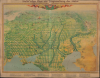
Stalin'scher Plan zur Umgestaltung der Natur. [Stalin's Plan for the Reorganization of Nature.]
Stalin's plan for continental-level terraforming.
- Digital Map Information
- Suitable for large format printing
- Full resolution TIFF file
- ICC color profile embedded
- Delivered instantly via download link
Stalin's plan for continental-level terraforming.
An extraordinary discovery, this is the only known surviving example of a 1949 bird's-eye view of the Ukraine, Russia, and the Caucasus, published to illustrate Stalin's grandiose plan to terraform the Soviet steppe. This view is a cartographic amalgam of Cold War environmentalism, propaganda, scientific ambition, Soviet dogma, and large-scale terraforming.Stalin's Great Plan for the Reorganization of Nature
On October 20, 1948, Stalin and his Council of Ministers introduced a bold new plan known as the 'Great Plan for the Reorganization of Nature' (Великий план преобразования природы). The plan emerged from the need to rebuild after the devastation of World War II (1939 - 1945) and from attempts to address recurring agricultural famines. Stalin promoted the idea that socialism could not merely adapt to nature but actively reshape it on a continental scale. The expansive plan, as illustrated here, encompassed approximately 120,000 hectares and a total length of over 5,300 km, essentially the breadbasket of the Soviet Empire, including western Russia, the Ukraine, the Caucasus, and eastern Belarus. It proposed a full terrforming of the region that included a regular grid system of irrigated fields surrounded by extensive 'shelterbelt' forests. Such a system, it was believed, would prevent drought, increase agricultural productivity, and ultimately cultivate a milder climate for the famously harsh steppelands.The 'Great Plan' can also be understood within the context of the values of Bolshevist-style socialism. Stalin maintained an ideological conviction that socialism could conquer and reshape even nature. The Bolshevik academician Sukachev wrote in 1950,
The grandeur of the socialist system of society's relationship with nature, a vivid expression of which is the plan for shelterbelt afforestation, becomes especially evident against the backdrop of the unrestrained plunder of natural resources and the systematic destruction of the foundation of fertility—the soil—in capitalist countries. <..> The current state of US agriculture is the clearest confirmation of Marx's thesis. In a short historical period, as a result of the predatory organization of agricultural production in the US, vast areas of previously cultivated and fertile land have been completely destroyed for agriculture.As such, the project was heavily propagandized throughout the Soviet Union. There were multiple posters and countless news articles on the topic, though all were exceedingly ephemeral and few survive today. The project as a whole is today little known outside of the Soviet Union.
Although the plan, as presented here, never fully materialized, significant work on it continued until Stalin's death in 1953, after which funding was cut and the existing work abandoned. Nonetheless, some elements of the plan, such as protective afforestation, remain ongoing on a less ambitious scale. Compared to later Soviet megaprojects (such as the diversion of Siberian rivers or the Aral Sea disaster), the Great Plan for the Transformation of Nature is regarded as one of the more environmentally constructive Soviet interventions.
Publication History and Census
This map was drawn by the Russian artist Boris Alexandrovich Mukhin (Борис Александрович Мухин) and printed in post-war East Berlin. We see no other surviving examples of this map with Latin text. We note a single surviving example in Cyrillic located in Russia.Cartographers
Boris Alexandrovich Mukhin (Борис Александрович Мухин; 1888 - 1979) was a Russian and Soviet painter, graphic artist, illustrator, poster designer, and teacher. Mukhin was born in Moscow in 1888, the son of a railway employee. He studied at the prestigious Stroganov Central School of Industrial Art, where he trained under the Polish architect and artist Stanisław Noakowski. He later taught at the same institution. From about 1911 onward, he worked in multiple artistic fields, including book illustration, decorative art, watercolor, graphic design, and poster art. Mukhin exhibited from before the Revolution and later became particularly known for Soviet posters and graphic work. After World War II (1939 - 1945), his work focused on political posters celebrating Stalin and the Communist Party's achievements. Further Details...
Greif Graphischer Grossbetrieb (fl. c. 1945 - 1956) was a state-owned printing concern in Soviet-occupied East Berlin after World War II (1939 - 1945). The firm was founded as an amalgam of formerly private presses consolidated under state control. The name, Greif (Griffen), was likely inherited from an earlier firm. It operated until about 1956, but possibly as late as the 1970s, and is best known for Soviet propaganda posters and related material. Further Details...
Condition
Good. Overall toning. Restoration to edge tears, some extending into the map. Foxing upper left.