
1813 Thompson Broadside of the Battle of Vitoria, Spain, Napoleonic Wars

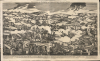

Field Marshal the Marquis of Wellington's Victory of Vittoria.
Uniquely British Cheap Print: Earliest printed representation of Wellington's victory at the Battle of Vitoria.
- Digital Map Information
- Suitable for large format printing
- Full resolution TIFF file
- ICC color profile embedded
- Delivered instantly via download link
Uniquely British Cheap Print: Earliest printed representation of Wellington's victory at the Battle of Vitoria.
The only known surviving example of this large-format woodcut 'cheap print' issued by George Thompson in 1813, celebrating the Duke of Wellington's stunning triumph over French forces at the Battle of Vitoria (June 21, 1813), a decisive battle in the years-long Peninsular War (1808 - 1814). It is likely the earliest printed representation of the battle, being a news-as-it-happened publication. The victory helped to solidify Wellington's stature as the ablest British commander of land forces, earning him the rank of field marshal and later the title of Duke. The 'cheap print' is a uniquely British form of graphic news publishing issued for distribution among the uneducated but engaged populace.A Closer Look
The view presents a panorama of the battle, likely based on written descriptions, as other visual representations of the battle are later. The chaotic scene, filled with smoke, soldiers, and war materiel, signifies the rout of French forces at Vitoria (Vittoria) at the hands of Wellington, on horseback at center-left, giving orders to his aides de camp, including the Prince of Orange (future King William II of the Netherlands, r. 1840 - 1849). Letters corresponding to indexes at bottom label important individuals, units, locations, and events. The foreground is filled with captured French artillery, ammunition, supplies, and war booty, which was as significant to the French expulsion from Iberia as the shocking Allied attack itself.'Cheap Prints'
George Thompson specialized in a uniquely British genre of popular, ephemeral works known as 'cheap prints.' Essentially street broadsides, cheap prints were crudely engraved on low-quality paper in response to public interest in current events. Sometimes they were folded and bound as 'chapbooks.' As a result of their ephemeral nature, cheap prints have a very low survival rate. As ephemeral broadsides, these works often had a satirical or even subversive tone, though they could also be patriotic (as here), didactic (emphasizing moral instruction), or contain popular poetry or ballads.The Battle of Vitoria
Fought on June 21, 1813, the Battle of Vitoria served as a decisive battle in the Peninsular War (1808 - 1814), effectively shattering French hegemony in Iberia. Leading a multinational coalition of British, Portuguese, and Spanish forces, Arthur Wellesley (1769 - 1852) executed a brilliant multi-pronged assault that caught King Joseph Bonaparte and Marshal Jean-Baptiste Jourdan entirely off guard. The resulting allied victory was absolute; the French army collapsed into a chaotic retreat, abandoning over 150 artillery pieces and a massive convoy of looted imperial baggage. This resounding defeat permanently broke the spine of French occupation in Spain, which had been under pressure from Spanish insurgents and Anglo-Portuguese armies, forcing Napoleon's forces to retreat across the Pyrenees and fundamentally shifting the balance of power in Western Europe.For the future Duke of Wellington (a Marquis at the time of the battle), Vitoria was the crowning achievement that cemented his status as one of the era's premier military strategists and British national heroes. The triumph demonstrated his masterful grasp of offensive maneuvers and theater-wide logistics, silencing domestic critics who had previously dismissed him as a merely cautious, defensive general. In recognition of this tactical prowess, the Prince Regent promoted Wellesley to the rank of Field Marshal (retroactively applied to him in this print), while his skyrocketing prestige granted him immense political leverage among the Allied powers, setting him up for later ambassadorial and parliamentary posts.
Wellington's victory at Vitoria coincided with other setbacks for Napoleon, namely the concurrent fallout from Napoleon's disastrous 1812 invasion of Russia and the 1813 German Campaign (part of the larger War of the Sixth Coalition), which expelled the French from Central Europe and set the stage for the establishment of the German Confederation in 1815. These setbacks for the Emperor, celebrated in Beethoven's contemporary piece 'Wellingtons Sieg oder die Schlacht bei Vittoria,' set the stage for the Allied occupation of France and Napoleon's first abdication in 1814 (often overshadowed by his stunning comeback during the Hundred Days of 1815 and ultimate defeat at Waterloo at the hands of the Duke of Wellington).
Publication History and Census
This print was issued by George Thompson on August 11, 1813, making it among the earliest, if not the earliest, popular print of the battle. It is, to our knowledge, the only surviving example of this print. The British Museum holds some contemporary works relating to the Battle of Vitoria, such as the aquatint print 'The Battle of Vittoria, June 21st 1813.' issued by Thomas Sutherland (Museum No. 1872,0608.192), but these do not match the scale of the present work.Cartographer
George Thompson (June 17, 1758 – February 15, 1826) was a British stationer, printer, and map publisher active in London in the late 18th and early 19th century. Thompson was born in London, the son of a butcher. He apprenticed with William Morgan of the Stationers Guild in 1773. Thompson specialized in ephemeral 'cheap prints' relating to current events and produced few maps, all of which were separately issued broadsides. Around 1798 – 1799 he appears to have issued a series of large format broadside maps of the world and continents. All George Thompson maps are extremely rare today. Thompson was succeeded by his son, George Nathaniel Thompson, after his death in 1834. Although Thompson published few maps, the size of his fortune at death, nearly 70,000 GPB suggests that he was a highly successful printer and stationer. Further Details...
Condition
Very good. Edge wear. Lower left corner expertly reattached.