
1885 Ilyin City Plan of St. Petersburg, Russia

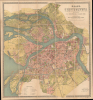

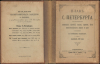
Планъ С. Петербурга составленный по новѣйшимъ свѣденіямъ [План С. Петербурга составленный по новейшим сведениям] / [Plan of St. Petersburg, Compiled Based on the Latest Information].
Venice of the North.
- Digital Map Information
- Suitable for large format printing
- Full resolution TIFF file
- ICC color profile embedded
- Delivered instantly via download link
Venice of the North.
This is a c. 1885 chromolithographed folding Russian-language city plan of St. Petersburg, Russia, published by the prolific cartographic establishment of Alexey Ilyin. It captures the imperial capital as it underwent a rebirth, growing into the fifth-largest city in Europe, with modern infrastructure, amenities, and industries.A Closer Look
This handsome map covers the city of St. Petersburg and its immediate hinterland, with developed areas shaded red, and large and important individual buildings illustrated and filled in with a darker shade of red. Meanwhile, undeveloped areas on the edge of the city are shaded green, with parks and cultivated areas in a darker green. Horsecar routes are traced with dashed blue lines. Indeed, the subtitle given on the map's cover emphasizes the inclusion of state buildings, gardens, parks, and the horsecar network, which, along with the map's folding format, suggest an intended use in urban navigation.The city's various districts are labeled in larger text and subdivided by numbered sections. The map reveals why St. Petersburg's nickname as 'the Venice of the North' is warranted, as the city is crisscrossed by branches of the Rivers Neva, canals, bridges, and ferry crossings (traced here with the label Перевоз). Imperial palaces, gardens, churches, military installations, railway stations, and other major institutions are labelled throughout, including the Winter Palace (Зимний дворец), the Peter and Paul Fortress to its north across the Neva with the adjacent Kronverk (Кронверк) Fortress, and the Semenovsky Platz (Семеновский Плац) military drill grounds, where Dostoevsky (discussed more below) was nearly executed as a young man for his revolutionary political activities.
A diagram of fire alarm signals (Пожарн : Сигналы) appears at bottom-left. This clever system, similar in a way to Morse Code, assigned different districts of the city a distinct arrangement of leather balls (or lanterns at night) which could be hung from watchtowers (kalancha, Каланча) attached to local fire stations. These signals would be relayed so that watchtowers throughout the city could share the message of where a fire had broken out. Although known for its grand stone palaces, most of St. Petersburg was still made of wood and prone to fire, making the coordination of fire brigades essential infrastructure, explaining its inclusion here. One of the kalancha fire towers can still be seen today at the B.I. Konchaev Fire-Technical Exhibition (i.e. Firefighting Museum) on Vasilyevsky Island.
Historical Context
This map was produced when St. Petersburg was growing rapidly, becoming the fifth-largest city in Europe around this time, after London, Paris, Vienna, and Berlin. Following the Emancipation of the Serfs in 1861, a tidal wave of rural migrants flooded the city in search of work, causing the population to more than double from roughly 540,000 in the 1860s to over 1.2 million by 1900. This demographic explosion was fueled by intense industrialization; the city's outskirts became a ring of smoke and iron, dominated by large enterprises, vast textile mills, huge rail yards, and industrial facilities, such as the kerosene storage tanks (Склады Керосин) and brick factory (Кирпичный Зав.) seen at bottom-right. Industrialization produced the relatively small but highly active Russian proletariat that would become the core of revolutionary activity in the following decades.Trappings of the best of modernity were present, including running water and gas lighting. Nevsky Prospect was illuminated by its first electric arc lamps in 1883, and the first telephone exchange opened in 1882. However, beneath this veneer of progress, the city struggled to cope with its own success. The Konka (Конка, horse-drawn tram) network was perpetually overcrowded, and despite some experimentation with electric trams, horsecars remained the main means of mass transit until 1907. Most problematic, especially given the city's low elevation and marshy terrain, the lack of a modern, unified sewage system meant that cholera remained a persistent threat. This era of St. Petersburg was defined by a jarring contrast between the electric-lit grandeur of the aristocratic center and the squalid, overcrowded tenements of the industrial periphery.
Russia's literary giants of the 19th century, particularly Dostoevsky (1821 - 1881), struggled with this emerging metropolis. Dostoevsky was attracted to Petersburg as a young man and became involved in its literary and political circles, but in time he came to regard the city as a decadent, nightmarish, sickly, sweltering urban labyrinth, driving his characters toward madness or spiritual crisis through its sheer claustrophobia and moral decay. Its bureaucratic, rational, cosmopolitan, and European character clashed with his romantic religiosity and Russian nationalism. Nevertheless, the city, with its bridges, prospects, and palaces, plays an essential role in his stories, effectively becoming a character in itself. This ambivalence about the city (where, of course, most of the artists and writers lived despite their complex feelings toward it) carried over into literary and theatrical works until the end of the Tsarist period.
Chromolithography
Chromolithography, sometimes called oleography, is a color lithographic technique developed in the mid-19th century. The process uses multiple lithographic stones, one for each color, to yield a rich composite effect. Generally, a chromolithograph begins with a black basecoat upon which subsequent colors are layered. Some chromolithographs used 30 or more separate lithographic stones to achieve the desired effect. Chromolithograph color can be blended for even more dramatic results. The process became extremely popular in the late 19th and early 20th centuries when it emerged as the dominant method of color printing. The vivid color chromolithography made it exceptionally effective for advertising and propaganda.Publication History and Census
This map was prepared by the Cartographic Establishment of Alexey Ilyin. It is undated, but from context, it must have been made c. 1885. On the one hand, the map should postdate 1883, when construction was started on the Church of the Savior on Blood (here as 'Church of the Resurrection' Церковь Воскресения) located on the spot where Tsar Alexander II was assassinated in 1881. On the other, the map lacks several important features (such as the Birzhevoy Bridge and Primorskaya Railway) constructed in the early-mid 1890s.The OCLC records six examples of this map in institutional collections, while it is also cataloged among the holdings of the National Library of Russia and the David Rumsey Historical Map Collection. However, as the map is not dated, the various editions (at least two and likely more) are not distinguished in catalog listings. Only the Library of Congress holds an example with a suggested date in the 1880s, while the Rumsey Collection dates their example to c. 1885, though it is almost certainly later, given bridges and railways present. The Rumsey collection also holds a wall map produced by Ilyin and dated 1887 (Rumsey 15977.000) that more closely matches the features present here.
Cartographer
Alexey Afinogenovich Ilyin (Алексей Афиногенович Ильин; April 11, 1834 - December 4, 1889) was a Russian General Staff officer and map publisher. He was born in Shlisselburg, Leningrad Oblast, Russia. Ilyin founded the publishing firm 'Chromolithography of Poltoratsky, Ilyin, and Co.', with Vladimir Poltoratsky (1830 - 1886) in 1859 in St. Petersburg. Poltoratsky left St. Petersburg and the firm in 1864, and Ilyin changed the firm's name to 'A. Ilyin's Cartographic Establishment'. Ilyin became a lifelong map maker and printer and served as cartographer for the Military Topographic Depot of the General Staff. By the end of his life, Ilyin had risen to the rank of lieutenant-general. Following Ilyin's death, his son Alexey Alexeevich Ilyin (1857 - 1942) took over the business with the help of Ilyin other son, Afinogen Alexeevich Ilyin (1857 - 1904). The company reached its zenith in the 1880s, producing 6 million maps in 1882 alone, which accounted for nearly 90 percent of all civilian maps published in Russia that year. Aside from maps and atlases, A. Ilyin's Cartographic Establishment also published books about geography, Russian Geographical Society publications, and the proceedings of the Geological and Statistical committees and other government agencies. They also published textbooks on mathematics, chemistry, physics, astronomy, and foreign languages, among many other disciplines. A Ilyin's Cartographic Establishment was nationalized following the 1918 Russian Revolution and became the First State Cartographic Enterprise. The factory was transferred to the Ministry of Defense during World War II, known as the Great Patriotic War of 1941 - 1945 in Russia. It was renamed the 444th Military Cartographic Factory in the 1990s. Further Details...
Condition
Very good. Dissected and laid on original linen. Accompanied by original binder.
References
Rumsey 15964.002 (dated c. 1885 but likely later). OCLC 5677500 (this edition or a near one), 5709396 (all editions).