
1910 Manuscript UK Shipping Industry Address Book w/ Titanic Associations

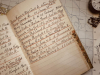
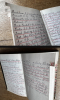
[Address Book, Titanic Associations.]
Address book with White Star Lines and Titanic content.
$6,500.00
Choose a Collection:
This Item
Enquire
Address book with White Star Lines and Titanic content.
This is a fascinating c. 1910 manuscript address book with significant White Star Lines and Titanic associations. The address book was compiled by someone with deep connections to the U.K. and specifically the Liverpool shipping industry.The book contains 177 neatly written names and addresses, 113 of which are in Liverpool in the vicinity of White Star Lines offices (1864 - 1897). While the owner and compiler of the book is unknown, the author was undoubtedly active in shipping or shipbuilding circles in Liverpool between about 1840 and 1910.HMS Titanic Content
The book, among other more tangential connections, contains the following names and companies directly associated with the Titanic:- Captain Edward Smith - Commander of the Titanic on its maiden voyage.
A. Gibson and Co - Smith joined as an ordinary sailor apprentice. - Bruce Ismay - Head of the White Star Line.
Ismay, Imrie and Co - The limited company behind the White Star Line. - William Murdoch - First Officer on Titanic’s maiden voyage.
Palmers Shipbuilding Co - Built the barque Lydgate, on which Murdoch served as First Mate sailing from New York. - Henry Tingle Wilde - Chief Officer on the Titanic's maiden voyage.
Chambers Jas and Co - Joined as an apprentice at age 17.
Later sailed with Evans Hugh and Co and Elder Dempster and Co. - Charles Herbert Lightoller - Second Officer and most senior surviving crew member.
Price W and Co - Joined as an apprentice aged 13 in 1888. - Chief Purser McElroy
Featured in the last known photograph of Captain Smith aboard Titanic.
Also sailed with Greenshields Cowie and Co. - Lord Pirrie - Chairman of Harland and Wolff, builders of the Titanic.
Pacific Steam Navigation Co - Pirrie died aboard the liner Ebro on June 7, 1924, aged 77; the ship was owned by this Liverpool-based company. - Captain Herbert Haddock
Lamport and Holt - Former Titanic captain prior to Southampton; also captained RMS Cedric.
A false report claimed Cedric had sunk after a collision with the Lamport and Holt steamer Titian. The rumor caused panic until both vessels arrived safely in port. - Other Companies with Titanic Associations
- Henry Wilson and Co Ltd - Manufactured Titanic's large kitchen ranges.
- Alexandra Towing Co Ltd - Provided tugs for Titanic's launch and sea trials.
- Cunard Steamship Co - Owner of RMS Carpathia, which rescued all 705 survivors and issued the first iceberg warning.
- Leyland Line - SS Californian sent ice warnings at 7:30 pm and 10:55 pm, the latter just 45 minutes before impact.
The Titanic
Conceived amid the fierce transatlantic rivalry of the early 20th century, Titanic was one of three Olympic-class liners commissioned by the White Star Line, controlled by the American financier John Pierpont Morgan (1837 - 1913) through the International Mercantile Marine Company, and overseen by its chairman Joseph Bruce Ismay (1862 - 1937) as a response to the speed-focused prestige of Cunard's Lusitania and Mauretania; instead of outright speed, Titanic was designed to emphasize size, comfort, and perceived safety. The ship was planned by naval architect Thomas Andrews (1873 - 1912) of Harland and Wolff, the Belfast shipyard led by Lord William James Pirrie (1847 - 1924), in collaboration with Alexander Carlisle (1854 - 1933), incorporating a double-bottom hull, a system of sixteen watertight compartments with electrically operated doors, and advanced Marconi wireless telegraphy supplied by the Marconi Company under Guglielmo Marconi (1874 - 1937), all of which contributed to its reputation as effectively 'unsinkable.' Construction began in 1909 and proceeded with remarkable scale and complexity, involving thousands of workers and cutting-edge industrial techniques, though not without compromises, including rivet quality variations and the decision, partly aesthetic and commercial, to reduce the originally planned number of lifeboats in favor of open deck space. Titanic was commanded on her maiden voyage by Captain Edward John Smith (1850 - 1912), the White Star Line's most senior master, with a bridge team including Chief Officer Henry Tingle Wilde (1872 - 1912), First Officer William McMaster Murdoch (1873 - 1912), and Second Officer Charles Herbert Lightoller (1874 - 1952); she departed Southampton on April 10, 1912, bound for New York, following established North Atlantic shipping lanes. Despite multiple ice warnings transmitted via wireless from vessels including the Californian and Carpathia, operational practices, such as maintaining near-service speed in iceberg-prone waters, limited binocular access for lookouts, and the prioritization of passenger wireless traffic, reflected industry norms rather than extraordinary negligence. On the night of April 14, 1912, Titanic struck an iceberg on her starboard side; the damage, while not catastrophic in a single location, extended across several compartments, exceeding the vessel's design tolerance, as the watertight bulkheads did not rise high enough to prevent progressive flooding once a critical number were breached. Within approximately two hours and forty minutes, the ship foundered and sank in the North Atlantic. The disaster revealed not a single point of failure but a convergence of design assumptions, regulatory shortcomings, and operational conventions, particularly the overconfidence in compartmentalization, insufficient lifeboat capacity under outdated Board of Trade regulations, and an industry-wide underestimation of iceberg risk, marking Titanic not merely as a maritime tragedy, but as a case study in the limits of early 20th-century engineering optimism and systemic risk.Publication History and Census
The author of this address book is unknown, but from the content, we believe it was compiled between 1840 and 1910. It is unique.Condition
Very good. Light wear.