
1860 Hiroshige II Ukiyo-e Triptych of Yokohama, Japan


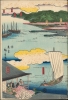
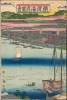
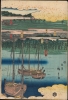
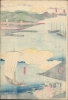
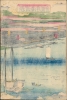
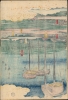
橫濱海岸圖會 / [View of the Coast at Yokohama.]
Yokohama emerging as an international port.
- Digital Map Information
- Suitable for large format printing
- Full resolution TIFF file
- ICC color profile embedded
- Delivered instantly via download link
Yokohama emerging as an international port.
An early 1860 ukiyo-e triptych by Utagawa Hiroshige II, capturing Yokohama, Japan, as it emerged as an international treaty port. Published just months after Yokohama opened to foreign trade in 1859, this panoramic view presents a city poised between the insular world of Tokugawa Japan and the profound transformations that would soon accompany sustained contact with the West. Among the earliest printed views of Yokohama, it offers a Japanese vision of the nascent port: cherry blossoms, temples, teahouses, theaters, and the notorious Miyozaki pleasure quarter occupy a landscape only beginning to accommodate global commerce. Most evocative is a woman seated in a waterfront teahouse, telescope in hand, gazing across the harbor - an image that seems to encapsulate Japan itself, watching with fascination as an unfamiliar world approaches.A Closer Look
This view, oriented southeast, shows the port city of Yokohama in its infancy as a global trade center. Rudimentary docks appear to the left, beyond which is the city's foreign quarter. At the center and to the right are the Japanese-occupied neighborhoods. Several features are labeled, including a forest and temple at the right, a theater (芝居) near the center, and a teahouse and ferry at the left in the foreground. In the background is the Miyozaki pleasure quarter (discussed below).This view is especially fascinating because it depicts Yokohama at the moment it opened as a port for foreign trade. Although the city owed its existence to treaties signed with foreign powers, evidence of the foreign presence is very subtle, and the view remains essentially Japanese in style and theme. No foreign ships appear in the harbor. The clouds, cherry blossoms, and color scheme give the view an ethereal feeling. Most intriguing is the woman in the teahouse holding a telescope, curiously eyeing developments on the opposite shore, perhaps a metaphor for Japan itself.
Miyozaki
Miyozaki was Yokohama's red-light district, modeled on and managed by brothel-owners from Edo's infamous Yoshiwara (in fact, it is labeled here as 'Yoshiwara corridor' 吉原廊). The district had been planned during discussions around the Harris Treaty (also known as the Treaty of Amity and Commerce, 1858) and other similar treaties with foreign powers that opened Yokohama to foreign trade. Located where today's Yokohama Park sits, it was separated from Yokohama proper by a moat and wall and accessed by a confined walkway that ended at a bridge with a large gate, which was the only way to enter or leave the district. It was foremost among the many curiosities in Yokohama that consumers of Yokohama-e (橫濱繪) prints were interested in. Foreigners were equally curious about Miyozaki, for obvious reasons, though the more genteel among them typically regarded the area with disdain, at least publicly.The teahouses and brothels in this district catered primarily to foreign (Western and Chinese) clients, in large part to avoid the potential for scandals involving foreigners and Japanese women not engaged in prostitution (as had been done for many years in the Maruyama red light district in Nagasaki). This fit a broader Tokugawa trend of sequestering supposedly immoral or harmful influences from society. This trend intensified in the decades just before Japan opened to foreign trade. While Yokohama maintained a laissez-faire ethos overall, Miyozaki was possibly the most strictly monitored and managed part of the entire city, as the Tokugawa were anxious to keep foreigners occupied and away from Japanese women not engaged in the sex trade. Certain establishments, especially the famous Gankirō (岩亀樓), aimed at more esteemed and wealthy clients, who could arrange for long-term mistresses, often depicted alongside foreigners in Yokohama-e prints.
As the city grew, the red-light district was relocated several times, beginning in 1867. Frequent fires and further urban sprawl led to further relocations, with it finally (in 1880) being placed in Magane, where it remained, with official sanction, until the Japanese government enacted an anti-prostitution law in 1958.
Yokohama - Japan's Gateway to the Outside World
This work is an early example of Yokohama-e, a ukiyo-e genre depicting foreigners and cultural interactions between Japan and the outside world. Although Japan reluctantly signed a 'Treaty of Peace and Amity' with the United States in 1854, opening the door to greater foreign presence and influence, the terms were vague. Other foreign powers piled into Japan to sign similar treaties granting their nationals rights to trade and reside in certain ports. The most important of these 'treaty ports' were Nagasaki and Yokohama; the former had been a major port for centuries, the latter much less so.The foreign powers demanded a port near Edo (Tokyo), understanding that the capital itself was not an option. Yokohama was chosen mainly because the most obvious option, Kanagawa-juku (神奈川宿), a nearby coastal station on the Tōkaidō, was opposed by the Shogun. Much like Shanghai in China, Yokohama grew rapidly and became the main conduit for the exchange of people, goods, and ideas between Japan and the outside world.
Artists rushed to depict the new visitors, who were regarded with curiosity and revulsion but, in either case, were an object of keen interest throughout Japan. Aside from Western traders, Chinese merchants and workers also lived in Yokohama, forming an important Chinese community that remains Japan's largest Chinatown. As a product of the treaty port system, Yokohama quickly embraced foreign technology, and Japan's first major rail line opened from Yokohama to Edo (by then renamed Tokyo) in 1872. Eventually, Yokohama grew to swallow Kanagawa-juku and other nearby towns, becoming the capital of Kanagawa Prefecture and Japan's second-largest city.
Publication History and Census
This ukiyo-e triptych was prepared by Utagawa Hiroshige II and published by Daikokuya Kinnosuke in early 1860. (Yokohama had only opened as a foreign trading port the previous June.) It should not be confused with Hiroshige III's similarly titled 橫濱海岸通之圖, which appeared a decade later. The present view is not only early but also quite scarce, cataloged only in the institutional holdings of the National Museum of Asian Art (Smithsonian) and the Yokohama City Central Library.Cartographers
Utagawa Hiroshige II (二代目 歌川広重; 1826 - September 17, 1869) was a Japanese ukiyo-e artist of the late Edo period trained in the Utagawa School. Aside from his birth name (Suzuki Chinpei 鈴木鎮平), details on his early life are scant, but at some point in adolescence or early adulthood he began apprenticing under Hiroshige (1797 - 1858) and was strongly influenced by his style. During the life of his master, Hiroshige II used a variety of pennames, but after his master's death in 1858 he began to use Hiroshige. As the most successful of his master's small group of students, Hiroshige II was groomed to be his master's heir in all matters and even married his daughter, Otatsu. However, the marriage was unhappy and ended after several years, with Otatsu remarrying another of her father's students, Shigemasa (c. 1842 - 1894), who began to use the Hiroshige name, eventually adopting the name Hiroshige III to differentiate himself from Hiroshige II. Further Details...
Daikokuya Kinnosuke (大黒屋金之助; fl. c. 1853 - 1879) was a publisher of the late Edo and early Meiji periods. The firm was almost certainly named after its founder and may have retained the name after his death. The firm was originally based in Tsukiji in Edo / Tokyo and later moved to Ningyocho in Nihonbashi. It published works by several of the late masters of the ukiyo-e genre, including members of the Utagawa School, Yoshitoshi, and Kawanabe Kyōsai. The subjects of its prints ranged from views and maps to anatomical works, representations of scenes from literature, and fantastical depictions of ghosts. Further Details...
Condition
Very good. Light soiling.
References
National Museum of Asian Art (Smithsonian) Accession Number S1998.28a-c. Yokohama City Central Library Call No. N187.