
1874 Hiroshige III Ukiyo-e Triptych of Yokohama Steam Train


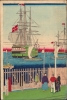
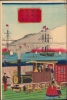
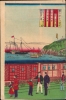
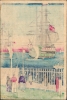
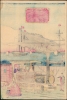
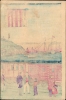
橫濱往返鐵道蒸氣車海上之圖 / [View of Steam Engine on the Seaside Yokohama Line].
Japan's first train.
$4,500.00
Choose a Collection:
- Digital Map Information
- Suitable for large format printing
- Full resolution TIFF file
- ICC color profile embedded
- Delivered instantly via download link
This Item
Enquire
Japan's first train.
A fascinating 1874 ukiyo-e triptych by Utagawa Hiroshige III celebrating Japan's first passenger railway and the astonishing modernization of Yokohama under the Meiji. Opened between Yokohama and Tokyo in 1872, the steam railway became one of the most potent symbols of a country transforming itself at extraordinary speed, linking Japan's leading international treaty port with the imperial capital. Published two years after the railway's inauguration, the triptych captures not simply a train, but a defining moment in the Meiji Restoration, when foreign technology was being rapidly absorbed and transformed into the infrastructure of modern Japan.A Closer Look
Hiroshige presents this new technological world in brilliant nishiki-e color: a locomotive and passenger cars dominate the foreground while international shipping crowds Yokohama harbor beyond, creating a remarkable juxtaposition of rail, steam, maritime trade, and Japanese urban life. Oriented northwest toward Yokohama harbor, this view depicts a steam train on the Tokyo-Yokohama line. Ships of various nations, including a paddle steamer at right, are anchored in the harbor, surrounded by smaller ships engaged in trade or fishing. In the background on the right is 'French Mountain' (フランス山), so named because French troops were stationed there from the early days of Yokohama.In the foreground is the titular train, with figures either sitting on the train, standing next to it, or regarding it from beyond a fence. Though ambiguous, most, if not all, of the figures appear to be Japanese, despite the fully Western-style Victorian dress most are wearing. The table at the top right is an early example of a timetable, providing basic information on fares, including different classes and discounts for children, and train times.
Japan's First Modern Railway
Although Japan had already seen dramatic changes in the years since the forcible opening of the country to foreign trade in 1859, the pace of change quickened throughout the 1860s and spread beyond the relative isolation of treaty ports like Yokohama. Although accompanied by social upheaval and civil war, this period was also exhilarating and dynamic. With the Meiji Restoration in 1868, the central government encouraged rapid adoption and domestication of foreign technologies, including railways. Foreign engineers and advisors brought in by the government advised the construction of a railway between Tokyo and Yokohama, which hitherto required taking the coastal Tokaido road or traveling by boat.Although earlier foreign travelers had brought model locomotives to Japan and a short demonstration line was built in Nagasaki in 1868, the line between Tokyo and Yokohama was the country's first true railway, as well as a major financial and political commitment by the new Meiji government. British railway engineer Edmund Morel helped design and plan the railway, including training Japanese railway engineers. However, he did not live to see its completion, dying of tuberculosis in November 1871 in Yokohama. Built on a narrow 'Cape gauge' (3 feet 6 inches) as opposed to the wider 'Stephenson gauge' (now known as standard gauge), the Tokyo-Yokohama line proved to be extremely popular, further propelling Japan's breakneck modernization and setting a model used for decades as Japan evolved into one of the world's premier railway nations.
Nishiki-e (錦繪)
Nishiki-e (literally 'brocade picture', also known as Edo-e 江戸繪 because it developed in the Tokugawa capital of Edo) is a style of woodblock printing that emerged in the 1760s and revolutionized the medium. Instead of producing a black-and-white print that was then hand-colored, or adding one or two color blocks, nishiki-e prints combined many blocks, each adding one color to a complete image, fitted together perfectly. As a result, printers could produce vibrant prints in greater numbers and in far less time, enabling the widespread distribution of woodblock prints, especially ukiyo-e prints.Nishiki-e remained the dominant mode of woodblock printing through the Meiji era and was critical to distributing prints depicting new technologies and ideas throughout Japan in the mid-to-late 19th century. This work falls squarely within the Yokohama-e (橫濱繪) genre, depicting foreigners and foreign technologies after Yokohama opened as a treaty port in 1859.
Publication History and Census
Utagawa Hiroshige III drew this ukiyo-e triptych, and Hamadaya Tetsugorō (浜田屋鉄五郎), an obscure and ephemeral publisher, published it in 1874 (Meiji 7). It is one of several similarly titled views of the Yokohama-Tokyo steam train that Hiroshige III depicted in the early 1870s. However, this appears to be among the scarcer in the series. We note institutional examples at the Yokohama City Central Library and the Kanagawa Prefectural Museum of Cultural History, and the work is scarce to the market.Cartographer
Utagawa Hiroshige III (三代目歌川広重; c. 1842 - March 28, 1894), also known as Andō Tokubei (安藤徳兵), was a Japanese woodblock artist of the Meiji era. He was a student and later son-in-law of Utagawa Hiroshige, often considered the last master of the ukiyo-e genre. Most of Hiroshige III's work falls within the Yokohama-e genre, depicting foreigners or foreigner technologies and styles in Japan. Further Details...
Condition
Good. Small areas of soiling and repaired wormholes at top.