
Bodmer, Karl (sold)
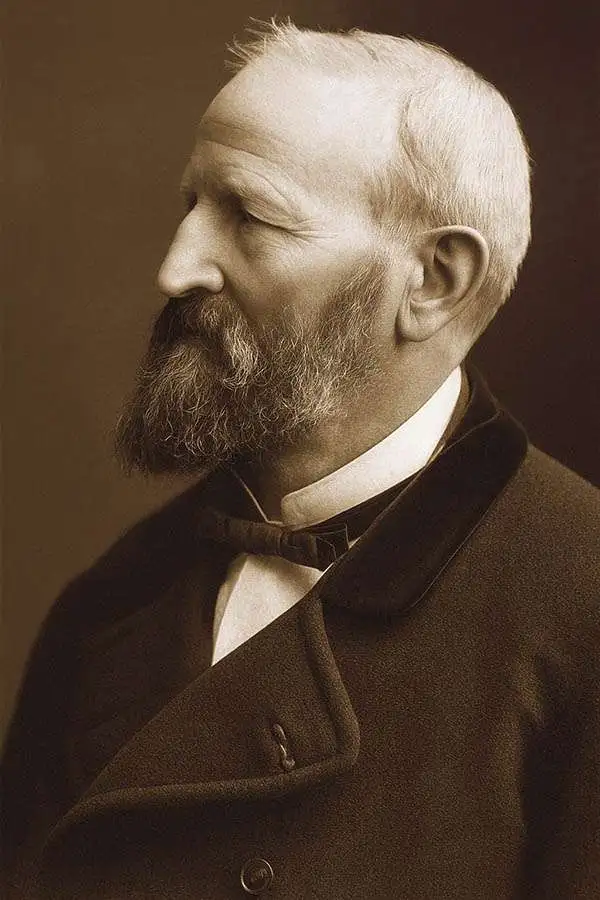
Karl Bodmer (February 11, 1809 - October 30, 1893), born Johann Carl Bodmer, was a Swiss-born French artist, engraver, and lithographer who was renowned on both sides of the Atlantic Ocean. Bodmer was born in Zürich and began to learn engraving when he was 13 years old from his uncle, Johann Jakob Meier, who had studied with painters Heinrich Füssli and Gabriel Lory. Karl Bodmer and his older brother Rudolf traveled throughout Switzerland with their uncle on artistic outings. By 1828, Karl Bodmer had begun work as a painter in Koblenz, where he was noticed by Prince Maximilian of Wied-Neuwied (1782 - 1867), who invited Bodmer to be his artistic companion on an expedition deep into the frontier of North America, along the upper reaches of the Missouri River. Bodmer would spend the years 1832 - 1834 in the company of Prince Maximillian and David Dreidoppel, a hunter and taxidermist. Bodmer's sketches of the American frontier, still dominated by Native Americans and a small handful of American and Canadian traders, were prepared as aquatints after the expedition's return and were hailed both in Europe and North America. They were among the first accurate depictions of Plains Indians, who were depicted with both vividness and humanity. Bodmer then moved to Barbizon, France and became a member of the emerging Barbizon School (which later included Edouard Manet and Edgar Degas, among others) and at this time went by the French form of his name as Jean-Charles Bodmer or simply Charles Bodmer. He resided there for many years afterwards, producing artworks using a variety of methods, including painting, etching, engraving, and lithography. He became rather obscure and impoverished in his later years, but his illustrations which were published in Prince Maximillian's Reise in das innere Nord-Amerika in den Jahren 1832 bis 1834 and several other works thereafter remain among the most important 19th century artistic depictions of Native Americans.
Early Depiction of Native Americans on the Upper Missouri.
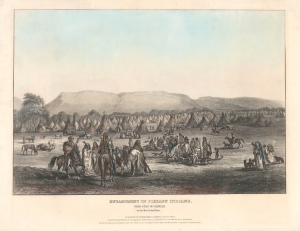
Encampment of Piekann Indians. Near Fort McKenzie on the Muscleshell River.
sold
- Digital Map Information
- Suitable for large format printing
- File Size: 17.25 MB
- File Type: ZIP / TIFF
- ICC color profile embedded
- Delivered instantly via download link
This is a rare 1842 view of an encampment of Piegan Blackfeet near Fort McKenzie, a trading post on the Upper Missouri River in today's Montana. It is based on an 1833 drawing by Karl Bodmer, a member of a scientific expedition to the American frontier led by the German naturalist Prince Maximilian of Wied-Neuwied, whose dramatic, colorful portrayals of Plains Indians were among the earliest to become widely known in both America and Europe. (more details)