
Brady, Mathew B. (sold)
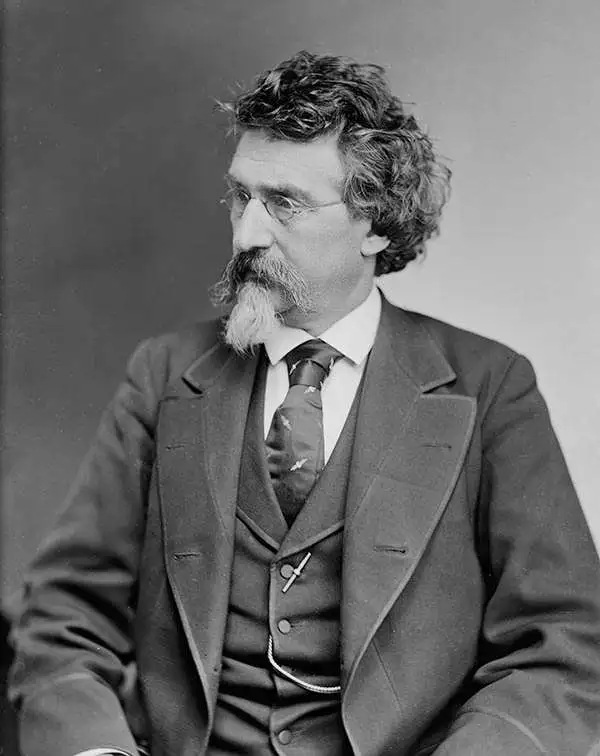
Mathew B. Brady (c. 1822-1824 - January 15, 1896) was an American photographer. Brady's early life is a mystery. In his later years, just before his death, Brady claimed to reporters that he had been born in Warren County, New York, near Lake George, and that he was the youngest of three children to Irish immigrant parents. However, before and during the Civil War, Brady claimed in official documents to have been born in Ireland. Brady moved to Saratoga, New York, at the age of 16, and began studying painting with William Page, a portraitist. Page and Brady moved to Albany, then New York City, in 1839, and Brady continued studying with Page as well as Samuel Morse, Page's former teacher. That year Morse had studied with Louis Jacques Daguerre (the inventor of the daguerreotype - an early form of photography) in France. Morse became an enthusiastic proponent of daguerreotypes and began promoting the new technology in New York. Brady's early involvement with Morse's new venture was limited to making leather cases for the daguerreotypes. But, when Morse opened a studio and began teaching classes on the new method, Brady eagerly became one of his first students. Brady opened his own studio in 1844 and the following year was exhibiting portraits of such luminaries as Edgar Allen Poe and Senator Daniel Webster. He opened another studio in Washington, D.C. in 1849, but had to abandon it in 1850 after falling out with his landlord. Brady hired Alexander Gardner in 1856. In 1858, when Brady decided to open a D.C. studio, he made Gardner the manager. At the beginning of the Civil War, Brady marketed his successful cartes de visite to departing soldiers and their families, but his interest soon turned to documenting the war itself. Brady petitioned General Winfield Scott and President Lincoln to allow his photographers to travel to battle sites. Lincoln approved his request, although he stated that Brady would have to finance everything himself. To do so, Brady developed a mobile photography studio and darkroom and employed over twenty men, each of whom had their own traveling dark room. Among his employees were Alexander Gardner and Timothy O'Sullivan. Brady's assistants took thousands of photographs of Civil War scenes, from the First Battle of Bull Run to Appomattox Court House. After the war, interest in Brady's photographs declined exponentially, leaving him in dire straits. Brady spent over $100,000 (about $1.878 million in 2022) during the war which resulted in the creation of over 10,000 glass negatives. Brady expected that the U.S. government would buy the negatives after the war, but, despite the recommendation of the Joint Committee on the Library, Congress did not purchase Brady's work. This forced Brady to sell his Washington studio in 1870 and later his New York studio, and eventually file for bankruptcy. He died penniless in the charity ward of New York City's Presbyterian Hospital.
The 55th New York Infantry Regiment defending Washington, D.C.
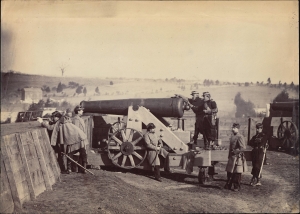
This is an 1861 Matthew Brady Civil War albumen photograph of the 55th New York Infantry manning the artillery at Fort Gaines in Washington, D.C. Based on the 55th New York Infantry Regiment's service record, this photo must have been taken in September or October 1861 when the regiment was on duty at Fort Gaines. Brady's photo-documentation of the Civil War is significant and played a role much like television journalism did during the Vietnam War - it brought the horrors and violence of the war to the home front, informing public opinion. (more details)
Ruins in Manassas Junction after the Confederate evacuation.
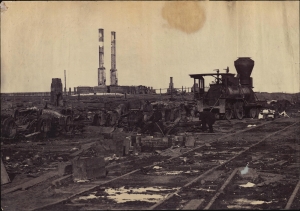
This is a striking 1862 Mathew Brady American Civil War albumen photograph of the ruins of Manassas Junction following Johnston’s scorched-earth evacuation of Confederate forces. The photograph presents the burnt out remains of a train and warehouse. Brady's photo-documentation of the Civil War is significant and played a role much like television journalism did during the Vietnam War - it brought the horrors and violence of the war to the home front, informing public opinion. (more details)
Photograph of the Battlefield of Gettysburg.
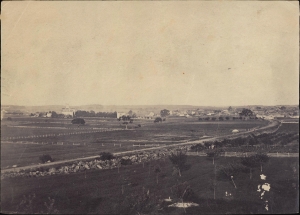
This is an 1863 albumen print of a Timothy O'Sullivan photograph of the Battlefield of Gettysburg. Brady's photo-documentation of the Civil War is significant and played a role much like television journalism did during the Vietnam War - it brought the horrors and violence of the war to the home front, informing public opinion. (more details)