
Heywood, Peter (sold)
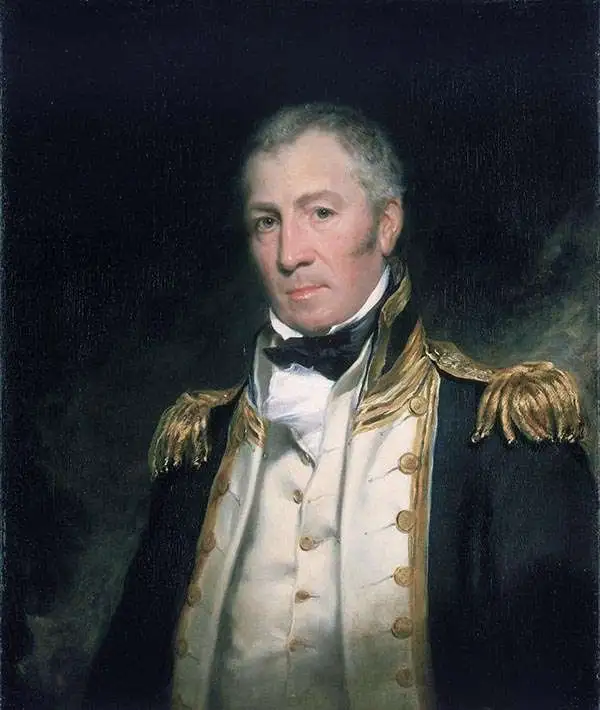
Peter Heywood (June 6, 1772 - February 10, 1831) was a British naval officer and hydrographer active in the late 18th and early 19th centuries. He was born in Douglas, Isle of Man, England. Heywood is best remembered for his association with William Bligh, the highly capable but notorious captain of the mutinous H.M.S. Bounty. At the beginning of the Bounty's fateful voyage, Bligh recognized Heywood, then just 15 and a family friend, along with Fletcher Christian, as smart and capable sailors, of which he wrote, 'These two had been objects of my particular regard and attention, and I had taken great pains to instruct them.' It is thus likely that Heywood was taught hydrography and marine surveying directly under Bligh. He was nonetheless among those who mutinied against Bligh on April 28, 1789 - Bligh's testimony even named him an instigator. He was captured in Tahiti, tried as a mutineer, condemned to death, and, in a remarkable twist of fate, pardoned, after which he returned to a long and privileged naval career. Historian Caroline Alexander suggests that Heywood suffered a sense of guilt over his pardon, knowing that he had 'perjured himself' in saying that he was kept below and therefore prevented from joining Bligh. He nonetheless remained in the Royal Navy for the next 29 years, putting Bligh's hydrographic training to good use in Ceylon (1803), India, Macao (1804), Morocco, South America, Sumatra, and northwestern Australia. His work received high praise from James Horsburgh, Hydrographer to the East India Company, who wrote that Heywood 'essentially contributed to making my Sailing Directory for the Indian navigation much more perfect than it would otherwise have been.' Heywood retired from Navy life in 1816, settling near Highgate, London. In retirement, he compiled a Tahitian language dictionary, compiled his papers, and corresponded widely with the luminaries of his generations, including Francis Beaufort and Charles Lamb.
Scoping out the Taipa for the EIC during the Napoleonic Wars.
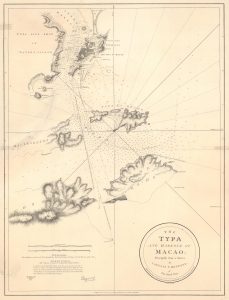
The Typa and Harbour of Macao; Principally from a Survey by Captain P. Heywood, of The Royal Navy.
sold
- Digital Map Information
- Suitable for large format printing
- File Size: 20.15 MB
- File Type: ZIP / TIFF
- ICC color profile embedded
- Delivered instantly via download link
This is the only known example of the 1809 Laurie and Whittle first edition of Peter Heywood's seminal survey of Macau (Macao) and nearby Taipa. This survey, conducted independently while Heywood's ship, the La Dedaigneuse, was being refitted in Macau, is the most important mapping of Macau since the 1778-79 survey of Heywood's erstwhile hydrography instructor, captain, and lifelong nemesis, Captain William Bligh of Bounty infamy. The survey appeared in the context of the Napoleonic Wars, when Franco-Spanish fleets were plaguing East India Company (EIC) fleets, and the British were keen to establish a foothold in the Pearl River Delta. Taipa, being a long-established EIC mooring point, was the prime target. (more details)