
Johnson, Donald Stewart (sold)

Donald Stewart Johnson (fl. c. 1938 - 1948) was the Superintendent of Sable Island from 1939 -1948, except for a period during the Second World War when he helped to set up the Royal Canadian Navy's Fleet Air Arm. His father had been captain of a ship that brought supplies to the island, allowing him to become acquainted with it from a young age. After briefly attending university and working for the Humane Establishment on Sable Island, Johnson joined the Royal Canadian Mounted Police as a constable. Before returning to Sable Island as its superintendent, he worked several jobs with the Mounties and on ships in the Atlantic while also developing his artistic skills as an illustrator. Johnson was known as the 'Atlantic Cowboy' as he often rode horses to get around on Sable Island (the island is famous for a distinctive breed of horse, whose origin is unknown but most likely were resettled after being seized from Acadians during their expulsion by the British during the French and Indian War).
'Graveyard of the Atlantic'.
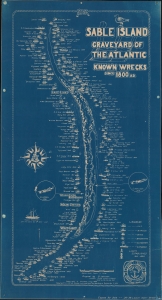
Sable Island Graveyard of the Atlantic Known Wrecks since 1800 A.D.
sold
- Digital Map Information
- Suitable for large format printing
- File Size: 858.39 MB
- File Type: ZIP / TIFF
- ICC color profile embedded
- Delivered instantly via download link
An alluring 1948 cyanotype pictorial map of Sable Island, Nova Scotia drawn by Donald S. Johnson. It highlights the very large number of shipwrecks that occurred around the island in the 19th and early 20th century, especially before the installation of lighthouses. (more details)
'Graveyard of the Atlantic'.
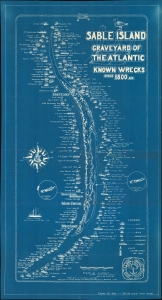
Sable Island Graveyard of the Atlantic Known Wrecks since 1800 A.D.
sold
- Digital Map Information
- Suitable for large format printing
- File Size: 94.79 MB
- File Type: ZIP / TIFF
- ICC color profile embedded
- Delivered instantly via download link
A striking 1948 cyanotype pictorial map of Sable Island, Nova Scotia, drawn by Donald S. Johnson. It highlights the very large number of shipwrecks that occurred around the island in the 19th and early 20th century, especially before the installation of lighthouses. (more details)