
Johnson, Jacob (sold)

Jacob Johnson (fl. c. 1790 - 1819) was a printer and publisher active in Philadelphia in the early years of the American Republic. Johnson was born to a prominent Quaker merchant family in Philadelphia and had gone into the book trade as early as 1790, opening a stall on High Street in his hometown. By 1792, he and his brother Benjamin Johnson (a dry-goods trader) had opened their own printshop, though their publications only really became regular in 1795. Afterwards, the pair quickly began to publish books on a range of topics, from the American Revolution, ancient history, agriculture (The American farmer's guide: or A new and excellent treatise on agriculture), and religious and moral topics, to pedagogy (including geography). Many of their works are published as 'B. and J. Johnson' or sometimes 'B., J., and R., Johnson' referring to Robert Johnson, probably a third brother. But, confusingly, Jacob and Benjamin also published in their own names only, and maintained separate office locations, albeit within a few blocks of each other. A notable portion of Johnson's published works were in German, perhaps an attempt to cater to Pennsylvania's German-speaking population. His cartographic output includes the game wall map titled 'The United States Geographical Amusement,' the earliest domestically-produced geographical game sold in the United States, as well as Benjamin Davies' A new system of modern geography (1805) and an 1811 'Map of the world with the most recent discoveries.' He might have also published a c. 1794 'Plan of the City of Philadelphia' (OCLC 46415822) that appeared in James Hardie's A short account of the city of Philadelphia. Johnson even opened branch locations of the business in Richmond, Virginia and Lexington, Kentucky to collect subscriptions for works-in-progress, traveling frequently to Richmond but residing primarily in Philadelphia. Starting in 1806, Johnson entered into a partnership with Benjamin Warner and thereafter generally published as 'Johnson and Warner,' though works with his inscription decreased considerably in the following years. His difficult work and travel schedule likely took a toll on his health and he died on a trip to Lexington in 1819 aged roughly fifty years. Afterwards, Johnson's printshop in Philadelphia was continued by family members and continued its stationery business until 1919. Warner continued the publishing arm of the business, issuing a well-regarded edition of The Federalist Papers and perhaps the earliest separately-issued folding map of the U.S. from the Atlantic to Pacific coasts (previously sold by us, UnitedStates-warner-1820) among other works, and continued publishing until about 1830. Warner trained John Grigg and placed him as manager of the Richmond location; Grigg later went on to found his own firm, which became one of the founding components of renowned published J. B. Lippincott and Co. In effect, then, the origins of Lippincott can be traced back to Jacob and Benjamin Johnson's firms in Philadelphia. The fullest biography of Johnson can be found in the 'Biographical Directory of the Virginia Printing Trade to 1820' section of the Index of Virginia Printing, now available online at the Library of Virginia's website.
First American Geographic Game.
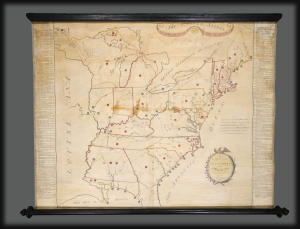
The United States Geographical Amusement / To the Youth of the United States this Map is dedicated by the Author.
sold
This is a scarce and very early 1806 Jacob Johnson geography game wall map depicting the early American Republic. It represents the first domestically-produced cartographic game in the United States of America. (more details)
First American Board Game - fostering patriotism in the first generation of born U.S. citizens.
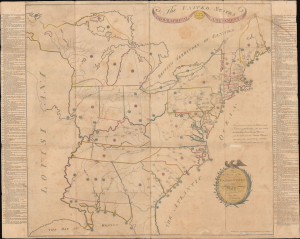
The United States Geographical Amusement / To the Youth of the United States this Map is dedicated by the Author.
sold
- Digital Map Information
- Suitable for large format printing
- Full resolution TIFF file
- ICC color profile embedded
- Delivered instantly via download link
This is the 1806 Jacob Johnson geography game map of the United States - the first American domestically-produced board game. With rich side panel content emphasizing patriotic themes surrounding the American Revolutionary War (1775 - 1783), this map was issued to foster the emerging sense of American identity in the first generation to come of age as citizens of the United States. The map game is, moreover, an important example of early American printing. (more details)