
Kirtland, Edwin Leander (sold)

Edwin Leander Kirtland (1833 - April 12, 1910) was an American publisher, public servant, and musician. Born in Westbrook, Connecticut, Kirtland graduated from Yale in 1859 and taught at Westbrook Academy the next year. he worled in the pension office in Washington, D.C. during the American Civil War and was in Ford's Theater the night President Abraham Lincoln was assassinated. After he retired from the pension office, he lived in Philadelphia for a few years before returning to Connecticut, where he was elected to the Connecticut State Legislature in 1869. He moved to Holyoke, Massachusetts in 1870. Kirtland purchased Henry M. Burt's share of the Holyoke Transcript, the town's weekly newspaper, in 1870 and sold his share of the newspaper in 1881. Kirtland was elected to the Massachusetts State Legislature in 1873 and wrote a history of the city of Holyoke, Massachusetts that was published in 1898. He held the position of superintendent of schools in Holyoke for twenty years. He died at his home in Holyoke in 1910. He married Laura Maria Whiting on July 6, 1892.
An extremely rare map of Holyoke, Massachusetts published by the owner of the Holyoke Street Railway Company.
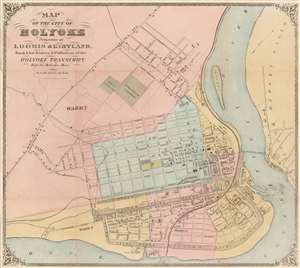
Map of the City of Holyoke.
sold
- Digital Map Information
- Suitable for large format printing
- File Size: 16.58 MB
- File Type: ZIP / TIFF
- ICC color profile embedded
- Delivered instantly via download link
This is a c. 1874 William Loomis and Edwin Kirtland city plan or map of Holyoke, Massachusetts, a historic mill town on the Connecticut River. Holyoke is located in the famous 'Five Colleges' region of the Pioneer Valley, including Amherst College, Hampshire College, Mount Holyoke College, Smith College, and the University of Massachusetts Amherst. Holyoke is divided into wards, each of which is shaded a different color to allow for easy differentiation. Buildings are illustrated throughout the city, many of which are labeled, including the grammar school, high school, city hall, as well as numerous businesses and churches. Three canals cut through the city, and the Connecticut River Railroad traverses a few city wards before reaching running along the bank of the Connecticut River. The whole is surrounded by a beautiful border. (more details)