
Matsumoto Nikichi (sold) (松本仁吉)

Matsumoto Nikichi (松本仁吉; fl. c. 1892 - 1897) was a Japanese geographer, translator, and educator based in Osaka. Little is known about his life, but Matsumoto was quite active during the 1890s, authoring several school textbooks and translating maps, including a very early Japanese map of Taiwan after the island was annexed in 1895. He also published a detailed geography of the islands of Taiwan the same year (臺灣島地誌撮要附錄), indicating he was something of a Taiwan expert just as Japan took control of the territory. The following year, he prepared the New Pocket Atlas (袖珍萬國地圖), based on John Bartholomew's Pocket Atlas of the World, which Matsumoto translated into Japanese and slightly modified. He also appears to have co-authored a four volume series of commentaries on Tang Dynasty poetry the same year, reflecting a broad range of interests and talents.
AKA: 松本仁吉
Diplomatic ploy that may have contributed the Qing cession of Taiwan/Formosa to Japan.
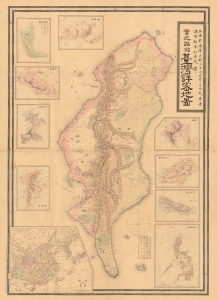
Detailed Map of Taiwan Field Survey. / 實地踏測台灣詳密地圖
sold
- Digital Map Information
- Suitable for large format printing
- File Size: 63.22 MB
- File Type: ZIP / TIFF
- ICC color profile embedded
- Delivered instantly via download link
This 1895 Nakamura Yoshimatsu map of Taiwan is one of the most unsung but influential examples of persuasive cartography ever published. The large-scale map of Taiwan appeared at the end of the First Sino-Japanese War (August 1, 1894 - April 17, 1895), just prior to the Treaty of Shimonoseki (April 17, 1895) and the Japanese invasion of Taiwan (May 29, 1895 - October 21, 1895). The map, attributed to a likely fictional British naval officer named John Waters, employs creative cartography to reshape Taiwan, while retaining the overall area, effectivley reducing the size of Qing controlled Formosa and increasing the size of the ungoverned 'savage zones' - a ploy that played into the Japanese position that the Qing did not truly possess the island. It was likely presented at the Shimonoseki negotiations, where the Japanese were able to take advantage of Qing China's infamous lack of cartographic knowledge about Formosa to formally seize the island. (more details)