
Rice, Charles A. (sold)

Charles A. Rice (November 6, 1885 - August 12, 1931) was an American civil engineer. Born in Buffalo, New York, Rice was a member of the New York National Guard with the rank of sergeant during its deployment to the Mexican border in 1916-17. While there he created a map that others could use to trace their own movements around the area. Per a short article that appeared in The Buffalo Times on August 12, 1917, we learned that Rice served in the 74th Infantry Regiment for a year, before which he was an engineer in the State Highway Department. He obtained an honorable discharge after his year in the New York National Guard and found work in an irrigation engineering company. He was arrested in McAllen, Texas, where the regiment had been stationed, on suspicion of violating the Espionage Act, although we have found no trace of what happened with this charges. Rice stayed in McAllen, eventually becoming the City Engineer, a post he held for only six months before his death. He died on August 12, 1931 from a pulmonary embolism while living in McAllen, Texas. At the time of his death he was married to Virginia Rice, who appears to have been his second wife. His first wife, whom he married in 1907, was named Mary Octavia Rice.
An extremely rare map created for soldiers who had served along the U.S. Mexican border during the Mexican Expedition.
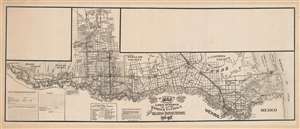
Map Showing Lines of March and Border Patrols, In My Mexican Border Service. 1916 - 1917.
sold
- Digital Map Information
- Suitable for large format printing
- File Size: 29.59 MB
- File Type: ZIP / TIFF
- ICC color profile embedded
- Delivered instantly via download link
This is a 1917 Charles A. Rice map of the United States-Mexico border dating from the 1916 - 1917 Mexican Expedition. The map depicts the region along the meandering Rio Grande River from Rio Grande City southeast past McAllen to Brownsville and the Gulf of Mexico. Sergeant Rice created this map with the intention that individual soldiers would the map to trace their movements in the area. A table situated in the lower left corner, which is unfortunately blank on this example, provides these soldiers with a place to write down specifics concerning their service along the border, including their name, enlistment date, a summary of events, and discharge date. The convoluted nature of the river border suggests something apropos to day - the futility of building a wall. (more details)