
Strada, Famiano (sold)

Famiano Strada (1572 - 1649) was an Italian Jesuit historian, particularly of the early part of the Eighty Years' War, from the abdication of Charles V in 1556 to the capture of Rheinsberg in 1590. He was born in Rome, entering the Jesuit order as a young man and teaching rhetoric in the Roman College early in the seventeenth century. In 1617 he was tasked by Ranuccio I Farnese, Duke of Parm to write a history of the war in the Netherlands, access which afforded Strada a range of sources including the letters of royalty, ambassadors, and even spies; Strada would throughout his work characterize these as 'state secrets.' The publication of his history consumed Strada's life: the first volume of the work, describing the period between 1559 and 1597, would be published in Rome in 1632; the second covering 1579 to 1589 saw print in 1647. A third volume appears to have been planned, but its publication was prevented by Spanish authorities, who perhaps considered more contemporary revelations to be detrimental to Spanish policy. The earlier volumes would themselves appear in many editions, some translated into English, Italian, French and Spanish.
Leo Belgicus, in a desirable edition.
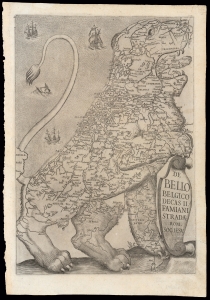
De Bello Belgico Decas II Famiani Stradae Rom. Soc. Iesu
sold
- Digital Map Information
- Suitable for large format printing
- DPI: 600
- File Size: 20.56 MB
- File Type: ZIP / TIFF
- ICC color profile embedded
- Delivered instantly via download link
This 1632/1647 map of the Netherlands is an exemplar of one of the most distinctive heraldic geographical motifs: the famous Leo Belgicus. This depiction of the Low Countries in the form of a lion rampant appeared as the title page in the first, Rome edition of Famiano Strada's 1632 history of the Dutch Revolt. While later editions of Strada featured a Leo in their frontispieces, the plate employed in the 1632 first volume and the 1647 second volume of the first edition was the largest and most beautifully engraved, and among the most desirable. This image's appearance during the course of the Eighty Years' War (c. 1566/1568 - 1648) has led to it being hailed as a cartographic expression of national pride - in spite of its origin being firmly rooted in histories of the war produced predominantly from a Spanish perspective. (more details)