
Wheeler, James Talboys (sold)

James Talboys Wheeler (December 22 or 23, 1824 – January 13 1897) was a bureaucrat-historian of the British Raj, and one of the first European historians of India to rely on documentary sources. The son of a bookseller, he was privately educated, and first attempted an unsuccessful career as a publisher and bookseller himself before venturing into authorship of educational literature and editorial work. In 1858 he moved to Madras to become editor of the Madras Spectator in India; Later that year he was appointed professor of moral and mental philosophy at Madras Presidency College, and during his time there developed an interest in Hindu customs - of which he believed Europeans in India were largely ignorant. Wheeler would become a professional bureaucrat in the Indian Service, employed by the Raj government in Madras, and later in Calcutta and British Burma. During his time in Madras, he would produce his Madras in the Olden Time, a history based on the wealth of government records made accessible to him through his work; the first chapters would be published serially in the Madras Spectator. He produced a number of summary reports relating to the history and politics of countries that bordered on British India for the government during his time in Calcutta; beyond his bureaucratic work, he would write a four-volume History of India, which was published between 1867 and 1881.
No examples catalogued in OCLC or visible on the market
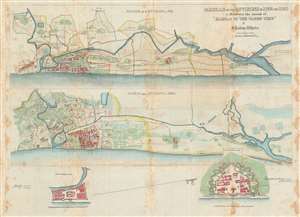
Madras and it Environs in 1733 and 1862 to illustrate the Annals of 'Madras in the Olden Time' by J. Talboys Wheeler.'
sold
- Digital Map Information
- Suitable for large format printing
- File Size: 44.22 MB
- File Type: ZIP / TIFF
- ICC color profile embedded
- Delivered instantly via download link
This is a rare 1862 map of Madras in India, now known as Chennai. It was printed for James Talboys Wheeler for inclusion in his history of the Presidency of Madras. The sheet actually contains two full maps of the city and its surrounds - one dated to 1733, and the other showing the 'present day' city, revealing Madras' growth and the extensive development of the plain surrounding it. (more details)