
Gell, William (sold)
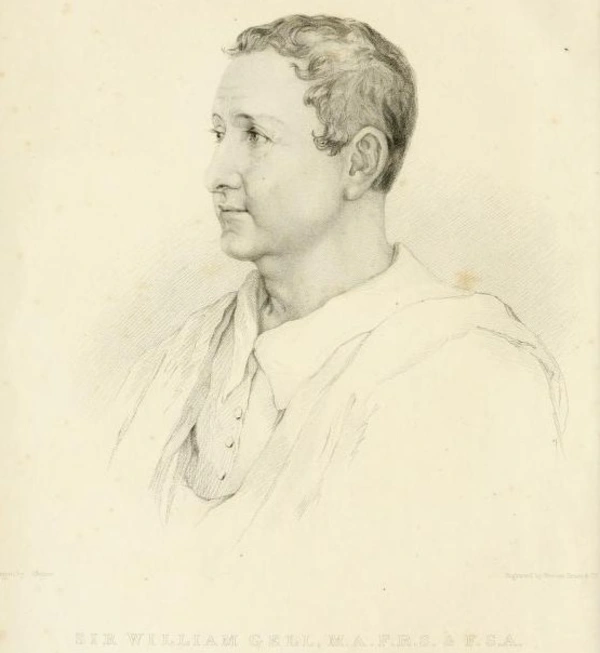
William Gell (March 31, 1777 - February 4, 1836) was an English cartographer, classical topographer, archaeologist, and draughtsman active in Greece, Asia Minor, and Italy during the early 19th century. Born at Hopton Hall near Wirksworth, Derbyshire, he was the younger son of Philip Gell and Dorothy Milnes. He attended Derby School and Cambridge, graduating B.A. in 1798 and M.A. in 1804, and also studied at the Royal Academy Schools. His principal contribution to cartography was integrating measured routes, bearings, maps, and drawings with the identification and description of ancient sites. He began his travels in the eastern Mediterranean in 1800, and his examination of the Troad in 1801 supplied material for The Topography of Troy, and Its Vicinity (1804), which supported the later rejected identification of Troy at Bounabashi, now Pınarbaşı. Further journeys furnished The Geography and Antiquities of Ithaca (1807), The Itinerary of Greece (1810), and Itinerary of the Morea (1817). His surviving field notebooks record the angles, bearings, traveling times, inscriptions, and monuments underlying this work. A fellow of the Royal Society and a member of the Society of Dilettanti, he directed the latter's expedition to Greece and Asia Minor in 1811 - 1813 and was knighted in 1814. After accompanying Caroline, Princess of Wales (1768 - 1821), to Italy that year as a chamberlain, he established his home there, dividing his time between Naples and Rome. With the architect John Peter Gandy (1787 - 1850), he published Pompeiana: The Topography, Edifices, and Ornaments of Pompeii in 1817 - 1819; his independent continuation appeared in 1832. His major later cartographic undertaking was Rome and Its Environs, from a Trigonometrical Survey, published in 1834 with the two-volume The Topography of Rome and Its Vicinity. Based on fieldwork and surveying undertaken in 1822, the map combined the physical landscape of the Roman Campagna with ancient settlements, roads, tombs, and other remains. Despite increasingly disabling gout, Gell continued his scholarly work until his final illness. He died unmarried at Naples on February 4, 1836, and was buried in the English cemetery there; his papers passed to his close friend and executor Richard Keppel Craven (1779 - 1851).
We're Still Hunting
We don't yet have any maps by this cartographer in stock — but that's more a matter of timing than availability. New acquisitions arrive regularly, and pieces from this maker do surface. Check back soon, or reach out if you're specifically looking for one — we're always happy to keep an eye out.
Have a map by this cartographer you're looking to sell? We'd love to hear from you.