
1949 Seymour Pictorial Airline Map of the Eastern Hemisphere, B.O.A.C.

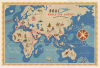

B.O.A.C. World Air Routes Eastern Hemisphere.
Tying Together the Commonwealth.
- Digital Map Information
- Suitable for large format printing
- Full resolution TIFF file
- ICC color profile embedded
- Delivered instantly via download link
Tying Together the Commonwealth.
This is a 1949 E. O. Seymour pictorial map of the Eastern Hemisphere produced for the British Overseas Air Corporation (B.O.A.C). It was prepared during the airline's 'Golden Age,' when a Postwar commercial air travel boom was taking flight and travel between continents was becoming increasingly accessible.A Closer Look
Done in the charming pictorial style pioneered by French artist Lucien Boucher for Air France, this map covers the Eastern Hemisphere (loosely defined). The routes of B.O.A.C. between different cities are traced, while illustrations depict representative architecture, clothing, customs, and characteristics of different destinations, even those not reached by B.O.A.C., such as Moscow. The routes reflect the status and legacy of the British Empire, disintegrating at the time but maintaining ties through the Commonwealth (this map coinciding with the 1949 London Declaration, which established the Commonwealth in its modern form).Historical Context
The British Overseas Airways Corporation was officially forged in the crucible of 1939, just as the world descended into total war. Created by a Parliamentary Act that merged the struggling Imperial Airways and British Airways, Ltd., B.O.A.C. spent its infancy as a vital strategic asset for the British government. Throughout World War II, the airline maintained 'lifeline' routes across the Atlantic and to the far reaches of the British Empire, often flying unarmed and camouflaged aircraft through contested airspace. In the immediate aftermath of 1945, B.O.A.C. faced a difficult transition from military support to commercial competition. The airline grappled with a fragmented fleet; while national pride dictated the use of British-made aircraft, many were merely converted bombers like the Avro Lancastrian that could not match the efficiency of American-made Lockheed Constellations. Despite these growing pains, the late 1940s remained the airline's 'Golden Age,' with luxury Short Solent flying boats departing from Southampton to serve routes across Africa and Asia. The era reached a major turning point in 1949 when B.O.A.C. absorbed British South American Airways (BSAA), consolidating Britain's long-haul operations under one banner and clearing the path for the looming revolution of the jet age.The Speedbird
The 'Speedbird,' appearing on this map next to the title, is a stylized emblem of a bird in flight designed in 1932 by Theyre Lee-Elliott as the logo of Imperial Airways. When Imperial Airways merged with British Airways Ltd., forming the British Overseas Airways Corporation or B.O.A.C., the logo was retained. B.O.A.C. eventually became British Airways. The Speedbird logo continued to be used until finally being retired in 1984.Publication History and Census
This map was drawn by artist E.O. Seymour, printed by McCorquodale and Co., and published by the British Overseas Airways Corporation in 1949 (based on the printer's code appearing after McCorquodale's name). There are multiple printings of this map and its accompanying Western Hemisphere sheet, sometimes printed back-to-back and sometimes separated, as here. The present example is also notable and rarer for using red rather than black lines to indicate air routes, which are also somewhat more numerous than in the earlier edition, especially with regard to Transatlantic flights (see our BOACEastWest-seymour-1949 for comparison). We are aware of examples with red routes, but with fewer Transatlantic routes, suggesting at least three printings. It is easy to imagine that B.O.A.C. issued these in quick succession in 1949 and perhaps the following year or two as their network rapidly expanded. Since these all share the same title and publication information, it would be impossible to distinguish them in catalog listings without a digitized image. In any event, we only locate one example in the OCLC, held by the University of California San Diego (printed back-to-back), while the David Rumsey Historical Map Collection also holds two editions (printed back-to-back, one with the less numerous routes in black and the other with more numerous routes in black).Cartographers
E.O. Seymour (fl. c. 1949 - 1952) was a British postwar commercial artist and illustrator who produced works for airlines, especially the British Overseas Airways Corporation (BOAC). Little information about him is available, even his full name, and his known works number only four, pictorial air route maps of the Eastern and Western Hemisphere for BOAC, a travel poster for BOAC titled 'Fly to South America' and featuring a depiction of an old mission church, and a similar poster titled 'Fly to South Africa' for South African Airways. Further Details...
George McCorquodale (May 10, 1817 - 1895) was an English printer active in the late 19th century. McCorquodale was the son of Hugh McCorquodale and Lucia Hall. He was born in Liverpool, where in 1841 he established a stationer's shop, Liverpool Printing and Stationery Company. Attaining considerable success, George founded McCorquodale and Company in Newton-le-Willows in 1846. McCorquodale capitalized on printing maps, timetables, and pamphlets for the growing English railroad industry. By the 1870s, the firm established printing factories in London, Glasgow, and Leeds. In 1878, Sir Richard Moon, chairman of the London and North Western Railway, convinced McCorquodale to establish a printing office in Wolerton, then a major railroad town. This eventually led to commercial printing of books, stationary, and registered envelope. By this time, McCorquodale was one of the largest printers in the British Isles. In addition to his businesses, McCorquodale held the office of High Sheriff of Lancashire in 1882, and High Sheriff of Anglesey in 1888. He retired to Anglesey, dying in 1895. The McCorquodale company remains active and is based in Derby. Further Details...
Condition
Very good. Laid down on linen, poster style. Some restoration along original fold lines, particularly the centerfold. Slight loss lower left corner.
References
Rumsey 8740.002 (alternate printing), 14072.002 (earlier ed.). OCLC 802411843 (alternate printing).