
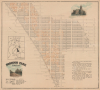
1895 Vanden Houten Promotional Real Estate Map, Borough Park, Brooklyn


This item has been sold.
Borough Park Company.
From 'Blythebourne' to Borough Park.
- Digital Map Information
- Suitable for large format printing
- Full resolution TIFF file
- ICC color profile embedded
- Delivered instantly via download link
From 'Blythebourne' to Borough Park.
This is a rare c. 1895 promotional plat map of Borough Park, Brooklyn printed by W. F. Vanden Houten for the Borough Park Company. It presents the neighborhood during the most active part of its development phase, when it was undergoing a rapid transformation from an exurban commuter community to a planned city grid with modern amenities like running water and gas lines.A Closer Look
The map is oriented with north towards top-left. Streets are traced and labelled throughout, with the ghosted in 'Old New Utrecht Road' and an intersecting road roughly parallel with 53rd St. at right indicate that they were going to be done away with. Individual lots are likewise outlined, numbered, and marked as sold where applicable, while existing homes, churches, schools, and other structures are indicated. Soldi lines that cut jaggedly through the planned development are likely the previous property lines from the when the area consisted primarily of farms; the promotional text at bottom-right is keen to point out that the area 'is not an outlying farm, but a developed section of the City.' An inset map of Borough Park within Brooklyn appears at left above the title, while views of the School House and Fort Hamilton Parkway are illustrated in the margins.The Atlantic Avenue Railroad West End Division seen here was a recent acquisition of the Brooklyn, Bath and Coney Island Railroad (redubbed the Brooklyn, Bath, and West End Railroad), originally opened in 1864 and recently electrified as a trolley at the time of publication. The 1913 Dual Contracts agreement led to the construction of an elevated line, now used for the D Train service of the New York City Subway. The 50th St. station is located near the 'Borough Park Main Office' indicated here.
Historical Context
In the 1880s, the land now known as Borough Park still essentially a collection of Dutch farmsteads. The transition toward modernization kicked off in 1887 when Electus Litchfield purchased a significant portion of this farmland to create a suburban escape he called Blythebourne, which was facilitated by the expansion of the Brooklyn, Bath, and West End Railroad. This era was defined by the construction of Victorian-style cottages with large yards, appealing to those looking for a quiet, commuters' sanctuary. The neighborhood's definitive rebranding and expansion occurred in the late 1890s, catalyzed by the ambitious State Senator and real estate developer William H. Reynolds (1868 - 1931), named here as President of the Borough Park Company. After purchasing the Blythebourne land and surrounding acreage, Reynolds rebranded the development as Borough Park. He implemented an aggressive 'modern improvements' campaign, installing paved sidewalks, gas lines, and water mains. By the turn of the century, Reynolds had successfully transformed the pastoral landscape into a meticulously planned residential hub, setting the stage for the massive waves of immigration and urbanization that would soon redefine the neighborhood's cultural and social fabric.Borough Park's Jewish Connections
While it was initially marketed to an upscale, non-Jewish clientele, the completion of the West End elevated train line in the mid-1910s changed the trajectory of the neighborhood forever. Jewish families from the overcrowded Lower East Side began viewing Borough Park as a place where they could trade tenement life for fresh air, private yards, and modern plumbing. Borough Park blossomed into a prestigious enclave for upwardly mobile Orthodox Jews, as opposed to other neighborhoods where secular or radical Jewish groups predominated. This period saw the rise of grand architectural landmarks, most notably Congregation Shomrei Emunah (founded in 1907), which became the neighborhood’s spiritual anchor. The community was a vibrant mix of white-collar professionals and business owners who established a robust network of Hebrew schools, social clubs, and charitable organizations. In the post-World War II era, the neighborhood saw an influx of Hasidic refugees and Holocaust survivors from Europe, which eventually shifted the community from a modern Orthodox suburb in the city to the globally-recognized center of Hasidic life it remains today.Publication History and Census
This map was prepared by the Borough Park Company and printed by William Frederick Vanden Houten around the year 1895. It is undated, but the reference of fares 'to New York City' suggests that it predates the 1898 consolidation of Greater New York. At the same time, the appearance of the Fort Hamilton Parkway indicates a date of 1892 or later, and the 'Atlantic Avenue Railroad West End Division' indicates a date of 1893 or later. This map is quite rare; its only appearance in institutional collections is a possible later edition (cataloged as dating to 1910) appears to be held by the New York Public Library.Cartographer
William Frederick Vanden Houten (1854 - 1943), often publishing as Vanden Houten and Co. and sometimes as Press of W.F. Vanden Houten Co., was a lithographic printer active in New York City (Manhattan and Brooklyn) in the late 19th and early 20th centuries. Little is known of his early life and training aside from his being born in Holland and immigrating in 1865, but Vanden Houten began publishing around 1879, initially primarily focusing on legal decisions and texts, then branching out into other fields in the mid-1890s. In 1895, Vanden Houten was elected secretary and treasurer of the North America and Brazil Mail Steamship Company, which presumably limited the amount of time he could contribute to printing. The use of 'Vanden Houten and Co.' from the early 1880s suggests that Vanden Houten had long-established business partners, though records of publications with his name end around 1910, suggesting that the printing business was a secondary concern. He appears to have continued business ventures in other fields, serving on the board of trustees of the Great New York Savings Bank in the early 20th century (though still listed as a 'Printer' in the bank's documents and on census documents until at least 1930). In 1915, Vanden Houten's three sons (George H., John C., and William F., Jr.) organized a new firm called W. F. Vanden Houten's Sons, based in Manhattan; it nominally operated until the late 1940s, though with few known publications aside from several editions of the Annual Report of the Silk Association of America. Further Details...
Condition
Very good. A few minor verso repairs along edges. Paper thin.
References
OCLC 1355966015 (later edition).