
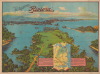
1929 Henry Chromolithograph View of Ku Ring Gai Chase, Australia

This item has been sold.
The Beautiful 'Riviera'
Failed Development Scheme in Sydney's Natural Wonderland.
- Digital Map Information
- Suitable for large format printing
- Full resolution TIFF file
- ICC color profile embedded
- Delivered instantly via download link
Failed Development Scheme in Sydney's Natural Wonderland.
This is a stunning c. 1929 promotional bird's-eye view of the Ku-ring-gai Chase National Park, just south of Sydney, Australia, drawn by artist Victor Henry and printed by the lithographer Simmons, Ltd. The 'Riviera' resort proposed here, itself a compromise after an earlier planned housing development was scrapped, was never constructed due to opposition, leaving the parklands and their remarkable views open to the public for posterity.A Closer Look
The view looks towards the northeast over the northernmost tip of the West Head and Commodore Heights portion of the park, with Cowan Creek at left, the Hawkesbury River at top, and the Pittwater at right. A red line traced on the view, from roughly Flint and Steel Point to Resolute Beach, corresponds to the line separating the 'Riviera' from the park seen on the inset map at bottom. Beaches, bays, points, and other features are labeled throughout, while boats, lighthouses, and beachside facilities are illustrated. An inset map at bottom displays the development and the park within the wider Sydney area, including road and rail connections. Text surrounding the inset map, written by Sydney William Stokes, 'Surveyor to the Estate,' promotes the development opportunities on the land, including possibilities of subdivision.This proposed development was one of several in the early 20th century that tried to utilize parts of the park or adjacent lands for luxury housing development. This land had originally been granted by the Crown to explorer and early settler William Lawson in 1834. After the establishment of the Ku-ring-gai Chase, Lawson's descendants attempted to offer it to the Chase Trust for ₤1 per acre, but the Trust was not able to make the purchase, and the Department of Lands rejected the same offer. Therefore, the last surviving trustee of Lawson's estate sold the land to surveyor John Miller and Rosa Ellen Jane Mobbs, wife of auctioneer George Mobbs, for ₤1500; though arranged in the late 1910s, the transfer of property was not completed until 1924.
Miller and Mobbs quickly set about plans to develop the land as weekend villas for Sydney's ultra-wealthy. Problematically, though, there was not yet a road to Commodore Heights. Despite not yet formally owning the land and not having permission from the Chase Trust or anyone else, Miller began to construct just such a road in 1919. When the Chase trustees learned of this scheme, they quickly moved to end it. The project languished, with the exception of a model villa house at Flint and Steel Bay (seen here) by Eardley Henderson 'Mac' McGaw. But in 1925, another surveyor, Sydney William Stokes, joined the development syndicate and pushed aggressively for the construction of a road to the proposed development. Despite opposition from the Chase Trust, Stokes was able to gain the support of the Department of Lands and the local Warringah Shire Council, and construction of the road (seen here in the view at bottom and in the inset map as 'Riviera Drive') began in 1927. Stokes managed to convert the land to Torrens Title and became the proprietor of the entire estate aside from a few small lots reserved for Miller, Mobbs, and McGaw.
Having seemingly lined up all his ducks in a row, Stokes moved to sell the land to a developer who would subdivide it and begin construction of villas, but he was unable to find buyers in 1928 or 1929. The Great Depression put a damper on Stokes' hopes, and in 1931, he instead proposed developing the land as a country club with fewer homes, but this too failed to attract interest. Eventually, Stokes defaulted on his mortgages and sold the land to other developers, who owned it until the New South Wales Government took control in 1939.
Ku-ring-gai Chase National Park
Ku-ring-gai Chase National Park is a protected area and popular tourist destination just north of Sydney. The land originally belonged to the Guringai (Ku-ring-gai) people and is one of the most concentrated sites for Indigenous heritage in Australia, containing over 800 recorded sites, including rock engravings, middens, and burial sites. The park's existence is largely credited to Eccleston Du Faur (1832 - 1915), a French-born surveyor and patron of the arts who lobbied for decades for a protected area to be established near Sydney, which was then expanding rapidly. In 1894, Ku-ring-gai Chase was formally dedicated, making it the second national park in Australia (after Royal National Park). The name, which Du Faur coined, combines the name of the traditional inhabitants with the English term 'chase,' a place where game is kept for hunting (though he intended it more as a 'wildwood' for public enjoyment).While Du Faur wanted a park, he also needed money to run it, as the park did not receive any government funding. This led to a series of proposals to slice off the park's fringes for high-end residential development. 'Choice' lands, such as those overlooking Cowan Water and the Pittwater, were seen as prime real estate for Sydney's elite. Developers envisioned grand estates that would overlook the wilderness, essentially providing the wealthy with a private backyard maintained by the public. These plans provoked a backlash and, as Sydney grew denser, the argument that the park should be an accessible 'lungs of the city' gained traction. Instead of housing, development efforts pivoted toward recreation and tourism, with continuing efforts to set aside land for elite resorts, as seen here. But battles over uses of the parkland continued throughout the 20th century, including a proposed highway through the bushland and suburban development adjacent to the park. Today, the park is protected under the National Parks and Wildlife Act, and the 20th-century dreams of cliffside mansions remain only as ghost stories.
Chromolithography
Chromolithography, sometimes called oleography, is a color lithographic technique developed in the mid-19th century. The process uses multiple lithographic stones, one for each color, to yield a rich composite effect. Generally, a chromolithograph begins with a black basecoat upon which subsequent colors are layered. Some chromolithographs used 30 or more separate lithographic stones to achieve the desired effect. Chromolithograph color can be blended for even more dramatic results. The process became extremely popular in the late 19th and early 20th centuries when it emerged as the dominant method of color printing. The vivid color chromolithography made it exceptionally effective for advertising and propaganda.Publication History and Census
This view was drawn by artist Victor Henry and printed by Simmons Ltd. in Sydney for surveyor (and owner of the estate) Sydney William Stokes. It is undated, but from context it can be assumed to be 1928 or 1929. It is quite rare and is only held by the Ku-ring-gai Chase National Park Heritage Collection and the Powerhouse Museum in Sydney.Cartographers
Victor James Percival Henry (May 31, 1866 - May 10, 1932), not to be confused with a contemporary French artist of the same name nor a contemporary Australian newspaper owner in Cobargo, was an Australian artist and illustrator active in Sydney during the late 19th and early 20th centuries. He was also known to work in glass etching and was described in 1895 by the Melbourne magazine Table Talk as 'a born colourist.' Little is known of Henry's life aside from his being born in Fitzroy (near Melbourne) and working primarily in Sydney. In 1891, he married Elizabeth Frayne (1866 - 1929) but the couple had no children. His only known surviving works are an impressive 1929 view of the Ku-ring-gai Chase area produced for a real estate developer and an undated view for the 'Seven Hills Estate' west of Sydney. Further Details...
Simmons Ltd. (fl. c. 1918 - 1954), not to be confused with the tobacconist and sports retailer Mick Simmons Ltd., was a printing and publishing company based in Sydney, Australia, renowned for printing movie posters (daybills), government documents, and commercial literature. The company was primarily located at 31–33 Parramatta Road, Glebe (also referred to as 32 Parramatta Road). They operated as both letterpress printers and lithographers, a dual capability that allowed them to handle everything from standard book typesetting to complex, multi-color advertising posters. They are nowadays best known for their spectacular chromolithographed movie posters, including those done for RKO Radio Pictures, which have become highly collectible. Further Details...
Condition
Very good. Laid down on linen. Slight wormhole loss upper border.
References
Ku-ring-gai Chase National Park Heritage Collection: Object number 2014.7. Powerhouse Museum Object No. 92/198-1. Dawson, T., The Commodore and the Pastoralist – the story of Commodore Heights and West Head at Broken Bay , (Manly Warringah and Pittwater Historical Society) 2011.