
1564 Gemma Frisius edition of Peter Apian's Introduction to Cosmography

Cosmographia Petri Apiani, Per Gemmam Frisium apud Louanienses Medicum et Mathematicū insignem, iam demum ab omnibus vindicata mendis, ac nonnullis quoque locis aucta. Additis eiusdem argumenti libellis ipsius Gemmae Frisij.
The best introduction to Cosmography, in a complete, original example.
- Digital Map Information
- Suitable for large format printing
- Full resolution TIFF file
- ICC color profile embedded
- Delivered instantly via download link
The best introduction to Cosmography, in a complete, original example.
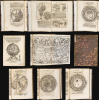
This is Gemma Frisius' 1564 edition of Peter Apian's Cosmographia, which from 1524 was the essential scholarly introduction to the world and its place in the cosmos. This concise text touched on astronomy, geography, cartography, and navigation. It was not a rote copy of Apianus' text, with significant commentary from Gemma, as well as that scholar's own world map. The text includes its five volvelles, all assembled and in their original condition. These manipulable diagrams are often found missing parts or replaced in facsimile; the condition of these here represents a remarkable survival.The Map
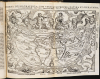
The initial editions of Apian's work contained a different map than the present work: his 1520 reduced version of Martin Waldseemüller's 1507 world map. That map was important in its day - and it remains one of the first printed maps to name America. But by the time Gemma Frisius came to edit this book, the original world map was out of date and in need of replacement. Gemma added a new map, based on his own 1540 wall map (now lost). Like the Apianus, it is presented on a cordiform projection. But the Apianus, as with the Waldseemüller, was centered on the Ptolemaic oikoumene, with the new discoveries appended to the west, east, and south; its presentation of both the Americas and eastern Asia reflected the state of the art as it stood in 1507. Gemma's map instead centered on the Atlantic Ocean, and presented a more modern, if simplified, understanding of the world. South America is quite recognizable and includes the Strait of Magellan. The presentation of North America, despite its depiction as a long, slender landmass, is notable for its emphatic separation from Asia. (North America is here named Baccalearum, the Land of Cod, reflecting the long history of Europeans fishing the Canadian Maritimes.) The Pacific Ocean, though unnamed, is shown framed by its American and Asian coastlines. The map clearly presents a northwest passage, of which Gemma was an early proponent. China (Synarum Regio) is depicted as a peninsula on the Asian Pacific coast. In the East Indies, Taprobana (Sumatra) and Java are named.The map is decoratively rich. As with the map it replaced, its heart-shaped projection is framed with clouds and well-executed wind-heads. The map is topped by the figures of a lightning-wielding Zeus, and a no less deified depiction of Emperor Charles V. The border of the map is embellished with animal representations of the constellations. The southern wind-heads, eerily, are depicted as skulls: the south winds were understood to carry plague.
Interactive Tools for Learning
This example of the book is remarkable for the state of preservation of its five volvelles, manipulable diagrams ranging from the simplest (with a thread attached to the center, for determining positions of the zodiac month by month) to complex, three-piece tools for studying longitude, the effects of the angle of the planet's axis, as well as a volvelle demonstrating the use of an astrolabe.Publication History and Census
Gemma Frisius produced his first edition of Apian's Cosmographia in 1533; that edition lacked a world map. He produced many further editions, the 1544 being the first to include the new world map. The present 1564 edition was published in Antwerp by Arnoldo Berckmann. The edition is well represented in institutional collections; it appears on the market from time to time in widely varied conditions.Cartographers
Petrus Apianus, or Peter Apian (April 16, 1495 – April 21, 1552) was a German humanist, astronomer, mathematician and professor who lived and worked in Ingolstadt and Vienna. He produced the most popular textbook on astronomy in the 16th century, the Cosmographicus Liber, and is known for his map of the world which until the rediscovery of Martin Waldseemüller's 1507 wall map was thought to be the first to use the place-name 'America.' His works were influential and were published in many languages, into the 17th century.
He was born as Peter Bienewitz in Saxony; his father, though not poor, was a Leisnig shoemaker. He gained an education and would between 1516 and 1519 study at the University of Leipzig. As is typical for academics of this era, he Latinized his name. The root of his German name, 'Biene,' is the word for 'bee;' hence, the Latin version of his name would be 'Apianus' (from the Latin 'Apis.' The humanists enjoyed word play.
From Leipzig, Apianus moved to Vienna to continue his studies. It was there that he would have encountered the monumental Waldseemüller map, which would inform his own 1520 map. Upon receiving his BA Apianus abandoned the plague-stricken Vienna for Landshut where he would produce his Cosmographicus liber in 1524. This, his magnum opus of astronomy and navigation, would be in print long after his death. Starting in 1527 he would operate a print shop in Ingolstatd, producing works contributing to the religious debates of his time, and printing many fine geographic and cartographic works. He came to the attention of emperor Charles V, whose admiration brought the scholar and printer a privilege in 1532 and 34; he would go on to become the emperor's court cosmographer and mathematician, a knight, and in time an Imperial Count Palatine. He married the daughter of a Landshut Councilman, and together they would have fourteen children.
Further Details...
Gemma Frisius (December 9, 1508 - May 25, 1555) born Jemme Reinerszoon, was a Dutch scholar, mathematician, cartographer, physician, and instrument maker. He is one of the first Dutch mapmakers, whose work would set the groundwork for the preeminence of Dutch cartography in the 16th and 17th centuries. His parents were poor, but he would nevertheless be able to study at the University of Leuven, achieving his MD in 1536. He would teach there his whole life, in the fields of medicine, mathematics, astronomy, and geography. Among his students was the illustrious Gerard Mercator. Gemma was prolific, editing many editions of Apianus' foundational Cosmographia, but also producing globes, mathematical instruments, and surveying tools. In 1533, he first described in print the method of surveying by triangulation. He was the first to describe how a clock might be used to determine longitude (he considered this a theoretical puzzle, believing that man could not produce a sufficiently accurate clock - a feat that would eventually be achieved by John Harrison in 1761). He died in 1555 from kidney stones. Further Details...
Condition
Very good. Small quarto, rebound in 18th century German pasteboard covers. [2], 64, 2; 1 folding map. Signatures: A-H⁴ K-S⁴ (the folded world map is signed I). Some toning and spotting throughout, else excellent with no losses.
References
OCLC 1512658853. Shirley, R., The Mapping of the World #82.