
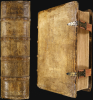
1564 Sebastian Münster Cosmographia: Original Binding

This item has been sold.
Cosmographey oder beschreibung aller länder, herrschafften, fürnemsten stetten, geschichten, gebreüche[n], hantierungen etc.
Window to the European World.
Window to the European World.
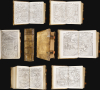
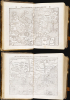
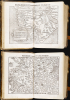
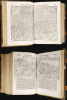
A strong example of Sebastian Münster's masterpiece: his Cosmographia Universalis, in a 1564 German edition. This was the original language of Münster's work: from 1544 to 1548, it was published only in his vernacular. This compendium, for more than half a century, has provided the European literate layperson with the best source of information about the world, via its lively descriptions, engaging woodcuts, and maps. These present their respective areas in what were often the earliest modern depictions available to the reader.A Popular Work
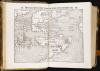
In its various editions, Cosmographia was one of the most copiously illustrated early books, containing nearly 1000 woodcuts as well as the first separate maps of America and Asia, and the first detailed contemporaneous maps of Europe and Africa. Virtually every page is illustrated - an important feature for an author attempting to reach a broad audience. The book was thus embellished from its 1544 first edition, but beginning in 1550, editions of Cosmographia were expanded to include a wealth of larger and more elaborate images that only increased its popularity.Münster also considered his audience in the languages he published in. Although in 1550 he began to publish a Latin edition of the book, he always kept a German edition updated, reflecting his largest audience. This was a practice his publisher, Perti, continued after the author's death. In addition to German and Latin, Münster added a French edition in 1552; and Petri added an Italian edition in 1558. The book retained its audience long after its initial publication, and its maps remained relevant until the 1570 publication of Ortelius' Theatrum Orbis Terrarum rendered Münster's geography obsolete.
The World Presented Anew
Münster's work benefited broadly from his expertise as a geographer, mapmaker, historian, and astronomer, but his efforts as a correspondent shone in Cosmographia. His letter-writing campaign spanned reached scholars across Europe. Münster's genius was, to a large extent, his ability to source maps, views, and descriptions from contemporary sources near to their subjects. The result is that many of the images and reports in this work are the earliest acquirable maps and views of what they depict. For example, the map of France is a neat reduction of the unacquirable 1525 map of France by Oronce Finé, the first such drawn by someone who lived there; the Poland / Hungary is derived from the lost 1525 map of Bernard Wapowski; the view of Edinburgh (the first printed depiction of that city, and the first of any city of the British Isles to appear in Münster's work) was provied by Alexander Ales, a Scot emigre.Adding to the Cosmographia
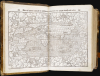
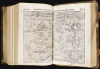
Dozens of the woodcuts gracing this book did not appear in this work prior to 1550. Münster constantly labored to expand and elaborate the work until his 1552 death by plague, both adding to the text and ordering the production of improved city views and decorative woodcuts. In particular, the introduction of competition in the form of Johannes Stumpf's 1548 history of Switzerland - a beautiful and elaborately illustrated work - spurred Münster to introduce more and finer decorative woodcuts. 1550 saw the addition of a wealth of full-sheet and folding city views, as well as illustrations such as Münster's famous depiction of the sea monsters thought to inhabit the northern oceans. Many of these woodcuts were composed by the Swiss formschneiders David Kandel, Hans Rudolf Manuel Deutsch, Jacob Clauser, Heinrich Holzmüller, and Christoph Schweicker, but other anonymous artists were clearly engaged in the mammoth work.Revealing the Wonders of the World
Although sometimes referred to as an atlas, Münster's magnum opus is more properly a 'cosmography', thus a much broader project. An atlas is first and foremost a collection of maps, and need not rely on any text at all; Cosmographia represented an attempt to describe, as the name suggests, the entire cosmos. It included descriptions of flora, fauna, geological and astronomical observations, historical notes, and cultural (some might even say anthropological) commentary. Part of Münster's goal with this work was to present a distinctly German counterpoint to the renaissance in scientific thought then underway in Italy.Publication History and Census
Münster's Cosmographia was a popular work, and as many as 50,000 were printed; of this edition, about 25 survive in institutional collections in varying conditions. We see examples of this edition appearing in just 6 auction records reaching as far back as 1952.Cartographers
Sebastian Münster (January 20, 1488 - May 26, 1552), was a German cartographer, cosmographer, Hebrew scholar and humanist. He was born at Ingelheim near Mainz, the son of Andreas Munster. He completed his studies at the Eberhard-Karls-Universität Tübingen in 1518, after which he was appointed to the University of Basel in 1527. As Professor of Hebrew, he edited the Hebrew Bible, accompanied by a Latin translation. In 1540 he published a Latin edition of Ptolemy's Geographia, which presented the ancient cartographer's 2nd century geographical data supplemented systematically with maps of the modern world. This was followed by what can be considered his principal work, the Cosmographia. First issued in 1544, this was the earliest German description of the modern world. It would become the go-to book for any literate layperson who wished to know about anywhere that was further than a day's journey from home. In preparation for his work on Cosmographia, Münster reached out to humanists around Europe and especially within the Holy Roman Empire, enlisting colleagues to provide him with up-to-date maps and views of their countries and cities, with the result that the book contains a disproportionate number of maps providing the first modern depictions of the areas they depict. Münster, as a religious man, was not producing a travel guide. Just as his work in ancient languages was intended to provide his students with as direct a connection as possible to scriptural revelation, his object in producing Cosmographia was to provide the reader with a description of all of creation: a further means of gaining revelation. The book, unsurprisingly, proved popular and was reissued in numerous editions and languages including Latin, French, Italian, and Czech. The last German edition was published in 1628, long after Münster's death of the plague in 1552. Cosmographia was one of the most successful and popular books of the 16th century, passing through 24 editions between 1544 and 1628. This success was due in part to its fascinating woodcuts (some by Hans Holbein the Younger, Urs Graf, Hans Rudolph Manuel Deutsch, and David Kandel). Münster's work was highly influential in reviving classical geography in 16th century Europe, and providing the intellectual foundations for the production of later compilations of cartographic work, such as Ortelius' Theatrum Orbis Terrarum Münster's output includes a small format 1536 map of Europe; the 1532 Grynaeus map of the world is also attributed to him. His non-geographical output includes Dictionarium trilingue in Latin, Greek, and Hebrew, and his 1537 Hebrew Gospel of Matthew. Most of Munster's work was published by his stepson, Heinrich Petri (Henricus Petrus), and his son Sebastian Henric Petri. Further Details...
Heinrich Petri (1508 - 1579) and his son Sebastian Henric Petri (1545 – 1627) were printers based in Basel, Switzerland. Heinrich was the son of the printer Adam Petri and Anna Selber. After Adam died in 1527, Anna married the humanist and geographer Sebastian Münster - one of Adam's collaborators. Sebastian contracted his stepson, Henricus Petri (Petrus), to print editions of his wildly popular Cosmographia. Later Petri, brought his son, Sebastian Henric Petri, into the family business. Their firm was known as the Officina Henricpetrina. In addition to the Cosmographia, they also published a number of other seminal works including the 1566 second edition of Nicolaus Copernicus's De Revolutionibus Orbium Coelestium and Georg Joachim Rheticus's Narratio. Further Details...
Condition
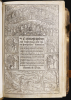
Excellent overall. 1 vol in folio (13.5 x 9.5 inches) title surrounded by 6 woodcut portraits; verso summary of new inclusions for the edition. Printer's mark on verso of end page./ 30pp foreward matter. Fourteen foretext maps, condition overall excellent. Invisible mend to modern world map; faint staining to map of Spain. 39 double-page woodcut city views, including three large fold-out view consisting of two sheets joined (foldout views of Worms, Heidelberg and Vienna appear to be replacements sourced from either the 1574 or 1578 German editions of the book, differing only in pagination.) City view of Frankfurt an der Oder with damaged corner not impacting image or text. About 75 other maps and views in the text; and about 900 small woodcuts in text (some repeated). Few minor marginal mends; new forward and end papers; clasps repaired. 1455 pp. with typical occasional irregularities in pagination.
References
OCLC 82257033. R. W. Karrow, Jr.,Mapmakers of the Sixteenth Century, pp. 410-34; Strauss, G., A Sixteenth-century Enclyclopedia: Sebastian Munster’s Cosmography and its Editions, p. 159. McLean, Matthew., The Cosmographia of Sebastian Münster: Describing the World in the Reformation.